
Hobby Box, Retail Box, Blaster, Mega, Jumbo, H2 and Choice: What Box Types Actually Mean
Learn what hobby, retail, blaster, mega, jumbo, H2, and Choice boxes mean, including exclusives, odds, pack counts, checklist access, and price.
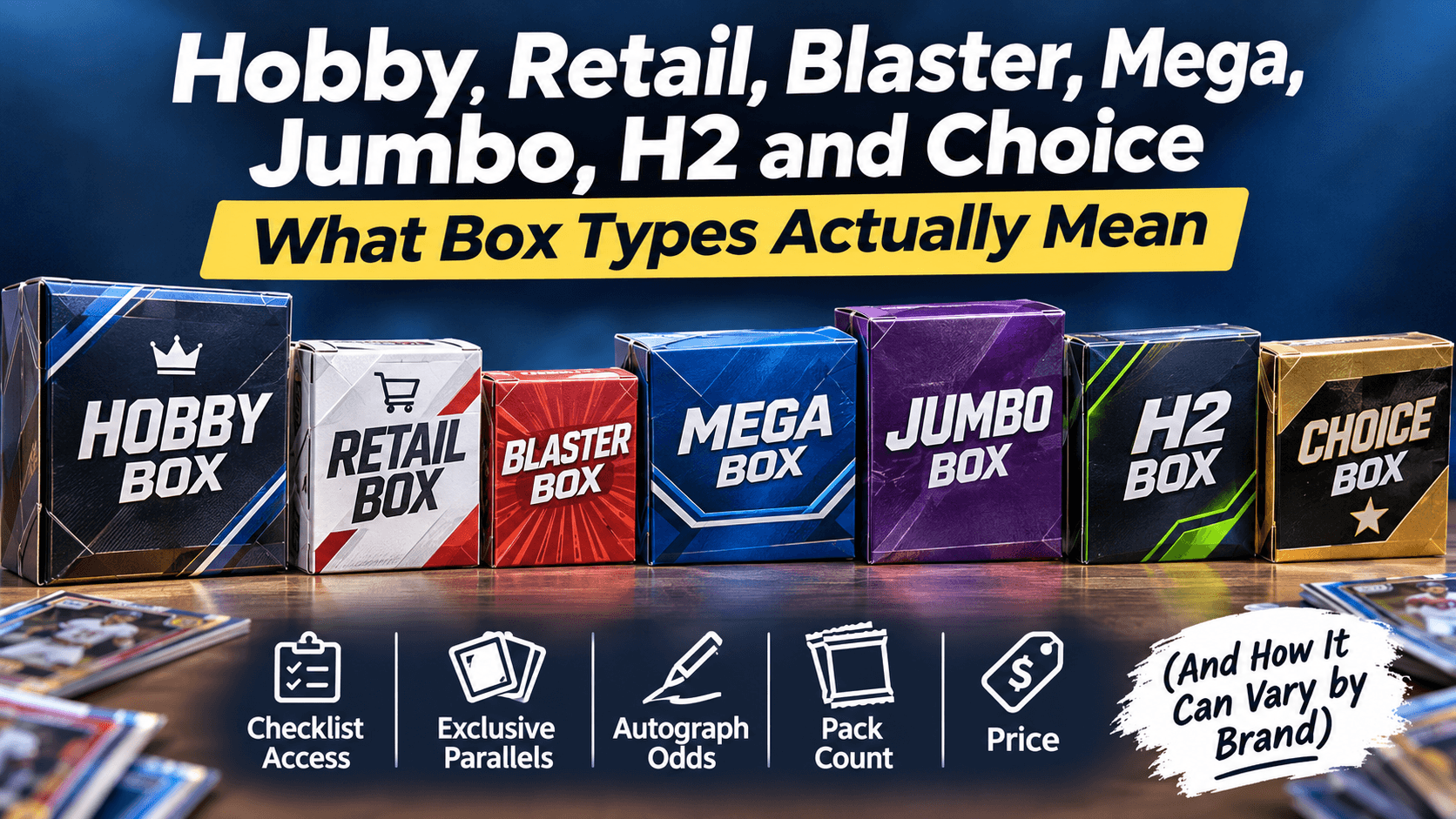
Trading card boxes can have surprisingly confusing names.
A single release might be sold as a hobby box, retail box, blaster, mega box, jumbo box, H2 box, Choice box, hanger, value box, or another configuration. Those names matter because the configuration can affect how many packs you receive, how many cards are in each pack, which parallel cards are available, the chances of pulling autographs, and even which portions of a release are accessible.
The important part is that these terms are not universal quality levels.
A hobby box is not automatically guaranteed to contain an autograph. A mega box is not always simply a bigger blaster. A jumbo box does not follow the same formula in every product. H2 and Choice boxes can contain exclusive cards that do not appear in the standard hobby configuration.
Even the traditional hobby-versus-retail distinction has become less rigid. Panini now offers products with names such as Hobby Blaster and Hobby Mega Box, showing that box shape, product configuration, and distribution category can overlap rather than fitting into one simple hierarchy.
The best approach is to treat configuration as a structured part of a release, then check the actual product information for that specific year and product.
What Does Box Type Mean In Trading Cards?
A box type is a product configuration that describes how cards from a release are packaged and distributed.
Configuration can affect:
- Number of packs per box
- Number of cards per pack
- Total cards per box
- Exclusive parallels
- Exclusive inserts
- Autograph availability
- Memorabilia availability
- Pull odds
- Guaranteed or average box contents
- Distribution channel
- Sealed box price
This is different from the identity of an individual card.
For example, two collectors might pull the exact same base card from two different configurations. One collector opened a hobby box and the other opened a blaster. If the cards share the same release, checklist, card number, player, design, and version, the box they came from does not automatically make them different cards.
Configuration explains where the card could be distributed.
Parallel, insert, autograph status, variation, serial numbering, and other card attributes explain what the card is.
That distinction becomes important when configurations contain exclusive cards.
Collectors who are still learning how these pieces fit together may also want to understand the difference between a base card, insert, and parallel.
Hobby Box vs Retail Box: What Is The Difference?
The traditional hobby box vs retail box distinction is mainly about product configuration and distribution, not card quality.
A hobby box is generally designed for the hobby-card market and may include configurations, parallels, autographs, memorabilia cards, or odds that differ from products intended for broader retail distribution.
A retail configuration is generally designed for wider consumer distribution and can include formats such as:
- Blaster boxes
- Value boxes
- Mega boxes
- Hanger boxes
- Fat packs
- Retail packs
The exact terminology changes between manufacturers and releases.
Hobby boxes often cost more than basic retail formats, but collectors should not assume every hobby box contains more valuable cards. The specific checklist access and odds matter much more than the word "hobby" printed on the packaging.
This is part of the larger way trading card releases work. A manufacturer can take one release and distribute portions of its content through several different configurations.
For example, a release might have Hobby, Jumbo, Value, Mega, Hanger, and other formats with different pack counts and exclusive content.
That is why a collector comparing hobby box vs retail box should ask a more useful question:
What does this specific configuration offer in this specific release?
Blaster Box vs Hobby Box: Is One Better?
A blaster box is usually a smaller multi-pack configuration sold at a more accessible price than a traditional hobby box.
Historically, blasters were closely associated with major retail stores. That association is still useful, but it is no longer a universal definition. Manufacturers can now release configurations explicitly described as Hobby Blasters.
A standard hobby box might offer:
- More packs
- Different autograph odds
- Hobby-exclusive parallels
- Different inserts
- More cards overall
- Different guaranteed or average box contents
A blaster might offer:
- Lower entry price
- Fewer packs
- Blaster-exclusive parallels
- Retail-exclusive inserts
- Different autograph or memorabilia odds
- A smaller total card count
Neither format is automatically better.
A collector chasing a blaster-exclusive rookie parallel may prefer the blaster. Someone chasing hobby-only autographs may prefer hobby. A set builder may care more about total card count than either label.
The actual product sheet, trading card checklist, and published odds should make the decision.
What Is A Mega Box?
A mega box is another boxed configuration that commonly offers more cards, more packs, or a different content mix than a smaller retail box such as a blaster.
The word "mega" sounds like a standardized size, but it isn't.
Mega box cards can include configuration-exclusive parallels or other content. The number of packs and cards can vary substantially from one release to another.
A Mega configuration might contain:
- More packs than a corresponding blaster
- More cards per pack
- Exclusive parallel patterns
- Exclusive inserts
- Different autograph opportunities
- Different numbered cards
- A different overall box price
The useful definition is not "a Mega is a large blaster."
It is:
A Mega Box is a distinct configuration whose contents must be checked against the specific release.
What Is A Jumbo Box?
A jumbo box is generally a higher-card-count or larger-pack configuration, especially common in flagship-style products.
Jumbo does not simply describe the physical size of the cardboard box. It can represent a distinct configuration with different pack sizes, card totals, exclusives, and hit expectations.
Topps frequently uses Jumbo as a major hobby configuration.
Jumbo boxes can be attractive to:
- Set builders seeking larger quantities of base cards
- Collectors chasing Jumbo-exclusive parallels
- Breakers who want higher card volume
- Collectors seeking configurations with different autograph or memorabilia structures
The name tells you which configuration you are looking at. The product information tells you what that configuration actually contains.
Collectors researching Topps products should also understand how different product families fit into the broader Topps Baseball release structure. Series 1, Series 2, Update, Chrome, Sapphire, and individual box configurations are related concepts, but they aren't interchangeable.
What Is An H2 Box?
An H2 box generally refers to a Hobby Hybrid configuration, a term strongly associated with Panini products.
H2 products often sit alongside a standard Hobby configuration while offering a different pack structure, price point, and group of exclusive parallels or inserts.
That is the key concept.
H2 does not mean:
- Half of a hobby box
- Exactly half the price of hobby
- The same checklist with universally worse odds
- A standardized number of packs
- A standardized number of autographs
Different H2 releases can be structured very differently.
Some may emphasize exclusive parallel patterns. Others may include autographs or memorabilia. Pack counts, box prices, and hit expectations can change by product and year.
Collectors researching an H2 box should check the product-specific configuration rather than relying on what H2 meant in another release.
This matters especially with Panini because Panini sports card releases include multiple product families such as Prizm, Donruss, Optic, Select, Mosaic, and National Treasures. Each can use its own configuration structure.
What Is A Choice Box?
A Choice box is a specialized configuration commonly associated with Panini products that often concentrates cards into a small number of packs while offering Choice-exclusive parallels or other content.
Some Choice boxes contain only one pack.
That doesn't mean the configuration is equivalent to buying one ordinary hobby pack. The pack can have a completely different content structure.
Choice configurations are often appealing to collectors who prefer a concentrated rip with a greater emphasis on parallels, rookies, autographs, or configuration-exclusive cards.
Again, "Choice" is not a universal formula.
Choice box cards need to be identified according to their actual card attributes. If a card is a Choice-exclusive parallel, the parallel itself is part of the card's identity. Simply being pulled from a Choice box is not enough to create a separate version of an otherwise identical card.
This distinction becomes especially important in parallel-heavy products such as Panini Prizm, where base cards, Silver Prizms, color parallels, numbered versions, and configuration exclusives can look closely related while representing different card identities.
Do Different Box Types Have Different Checklists?
Sometimes.
This is where configuration becomes much more important than simply comparing pack counts.
Different configurations from the same release can have:
- The same core base checklist
- Configuration-exclusive parallels
- Configuration-exclusive inserts
- Exclusive autograph parallels
- Exclusive memorabilia content
- Different short-print availability
- Different odds for shared cards
- Cards unavailable in certain configurations
A base checklist might appear across Hobby, Mega, and Blaster configurations while each box type has its own exclusive parallel.
In that situation, the underlying base card does not become a Hobby Base, Mega Base, and Blaster Base simply because it can be pulled from three different boxes.
The exclusive versions are different because their parallel, finish, color, pattern, serial numbering, or other recognized attributes differ.
That distinction prevents configuration from being confused with card identity.
Can The Same Card Come From A Hobby Box And A Blaster?
Yes.
This is one of the most important concepts for collectors learning how releases are structured.
Imagine the same player's base card is available in both Hobby and Blaster packs.
The two copies may share:
- Manufacturer
- Brand
- Product year
- Release
- Checklist
- Card number
- Player
- Photograph
- Core design
- Base status
If those attributes match, they may be the same card even though one came from a hobby box and the other came from a blaster.
Now imagine the blaster also contains an exclusive Blue Pattern parallel.
That card may share the same:
- Player
- Photograph
- Product
- Card number
- Core design
But differ in:
- Parallel
- Color
- Pattern
- Finish
- Scarcity
- Distribution availability
The second card is a different version because its card attributes changed, not simply because it came from a blaster.
If you're trying to determine exactly which version you have, CardWiki's guide to identifying a trading card by year, set, player, number, and variation explains the broader identification process.
Does Box Type Affect Autograph Odds?
It can, sometimes significantly.
Manufacturers may distribute autograph content differently between configurations.
One hobby configuration might advertise an autograph per box. Another might offer an autograph or memorabilia card on average. A retail configuration might make autographs possible but much harder to pull. Another retail or specialty format might contain its own exclusive autograph parallels.
There is no universal hobby-box autograph rule.
Collectors should look for wording such as:
- Per box
- On average
- Look for
- Exclusive
- Only found in
- One in every X packs
- Odds per pack
Those phrases do not mean the same thing.
"Look for autographs" is not the same as "one autograph per box."
Can Box Type Affect Which Parallels You Can Pull?
Yes, and this is one of the biggest reasons configuration matters.
Manufacturers frequently create parallels that are exclusive to particular box types or distribution channels.
A release might contain:
- Hobby-exclusive parallels
- Blaster-exclusive parallels
- Mega-exclusive patterns
- Retail-exclusive colors
- Choice-exclusive parallels
- H2-exclusive parallels
- Fanatics-exclusive versions
- Online-exclusive versions
These cards can share the same player, photograph, card number, and basic design while differing in color, pattern, finish, serial numbering, or another recognized parallel characteristic.
A configuration-exclusive parallel is still identified as a parallel, not simply as "a card from a Mega Box."
Some may also be serial numbered cards, while others may have estimated or implied scarcity without a printed serial number.
What About Short Prints And Variations?
Box configuration can also affect access to short prints, super short prints, and variations.
A manufacturer may make certain cards available in only some configurations or assign different odds depending on the box type.
This is another reason collectors should avoid identifying a card solely from its appearance.
A card that looks almost identical to a base card may actually be a short print or super short print.
Likewise, a card featuring a different photograph or another subtle change may be an image or photo variation.
Configuration can help explain where the card was available, but the identifying characteristics of the card still matter.
Does Box Type Affect Card Value?
Configuration can affect value indirectly, but the box itself does not automatically make an individual card more valuable.
A configuration can matter because it may provide access to:
- Exclusive parallels
- Lower-print versions
- Popular patterns or colors
- Exclusive autographs
- Rare inserts
- Different serial-numbered cards
Those features may influence collector demand.
But imagine an identical base rookie card can be pulled from both hobby and retail packs. Once the cards are removed from their packs, there may be no meaningful difference between them.
One is not automatically worth more simply because it came from a more expensive sealed box.
Collectors evaluating a card should consider factors such as:
- Player demand
- Rookie status
- Parallel
- Serial number
- Scarcity
- Condition
- Grade
- Autograph status
- Memorabilia
- Set reputation
- Collector demand
For a deeper explanation of how these factors interact, see why some trading cards are valuable and others aren't.
Rare does not automatically mean valuable. Scarcity becomes especially meaningful when collectors actually want the card.
Why Box Names Cannot Be Compared Across Brands
Box terminology becomes dangerous when collectors treat it as a universal ranking system.
A Mega Box from one brand can have nothing structurally in common with a Mega Box from another.
The same is true across different years of the same brand.
Manufacturers can change:
- Pack counts
- Cards per pack
- Exclusive parallels
- Autograph guarantees
- Memorabilia content
- Suggested pricing
- Distribution channels
- Checklist access
Box names can overlap as well. Terms such as Blaster, Mega, Hobby, Jumbo, H2, and Choice are useful labels, but they aren't universal technical standards shared across the entire trading card industry.
Product families can create another layer of confusion.
For example, Donruss and Donruss Optic have closely related branding, but they represent different product structures. Understanding Donruss vs Donruss Optic is different from understanding whether a particular Optic release came from a Hobby, Mega, Blaster, or Choice configuration.
Box names are useful labels.
They are not substitutes for reading the configuration details.
Common Beginner Mistakes
Assuming Hobby Is Always Better Than Retail
Hobby may offer content that a collector wants, but retail configurations can have desirable exclusives of their own
Calling Every Retail Box A Blaster
Retail is a broader distribution category that can contain Blaster, Mega, Value, Hanger, Fat Pack, and other configurations
Assuming A Mega Box Is Just A Bigger Blaster
Mega is a distinct configuration name, and its content structure can change between products
Assuming Every Jumbo Box Has The Same Guarantees
Jumbo pack counts, card counts, exclusives, autographs, and memorabilia content are product-specific
Treating H2 As A Fixed Formula
H2 generally refers to Hobby Hybrid, but its actual contents and exclusives depend on the release
Assuming Choice Means The Same Thing In Every Product
Choice configurations frequently contain specialized exclusive content, but the exact structure can change
Identifying A Card Only From The Box It Came From
The card itself still needs to be identified using its checklist, card number, parallel, finish, serial number, autograph status, variation, and other relevant attributes
Assuming An Expensive Box Makes Every Card Inside More Valuable
Sealed product price and individual card value are separate questions
Why This Matters To CardWiki
Box configuration is a perfect example of why trading cards need structured identification.
A card record may need to separate:
- Manufacturer
- Brand
- Product year
- Release
- Set
- Checklist
- Card number
- Player
- Card type
- Parallel
- Color
- Pattern
- Finish
- Serial number
- Variation
- Autograph status
- Memorabilia status
- Configuration
- Distribution channel
- Evidence
Configuration should not replace these other fields.
Consider a base card that appears in Hobby, Blaster, and Mega packs. Those three distribution paths should not automatically create three separate card identities.
Now consider a Mega-exclusive parallel of that base card.
The configuration is useful evidence explaining where the card could be found, while the exclusive parallel characteristics identify which version of the card it actually is.
This is part of the broader distinction between a product, release, set, and checklist. CardWiki's guide to what a card set is and how releases actually work explains why those concepts should not be casually collapsed together.
Keeping those concepts separate helps prevent similar cards from being incorrectly merged and prevents identical cards from being unnecessarily split into separate records.
Exact identification comes before valuation.
What Should Collectors Check Before Buying A Box?
Before buying any sealed configuration, read the information for that exact release.
Check:
- Product year
- Exact release name
- Configuration name
- Packs per box
- Cards per pack
- Total card count
- Advertised box contents
- Configuration-exclusive parallels
- Configuration-exclusive inserts
- Autograph wording
- Memorabilia wording
- Official checklist
- Published odds when available
Do not assume a 2026 Mega Box follows the same structure as a 2025 Mega Box.
Do not assume a Prizm H2 box works like a Select H2 box.
Do not assume a Topps Jumbo configuration follows the same rules as another manufacturer's large-format box.
The configuration name gives you a starting point. The specific release documentation gives you the answer.
Frequently Asked Questions
What Is The Main Difference Between A Hobby Box And A Retail Box?
The main difference is the product configuration and intended distribution. Hobby and retail formats can differ in pack count, card count, exclusive parallels, autograph access, memorabilia content, odds, and price. There is no universal rule that applies to every release.
Is A Blaster Box The Same As A Retail Box?
Not exactly. A blaster is a specific box configuration commonly associated with retail distribution. Retail is the broader category. Some manufacturers also use names such as Hobby Blaster, so collectors should check the exact product rather than relying only on the traditional definition.
Is A Mega Box Better Than A Blaster Box?
Not automatically. A Mega may contain more cards or different exclusive content, but the better choice depends on what the collector wants to pull and how the specific release is configured.
What Does H2 Mean In Trading Cards?
H2 generally refers to Hobby Hybrid, especially in Panini products. It is an alternate hobby configuration that can have its own packs, pricing, parallels, inserts, autographs, or other exclusive content.
What Are Choice Box Cards?
Choice box cards are cards distributed through a Choice configuration. Some may be ordinary cards also found elsewhere, while others may be Choice-exclusive parallels or autographs. The card's specific attributes determine whether it is a distinct version.
Does A Jumbo Box Always Have More Autographs?
No. Jumbo configurations often offer larger packs or higher card counts, but autograph guarantees and odds vary by product and year.
Are Hobby Cards More Valuable Than Retail Cards?
Not simply because of where they were pulled. If an identical base card appears in hobby and retail products, the hobby-pulled copy is not automatically a different or more valuable card. Configuration-exclusive parallels and other distinct versions can have different demand and scarcity.
How Do I Know Which Box Has The Best Odds?
Check the manufacturer's product information and published odds for the exact release and configuration. Do not rely on box terminology alone.
Conclusion
Hobby Box, Retail Box, Blaster, Mega, Jumbo, H2, and Choice are best understood as configuration labels, not universal rankings of quality or value.
They can change pack counts, prices, checklist access, exclusive parallels, inserts, autograph availability, and odds. What each term means in practice depends on the manufacturer, product, year, and release.
For card identification, keep configuration separate from the attributes that define the individual card.
Configuration explains how it entered the market. The card's checklist, parallel, variation, finish, serial number, autograph status, and other attributes explain what it is.


