
Donruss vs Donruss Optic: Rated Rookies and Optichrome
Donruss vs Donruss Optic explained. Compare paper cards, Optichrome, Rated Rookies, Holo parallels, inserts, and how to identify each release.
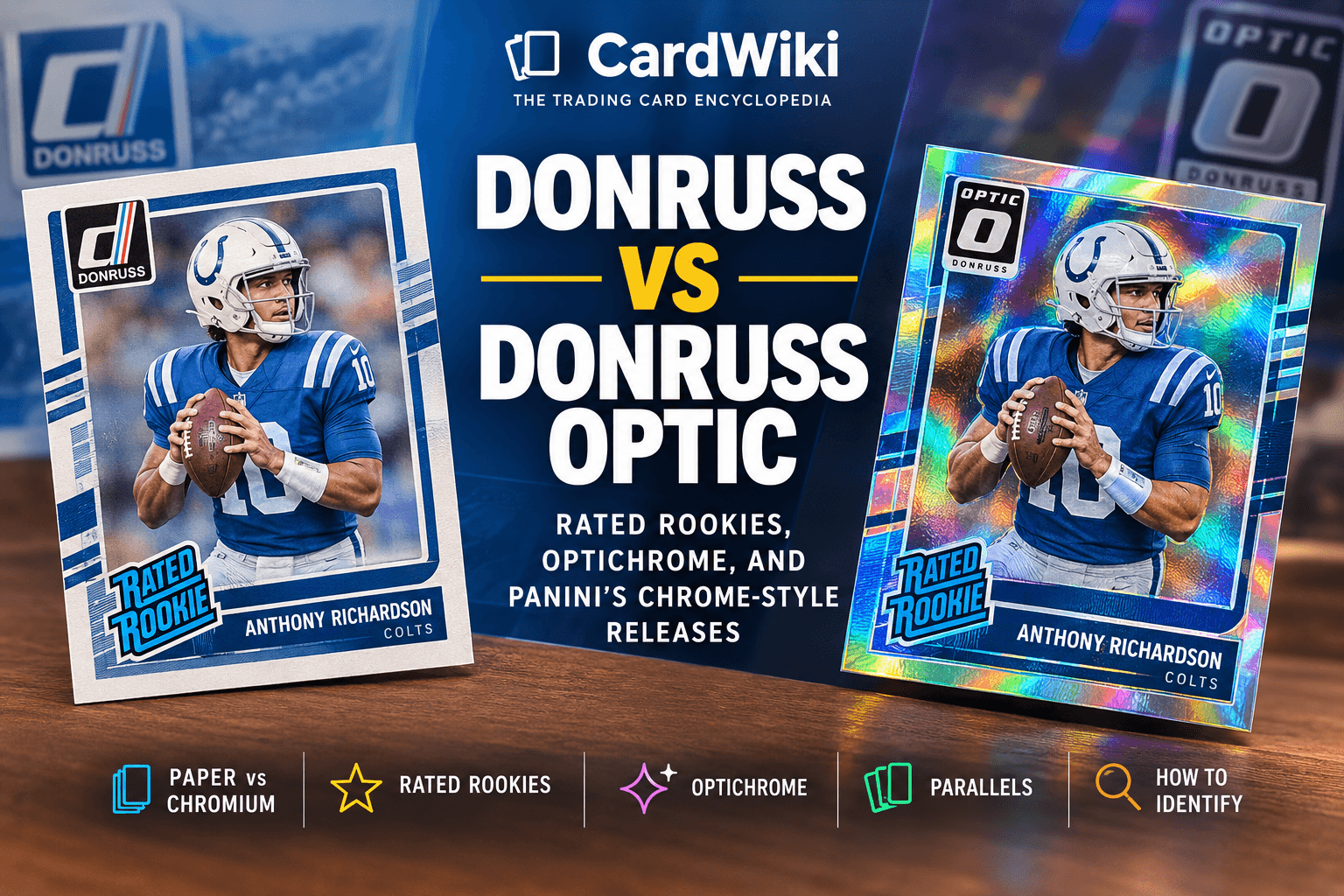
If you've collected football or basketball cards, you've probably encountered both Donruss and Donruss Optic. The cards can feature the same players, similar photographs, familiar designs, and the recognizable Rated Rookie logo.
At first glance, they might seem like different versions of the same trading card. However, there's an important distinction collectors need to understand.
Donruss and Donruss Optic are separate Panini product families. Traditional Donruss generally uses paper-based card stock, while Donruss Optic features reflective chromium-style technology known as Optichrome.
That difference affects how cards are identified, classified, collected, and valued.
Both products can feature Rated Rookies, inserts, autographs, and parallels. However, each has its own checklist structure and collectible versions.
Understanding Donruss vs Donruss Optic helps collectors avoid confusing one release with another, especially when researching rookie cards, identifying parallels, or comparing prices.
What Is Donruss?
Donruss is one of the most recognizable names in sports trading cards, with a history stretching back decades.
The original Donruss company became particularly well known for its baseball cards during the 1980s. Over time, the brand expanded across multiple sports and eventually became part of Panini's trading card portfolio.
Modern Donruss releases are especially recognizable for their traditional trading card designs, Rated Rookie branding, collectible inserts, and extensive parallel offerings.
Standard Donruss products generally feature printed paper card stock rather than the chromium-style surfaces associated with Optic.
Common characteristics include:
- Traditional paper-based card construction
- Base cards featuring veterans, stars, and rookies
- Rated Rookie cards highlighting selected first-year players
- Inserts featuring special designs and themes
- Color and finish parallels
- Autograph and memorabilia cards in applicable releases
- Special editions and variations
Donruss is often an accessible starting point for collectors interested in building sets, collecting favorite players, or learning the differences between base cards and specialized versions.
However, paper-based construction doesn't mean every Donruss card has an ordinary matte finish.
Certain Donruss parallels, inserts, and specialty cards can feature foil, reflective elements, unusual textures, or other treatments.
That's one reason collectors should identify the actual release rather than relying entirely on how shiny a card looks.
For a broader understanding of the manufacturer's products, our guide to Panini sports card releases explains how Donruss, Optic, Prizm, Select, Mosaic, and other recurring product families differ.
What Is Donruss Optic?
Donruss Optic is Panini's chromium-style interpretation of the Donruss brand.
Optic combines recognizable Donruss design elements with Panini's Optichrome technology, creating cards with reflective surfaces and a different visual presentation.
The relationship resembles how traditional paper-based and chromium-style releases coexist elsewhere in the trading card hobby.
However, an important distinction separates Optic from an ordinary parallel.
Donruss Optic is not simply a shiny parallel of regular Donruss. It is a separate trading card product.
A Donruss Optic release can have its own:
- Base checklist
- Rated Rookie checklist
- Holo parallels
- Color and patterned parallels
- Serial-numbered versions
- Inserts and short prints
- Autograph sets
- Product configurations
- Distribution exclusives
Even when an Optic card shares a player, photograph, or design with a traditional Donruss card, the two belong to different product identities.
This matters because collectors cannot always accurately identify a card using only its year, player name, and card number.
The product family is an essential part of identification.
Our article explaining what a trading card set is and how releases work provides additional context for distinguishing related products.
Donruss vs Donruss Optic: Complete Comparison Chart
The easiest way to compare Donruss and Donruss Optic is to examine their physical construction, product structure, parallel systems, and collecting characteristics.
| Feature | Donruss | Donruss Optic |
|---|---|---|
| Manufacturer | Panini | Panini |
| Product Family | Donruss | Donruss Optic |
| Card Stock | Primarily paper-based | Chromium-style Optichrome |
| Surface Appearance | Traditional printed finish, with specialty treatments | Generally glossy and reflective |
| Rated Rookies | Yes, in applicable releases | Yes, in applicable releases |
| Base Checklist | Donruss-specific | Separate Optic checklist |
| Common Parallel Types | Press Proofs, colors, and specialty treatments | Holo, colors, and reflective patterns |
| Insert Cards | Product-specific inserts | Product-specific inserts |
| Serial Numbering | Available on selected versions | Available on selected versions |
| Autographs | Available in applicable releases | Available in applicable releases |
| Short Prints | Available in selected sets | Available in selected sets |
| Configurations | Hobby, retail, and other formats | Hobby, retail, and other formats |
| Main Appeal | Traditional card collecting and set building | Chromium-style rookies and parallel collecting |
| Identification | Verify Donruss checklist | Verify Optic checklist |
The most important distinction is that Optic changes more than the surface of a single card.
It changes the product identity.
A Donruss Rated Rookie and a Donruss Optic Rated Rookie can represent two completely separate cards, even when they look closely related.
Collectors researching how trading card releases work should understand this distinction because product families, releases, sets, and parallels are not interchangeable categories.
What Are Rated Rookie Cards?
Rated Rookie is one of the most recognizable designations associated with Donruss.
The branding dates back to the 1980s, when Donruss began highlighting promising first-year players in its baseball products.
The familiar Rated Rookie logo became a lasting part of the brand's identity.
In modern collecting, Rated Rookies are especially associated with Panini's Donruss and Donruss Optic football and basketball products.
A Rated Rookie card typically features a player identified as part of that release's selected rookie group.
The distinctive logo helps collectors recognize these cards immediately.
Are Rated Rookies Actual Rookie Cards?
A Rated Rookie can be a player's recognized rookie card, but the Rated Rookie designation alone does not establish every aspect of rookie status.
Collectors should distinguish between:
- A card featuring a player during a rookie season
- A card carrying the Rated Rookie designation
- A recognized rookie card within a specific product
- A rookie insert or special version
- A rookie autograph or memorabilia card
- A prospect card issued before the player's recognized rookie-card season
These classifications can overlap, but they don't always mean the same thing.
For example, a player may have multiple rookie cards across Donruss, Donruss Optic, Prizm, Select, and other products.
Each belongs to a different product checklist.
Likewise, a Rated Rookie autograph should not automatically be cataloged as the same item as that player's unsigned Rated Rookie base card.
Our explanation of what makes a trading card a rookie card covers why rookie status requires more context than a logo or player photograph.
Are Rated Rookies Inserts or Base Cards?
In many modern Donruss and Optic releases, Rated Rookies are organized within the main base checklist as a recognizable rookie subset.
They are not necessarily separate insert cards.
However, historical products and specific modern checklists may organize rookie-related cards differently.
A Rated Rookie base card, a Rated Rookie autograph, and a rookie-themed insert can represent three different checklist identities.
The correct classification depends on the actual release.
Rated Rookie Identification Comparison Chart
The following chart illustrates how cards featuring the same rookie can represent different collectible identities.
| Card Example | Product | Card Type | Treatment | Same Card? |
|---|---|---|---|---|
| Rated Rookie Base | Donruss | Base rookie | Standard paper | Original Donruss version |
| Rated Rookie Press Proof | Donruss | Parallel | Press Proof treatment | Different version |
| Rated Rookie Base | Donruss Optic | Base rookie | Standard Optichrome | Separate product |
| Rated Rookie Holo | Donruss Optic | Parallel | Holo reflective finish | Different Optic version |
| Rated Rookie Gold | Donruss Optic | Parallel | Gold treatment | Different Optic version |
Examples are conceptual. The availability of particular parallels depends on the specific sport, product year, and checklist.
All five examples might feature the same athlete.
However, they should not be treated as interchangeable cards.
The player identity remains consistent, while the product, card type, parallel, or treatment changes.
This distinction becomes particularly important when collectors research different types of trading cards.
What Is Optichrome Technology?
Optichrome is Panini's terminology for the chromium-style technology used in products such as Donruss Optic.
Rather than relying on traditional paper-card presentation, Optichrome produces reflective card surfaces that create a metallic appearance.
This gives Optic cards their recognizable shine.
The technology also supports the reflective effects associated with many Optic parallels.
Depending on the version, a card might feature:
- A standard reflective base surface
- A rainbow-like Holo finish
- Colored reflective treatments
- Patterned backgrounds
- Special foil effects
- Additional surface designs
However, these effects should not all be described as the same thing.
Optichrome describes the product's underlying technology. Holo identifies a particular parallel treatment when that designation appears in the checklist.
A standard Optic base card is already reflective.
That does not automatically make it a Holo parallel.
This distinction is particularly important when inspecting cards under direct lighting.
A collector might see rainbow reflections on a chromium-style card and assume it is a special version.
The actual identity needs to be confirmed against the checklist.
Our guide to Refractor, Prizm, Chrome, and Holo cards explains how these related terms differ across manufacturers and products.
How Do Donruss and Donruss Optic Parallels Work?
Both Donruss and Donruss Optic feature parallel cards.
A parallel is an alternate version of a card that changes a recognized feature such as its color, finish, pattern, or serial numbering while preserving a relationship to the underlying card.
However, the two products use different parallel systems.
Donruss Parallels
Traditional Donruss releases commonly feature parallel families such as Press Proofs, along with other special treatments.
Depending on the sport and year, examples may include:
- Press Proof parallels
- Different color versions
- Canvas treatments
- Aqueous Test versions
- Die-cut parallels
- Serial-numbered versions
- Special printing and design treatments
These examples are not guaranteed to appear in every Donruss release.
A particular year might feature several Press Proof colors while another introduces additional patterns, finishes, or specialty versions.
Collectors should consult the checklist for their exact product year.
Donruss Optic Parallels
Optic uses a parallel system built around chromium-style card construction.
Examples appearing in different releases include:
- Holo
- Blue
- Red
- Purple
- Gold
- Green
- Velocity patterns
- Black Pandora
- Gold Vinyl
- Additional exclusive colors and patterns
Some Optic parallels are serial-numbered, while others are not.
Their availability and print runs vary between releases and configurations.
A Gold parallel in one product should not automatically be assumed to have identical numbering to a Gold parallel from another year or sport.
Likewise, two blue-looking Optic cards might belong to entirely different parallel families.
One could be a standard color treatment, while another uses a patterned or exclusive finish.
The appearance of a color is only the beginning of identification.
Our guide to trading card parallels explains why collectors should separate parallel family, color, pattern, finish, and serial numbering.
Donruss vs Optic Parallel Comparison Chart
| Parallel or Treatment | Product Family | What Changes? | Identification Notes |
|---|---|---|---|
| Standard Base | Donruss | No parallel treatment | Confirm the paper base checklist |
| Press Proof | Donruss | Color or printing treatment | Verify exact Press Proof designation |
| Canvas | Donruss | Surface or texture treatment | Confirm availability in the release |
| Standard Optic Base | Donruss Optic | Chromium-style construction | Not automatically a Holo |
| Holo | Donruss Optic | Reflective rainbow-style treatment | Verify the Holo checklist entry |
| Color Parallel | Donruss Optic | Card color or finish | Confirm name and numbering |
| Velocity | Donruss Optic | Patterned reflective treatment | Verify the exact Velocity variation |
| Gold Vinyl | Donruss Optic | Distinctive gold-patterned finish | Confirm release-specific identity |
Parallel availability, names, serial numbering, and distribution can vary significantly between products and years.
One practical takeaway is that a parallel name should never be assigned using color alone.
A card might appear gold, blue, purple, or black without belonging to the version a collector initially expects.
If a card includes serial numbering, that information should be recorded and compared with the official checklist.
Our explanation of serial-numbered trading cards covers how numbering works and why it matters.
Is an Optic Holo the Same as a Regular Optic Card?
No.
An Optic Holo is a recognized parallel version of an Optic card when it appears in the product's checklist.
The standard Optic base card already has a reflective surface, but the Holo version typically adds a distinct rainbow-like reflective treatment.
This is similar in concept to the distinction between a standard chromium-style card and a special reflective parallel from another manufacturer.
However, manufacturers use their own terminology.
Collectors should not automatically describe every Holo as a Refractor or every reflective card as a Prizm.
Panini, Topps, and other manufacturers maintain different product identities and parallel naming conventions.
For collectors comparing chromium-style Panini products, our guide to Panini Prizm and Silver Prizm rookie cards explains another important parallel system.
Do Donruss and Donruss Optic Have Different Inserts?
Yes. Both products can contain inserts, but their individual checklists determine which inserts are available.
An insert is generally a card belonging to a separately identified checklist rather than the standard base set.
Donruss and Optic have featured numerous recognizable insert concepts.
One particularly well-known example is Downtown.
Downtown cards feature distinctive illustrated designs and are associated with highly sought-after short-print insert chases in certain Panini releases.
However, collectors should not assume that every Downtown card belongs to the same product simply because the insert name is familiar.
A Downtown card from Donruss and one from Donruss Optic can have different product identities.
Other insert designs may be exclusive to a specific release, sport, or season.
It is important to record:
- Product family
- Release year
- Insert set name
- Player
- Card number
- Parallel version, if applicable
- Serial numbering, if applicable
An insert and an insert parallel should also be distinguished.
The same insert checklist may contain multiple collectible treatments.
Our guide to what an insert card is explains why inserts should not automatically be confused with base cards or parallels.
Collectors interested in limited-production insert cards can also explore short prints and super short prints.
How Can You Tell If a Card Is Donruss or Donruss Optic?
A collector can often make an initial distinction using the card's surface and branding.
However, accurate identification requires more than a quick visual inspection.
Step 1: Examine the Card Surface
Traditional Donruss base cards generally use conventional paper-based construction.
Optic cards typically feature a more reflective chromium-style surface.
The difference is often noticeable when cards are placed side by side.
However, special Donruss treatments can also be reflective, so surface appearance alone is not definitive proof.
Step 2: Examine the Front and Back
Look for product branding, copyright information, identifying text, and other manufacturer details.
Some cards include explicit Optic branding.
Others may require confirmation using checklist information, packaging details, or comparison images.
Do not assume that the presence of a Donruss logo rules out Optic.
Step 3: Locate the Card Number
Find the card number printed on the back.
This helps narrow down the checklist entry.
However, a card number alone is not necessarily unique across Panini's products.
Different releases can use overlapping numbering.
Step 4: Confirm the Product Year
Identify the year or season associated with the product.
Remember that copyright dates, release dates, and official product years are not always identical.
A sports card product labeled with one season may physically reach the market during the following calendar year.
Step 5: Check the Official Checklist
Compare the card against the correct Donruss or Donruss Optic checklist.
Confirm whether it belongs to:
- Base
- Rated Rookies
- An insert set
- A parallel family
- An autograph checklist
- A memorabilia checklist
- A recognized variation
This is often the most reliable way to resolve uncertainty.
Our explanation of trading card checklists covers how collectors use checklists to identify specific cards.
Step 6: Identify the Exact Parallel
If the card has an unusual finish, color, or pattern, compare it with the checklist's available versions.
Check for serial numbering on the front or back.
Do not assign a parallel name based only on a visual resemblance to another release.
The same-looking finish may be described differently across products.
Our guide to identifying trading cards by year, set, player, and number provides a broader identification process.
Donruss and Optic Card Identification Chart
| Identification Detail | What to Look For | Why It Matters |
|---|---|---|
| Manufacturer | Panini branding and product information | Establishes manufacturer identity |
| Product Family | Donruss or Donruss Optic | Separates the two product families |
| Product Year | Official year or season | Identifies the applicable release |
| Player | Name and image | Establishes the featured athlete |
| Card Number | Number printed on the card | Helps locate the checklist entry |
| Rookie Designation | Rated Rookie logo and checklist status | Identifies the rookie classification |
| Card Type | Base, insert, autograph, or memorabilia | Separates different checklist categories |
| Parallel | Holo, Press Proof, color, or pattern | Identifies the exact version |
| Serial Number | Numbered stamp, when present | Helps verify limited versions |
| Variation | Alternate photo, design, or other recognized change | Distinguishes special versions |
| Configuration | Hobby, retail, blaster, or other format | Helps identify distribution exclusives |
This process can also help collectors who are uncertain about which trading card set a card belongs to.
When two possible matches remain, check for recognized photo variations and other card variations before treating them as identical.
Does the Box Type Affect Which Optic Cards You Can Pull?
Yes.
Panini frequently distributes different cards and parallels through different product configurations.
Depending on the release, collectors may encounter:
- Hobby boxes
- Retail boxes
- Blaster boxes
- Mega boxes
- Fat packs
- H2 configurations
- Other specialty configurations
Certain configurations may offer exclusive colors, patterns, autographs, or other collectible versions.
For example, a parallel available in a retail blaster might not appear in a standard hobby box.
However, configuration should not be confused with the card's product family.
A Donruss Optic Rated Rookie pulled from a blaster is still part of the Donruss Optic product.
If it is an exclusive parallel, that parallel identity should be recorded separately.
Configuration explains where a card was distributed. Product and checklist information explain what the card is.
Collectors can explore this distinction further in our guide to hobby boxes, retail boxes, blasters, and mega boxes.
Are Donruss Optic Cards More Valuable Than Regular Donruss?
Donruss Optic cards sometimes command higher prices than their traditional Donruss counterparts, particularly for certain rookie cards and desirable parallels.
However, Optic is not automatically more valuable.
A card's market value depends on several factors, including:
- Player popularity and performance
- Rookie status
- Product demand
- Parallel scarcity
- Serial numbering
- Condition
- Professional grade
- Autograph or memorabilia content
- Collector preferences
- Recent comparable sales
For example, a desirable low-numbered Donruss parallel could sell for more than a standard Donruss Optic base card of the same player.
Likewise, a highly demanded Optic rookie parallel may attract stronger interest than an ordinary Donruss rookie.
The comparison must involve the exact cards, not just the product names.
Condition also matters.
Chromium-style surfaces can reveal scratches, print lines, and other imperfections that may affect collector interest and professional grading outcomes.
Collectors researching why some trading cards are valuable should remember that scarcity and demand are related but separate concepts.
A rare card is not necessarily an expensive card.
Does Grading Matter for Donruss and Donruss Optic?
Professional grading can help collectors evaluate and document a card's condition.
Services such as PSA, BGS, and SGC assess characteristics including centering, corners, edges, and surface quality.
Both traditional Donruss and Donruss Optic cards can be submitted for grading.
However, the physical characteristics of each product can create different condition concerns.
Paper-based cards may show visible corner wear, edge damage, or surface defects.
Chromium-style cards may reveal scratches, print lines, and reflective-surface imperfections.
Neither construction guarantees a particular grade.
Professional grading also does not correct an inaccurate product or parallel identification.
Collectors should establish the exact card identity before making decisions about grading.
Our beginner's guide to trading card grading and PSA, BGS, and SGC explains how the process works.
Common Mistakes Collectors Make With Donruss and Optic
Confusion between these product families can lead to incorrect identification, inaccurate listings, and misleading price comparisons.
Frequent mistakes include:
- Treating Donruss Optic as a Donruss parallel: Optic is a separate product family
- Assuming every shiny Optic card is Holo: Standard Optic base cards are already reflective
- Identifying cards only by the Rated Rookie logo: Both product families use Rated Rookie branding
- Ignoring the official checklist: Similar designs can represent different cards
- Confusing inserts with parallels: A Downtown insert is not simply a parallel of a base Rated Rookie
- Assuming color names always mean the same thing: Parallel names and numbering can change between releases
- Treating all rookie cards as equally valuable: Demand, condition, scarcity, and product reputation affect prices
- Comparing sales without checking the version: A Holo, numbered parallel, and base card can have very different market histories
These mistakes are especially common when collectors rely only on photographs or abbreviated marketplace titles.
A listing described as a "Donruss Rated Rookie" may be missing the product information needed to identify the card accurately.
Why This Matters to CardWiki
The difference between Donruss and Donruss Optic illustrates an important principle of trading card identification.
Cards that look similar are not necessarily the same card.
A reliable trading card record needs to distinguish multiple layers of identity.
For example, consider a hypothetical Donruss Optic Rated Rookie Holo card.
Its structured record might include:
- Manufacturer: Panini
- Brand: Donruss
- Product Family: Donruss Optic
- Product Year: The applicable season
- Release: The exact Donruss Optic product
- Set: The applicable Rated Rookies checklist
- Player: The featured athlete
- Card Number: The official checklist number
- Card Type: Rookie card, where applicable
- Parallel Family: Holo
- Finish: Reflective Holo treatment
- Serial Number: Recorded if present
- Autograph Status: Signed or unsigned
- Configuration: Distribution information, where relevant
- Evidence: Checklist, card photographs, and identifying details
Compare that with the player's traditional Donruss Rated Rookie.
Even if the two cards share similar artwork, they would have different product identities.
An ordinary Donruss parallel and an Optic parallel would also have distinct records.
CardWiki's structured approach helps prevent these cards from being grouped incorrectly.
It also makes future identification, collection organization, checklist research, and value comparisons more reliable.
Our guide to what a real trading card database needs explains why these structured details matter.
Exact identification comes before valuation.
Frequently Asked Questions
Is Donruss Optic Better Than Donruss?
Neither product is universally better. Traditional Donruss appeals to collectors who enjoy paper-based cards, recognizable rookie designs, and set building. Donruss Optic appeals to collectors interested in chromium-style surfaces, Holo parallels, and reflective treatments. Personal preference and specific card identity matter more than a blanket ranking.
Are Donruss and Donruss Optic the Same Set?
No. They are related Panini product families, but they have separate releases and checklists. Even when cards share similar designs or players, collectors should identify them individually.
What Does Optichrome Mean on a Trading Card?
Optichrome is Panini's chromium-style card technology associated with products such as Donruss Optic. It creates the reflective appearance that distinguishes Optic from traditional paper-based Donruss cards.
Is an Optic Rated Rookie a Different Card From a Donruss Rated Rookie?
Yes. A Rated Rookie from Donruss Optic belongs to a different product than the corresponding Rated Rookie from standard Donruss. The cards may look similar, but their product identities are separate.
Is Every Donruss Optic Card a Holo?
No. Regular Optic base cards already have reflective surfaces. A Holo is a particular parallel treatment identified within the applicable release's checklist.
Does Donruss Optic Have Numbered Parallels?
Yes. Many Donruss Optic releases feature serial-numbered parallels. However, the available colors, patterns, and numbering vary by year, sport, set, and configuration. Not every Optic parallel is numbered.
Is Donruss Optic the Same as Panini Prizm?
No. Donruss Optic and Panini Prizm are separate product families. Both can feature reflective card surfaces and extensive parallel systems, but they have different designs and checklists.
How Can I Find Out Which Donruss Card I Have?
Start with the product branding, surface, card number, year, and player. Compare those details with the appropriate Donruss or Donruss Optic checklist. Then identify any parallel, insert, autograph, or variation designation before researching its value.
Final Thoughts: Understanding Donruss vs Donruss Optic
Donruss and Donruss Optic share a recognizable heritage, but they represent different collecting experiences.
Traditional Donruss emphasizes the familiar paper-card format, while Donruss Optic introduces reflective Optichrome construction and its own chromium-style parallel system.
Both offer Rated Rookies, collectible inserts, and opportunities to pursue particular players and versions.
The most important lesson isn't that one product is better than the other.
It's that similar branding, familiar designs, and matching players do not automatically mean two cards have the same identity.
Knowing the difference helps collectors build more accurate collections, interpret checklists correctly, avoid misleading comparisons, and understand exactly what they own.
That is the foundation of informed trading card collecting and the structured identification approach behind CardWiki.


