Panini Sports Card Releases Explained: Prizm, Donruss, Optic, Select, Mosaic, National Treasures, and More
Learn how Panini Prizm, Donruss, Optic, Select, Mosaic, and National Treasures differ, including product families, parallels, tiers, and collecting goals.
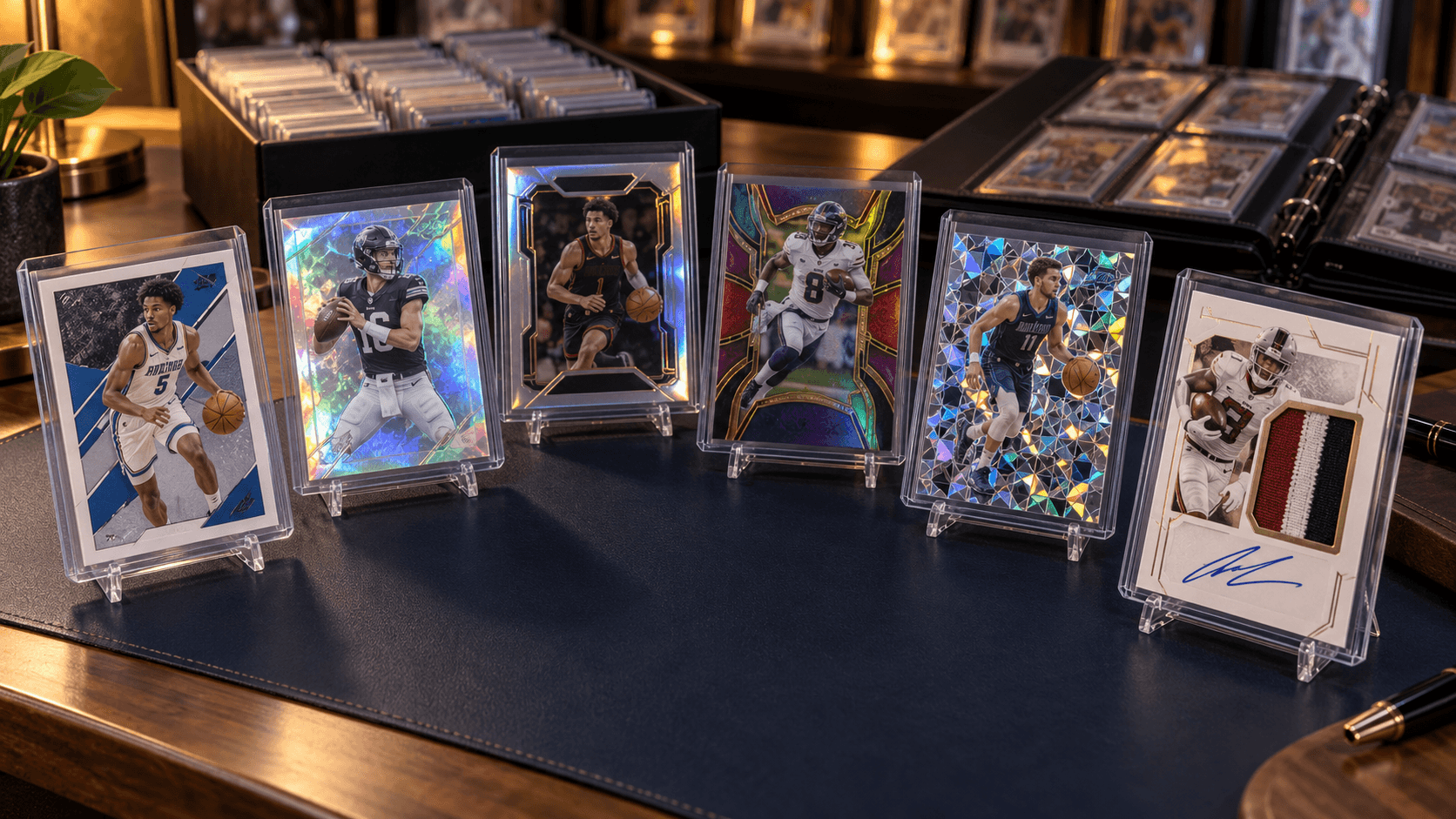
Panini sports card releases are individual products within recurring families such as Prizm, Donruss, Donruss Optic, Select, Mosaic, and National Treasures. Each family has its own approach to design, checklist structure, parallels, and collecting.
That’s why “a Panini rookie card” only tells you part of the story.
The same athlete might appear on a paper-style Donruss card, a reflective Optic Rated Rookie, a Select card from a specific checklist tier, and a National Treasures patch autograph. Those cards belong to different products and offer different collecting experiences.
Understanding how trading card releases work helps you see where each card belongs. This guide explains the broad Panini map, how the major families compare, and which details you need before identifying or valuing a card.
How Are Panini Product Families, Releases, and Sets Different?
Panini is the manufacturer. Prizm, Donruss, Select, and the other familiar names are product families or brands within its lineup.
A specific year or season, sport, and product name identify a particular release. Within that release, collectors may encounter a base checklist, rookie subsets, inserts, autograph sets, memorabilia sets, and parallels.
Think of the structure this way:
- Manufacturer: Panini
- Product family: Select
- Specific release: A particular season of Select Basketball
- Checklist section: Concourse, Premier Level, Courtside, or another applicable section
- Card identity: Player, card number, and exact version
A trading card set is a defined group of cards. A release can contain several such groups, which is why a product’s base set and autograph checklist shouldn’t be treated as interchangeable.
Product families also aren’t guaranteed to appear in every sport or every year. Check the specific release rather than assuming a familiar Panini name always means the same checklist, licensing, or packaging.
What Are the Main Panini Product Families?
The major names become easier to understand when you compare their broad collecting roles.
| Product Family | General Style | Common Collecting Focus | Important Identity Detail |
|---|---|---|---|
| Prizm | Reflective chromium-style cards | Rookies, Silver parallels, and color collecting | Exact parallel, pattern, and numbering |
| Donruss | Traditional paper-style foundation | Base sets, Rated Rookies, and inserts | Donruss release and checklist section |
| Donruss Optic | Chromium-style interpretation of Donruss | Rated Rookies, Holo parallels, colors, and autographs | Optic identity and exact version |
| Select | Chromium-style cards with tiered base structures | Checklist levels and parallel collecting | Tier plus parallel |
| Mosaic | Reflective cards with recognizable patterned treatments | Colors, patterns, subsets, and inserts | Base, Silver, Mosaic treatment, or another named version |
| National Treasures | Premium autograph and memorabilia presentation | Patch autographs, signatures, and specialized memorabilia cards | Exact autograph or memorabilia set |
This is an orientation guide, not a universal ranking.
A collector building a complete set may want something different from a collector pursuing one player’s autographs. Understanding the different types of trading cards helps separate those goals before product names start influencing your choices.
What Is Panini Prizm?
Prizm is one of Panini’s best-known chromium-style product families. Its reflective presentation, rookie cards, and extensive parallel structures make it a central name in modern collecting.
Collectors often use Prizm as a flagship chromium chase, especially when comparing a player’s base rookie with Silver and colored versions.
However, “Prizm” can mean two things:
- The Prizm product family
- A named reflective parallel treatment used within Panini products
A Select card described as a Silver Prizm still belongs to Select. The finish terminology doesn’t move it into the standalone Prizm release.
Within a Prizm release, collectors may find base cards, Silver parallels, colored or patterned parallels, inserts, and autographs. The available versions depend on the sport, year, and configuration.
The practical lesson is simple: a reflective base card isn’t automatically a Silver parallel. Compare it with the correct checklist and reference images.
CardWiki’s explanation of Refractor, Prizm, Chrome, and Holo terminology provides more context for separating product names from finish names. Panini’s own Prizm previews also document Silver, color, and configuration-specific parallel content.
What Is Donruss, and Where Do Rated Rookies Fit?
Donruss generally provides a traditional paper-style foundation within Panini’s sports card lineup. Its familiar design language gives collectors a different experience from the reflective surfaces associated with Prizm or Optic.
Rated Rookie branding is one of the most recognizable parts of the Donruss identity.
However, Rated Rookie doesn’t identify the complete card. You still need the release, sport, player, card number, and version.
A Donruss Rated Rookie and a Donruss Optic Rated Rookie may feature related branding or design elements, but they belong to different products. Their materials, checklists, parallels, and collector demand can differ.
It also helps to understand what makes a card a rookie card. Rookie branding, a player’s first appearance, and the hobby’s treatment of a specific release aren’t always interchangeable.
For collectors, Donruss can offer a familiar starting point: build the base set, collect a favorite team, pursue Rated Rookies, or focus on particular inserts. The exact opportunities depend on that year’s product.
How Does Donruss Optic Relate to Donruss?
Donruss Optic takes the Donruss identity into a chromium-style format. Panini has described Optic as an Optichrome-enhanced interpretation of Donruss, preserving familiar elements while changing the presentation.
That relationship explains why collectors recognize Rated Rookie branding across both families.
It doesn’t mean Optic is simply a shiny parallel of the paper Donruss release. Donruss Optic is its own product, with its own checklist and version structure.
Collectors researching Donruss Optic should confirm:
- Whether the card is base or parallel
- The official Holo, color, or pattern name
- Whether it belongs to a rookie, insert, or autograph checklist
- Any serial numbering
- The applicable release and configuration
Holo terminology commonly appears in Optic collecting, but exact names should come from the relevant product information.
Shared imagery can make two cards look closely related without making them identical. The same principle applies when comparing a base card, insert, and parallel: appearance alone doesn’t establish the checklist relationship.
Why Does Select Have Different Levels?
Select is especially recognizable for tiered base checklists. A tier is a defined section of the base set with its own design and checklist position.
For example, 2018-19 Select Basketball used Concourse, Premier Level, and Courtside. Its product information also described different expected quantities of those levels in hobby boxes.
Football uses sport-specific terminology. The 2019 Select Football release featured Concourse, Premier Level, and Field Level. Other releases can use different or expanded structures.
The tier and parallel are separate identity fields.
A Concourse Silver and a Courtside Silver aren’t interchangeable versions of one underlying card. Each belongs to its own base checklist section, and each section can have its own parallel relationships.
When identifying Select, confirm:
- Sport and product year
- Checklist tier
- Player and card number
- Base or parallel status
- Color, pattern, finish, and numbering
Don’t assume every Select release uses three levels or that every player appears in every level. Understanding what a trading card checklist contains helps you verify the structure instead of relying on memory.
What Makes Panini Mosaic Different?
Mosaic has its own product identity, with reflective cards, recognizable patterned treatments, colors, subsets, and inserts.
Its terminology requires care because “Mosaic” can describe the product family and appear within the name of a particular parallel treatment.
A card from Mosaic isn’t automatically the Mosaic parallel of that card.
Panini’s 2020-21 Mosaic Basketball preview, for example, listed Silver Prizms and Mosaic Prizms separately. It also identified specific autograph and insert content. That illustrates why collectors should preserve the full version name rather than labeling everything “shiny Mosaic.”
When researching Panini Mosaic, check whether the card is:
- Standard base
- Silver parallel
- Mosaic parallel
- Another named color or patterned parallel
- Insert or autograph card
Exact options vary by release and configuration.
A patterned treatment doesn’t automatically establish rarity, and an unnumbered card doesn’t automatically establish a known print run.
CardWiki’s explanation of what parallel means in trading cards helps clarify how a recognized treatment creates a separate version while maintaining its relationship to the underlying card.
What Is National Treasures?
National Treasures is a premium Panini family built around autographs, memorabilia, and elaborate card presentations.
Collectors commonly associate National Treasures cards with rookie patch autographs, larger memorabilia windows, specialized signatures, and booklet formats. Panini’s 2024-25 Basketball coverage highlights autograph sets, memorabilia sets, patch autographs, and rookie booklets.
The product name still isn’t a complete description.
A standard memorabilia card, rookie patch autograph, veteran autograph, and booklet can all belong to National Treasures while serving different collecting goals.
Before comparing cards, verify:
- Exact set or subset
- Rookie and autograph status
- Signature format where documented
- Memorabilia description
- Parallel and serial numbering
Read the card’s authentication language carefully. A visible fabric piece doesn’t, on its own, establish that it was game-used or connected to a particular event.
Premium packaging also doesn’t guarantee premium resale value. Player demand, condition, the specific checklist, and the exact version remain important.
How Do Prizm, Optic, and Select Compare?
The Panini Prizm vs Optic vs Select comparison is best understood through product structure.
Prizm is often the starting point for collectors who want a recognizable chromium-style rookie and parallel collection.
Optic appeals to collectors who enjoy Donruss design language and Rated Rookie branding in a chromium-style presentation.
Select adds another layer through its checklist tiers. Identifying the level is part of identifying the card.
| Collector Question | Prizm | Donruss Optic | Select |
|---|---|---|---|
| What is the broad identity? | Standalone chromium-style family | Chromium-style Donruss family | Chromium-style family with tiered base structures |
| What should I confirm first? | Release and parallel | Optic release and checklist section | Release and tier |
| Where does complexity often appear? | Colors, patterns, and configuration exclusives | Rated Rookie versions, Holo treatments, and other parallels | Tier plus color, pattern, or finish |
| Is one automatically more valuable? | No | No | No |
Choose based on the cards you want to collect. A preferred photograph, design, checklist, or player connection can be more useful than a blanket product ranking.
What About Panini’s Other Product Names?
Panini’s broader catalog includes names such as Contenders, Chronicles, Absolute, Certified, Immaculate, and Flawless.
Each should be researched as its own family. Don’t assume its checklist, autograph structure, or materials match one of the products covered above.
Pay particular attention to full release names and qualifiers.
“Draft Picks,” “Collegiate,” and other edition labels can identify products that need separate research. A familiar brand name doesn’t establish the sport, uniforms, licensing, or relationship to another release.
This is where knowing how to tell what set a trading card is from becomes useful. Check the card’s front and back, then match the details against the appropriate checklist.
Do Hobby, Retail, Blaster, and Mega Boxes Change the Product?
Configuration describes how a product is packaged and distributed.
The same release may have multiple configurations, with differences in pack counts, available parallels, insert content, or advertised autograph and memorabilia content.
That doesn’t make “blaster” a parallel name.
It also doesn’t mean cards from different configurations are always identical. Exclusive content must be identified using its actual checklist name.
Before buying sealed product, compare:
- Full product name and year
- Configuration
- Pack and card counts
- Advertised content
- Exclusive parallels or inserts
- Whether stated quantities are averages
CardWiki’s comparison of hobby boxes, retail boxes, blasters, and mega boxes explains these packaging differences in more detail.
Check the specific box rather than applying one product’s advertised contents to every version of that release.
How Can You Identify a Panini Card Accurately?
Start with the card, then verify the checklist.
A useful identification process is:
- Confirm the sport and player
- Identify the product year or season
- Read the complete product name
- Locate the card number
- Match the base, subset, or insert checklist
- Confirm any tier, parallel, or variation
- Record autograph, memorabilia, and numbering details
CardWiki’s guide to identifying a trading card by year, set, player, and number explains the broader process.
Keep the checklist number separate from the serial number. A card marked #125 occupies a checklist position. A stamp such as 08/25 identifies an individual copy within that numbered version.
Understanding serial numbered cards helps prevent those fields from being confused.
Also check for genuine photo or image variations. A changed photograph and a changed reflective treatment aren’t automatically the same type of difference.
What Affects the Value of Panini Cards?
Product reputation contributes context, but the exact card determines the comparison.
Relevant factors include:
- Player demand
- Rookie status
- Product and checklist reputation
- Parallel identity and scarcity
- Autograph or memorabilia details
- Condition and grade
- Recent comparable sales
Rare does not automatically mean valuable.
A numbered card from a lightly collected player can attract less demand than a more widely available card of a popular rookie. A premium product name doesn’t remove that relationship.
CardWiki’s guide to why some trading cards are valuable explains these factors.
Condition also needs attention. Reflective cards can show scratches, print lines, or other surface issues, while thicker cards require careful inspection of corners and edges.
If you’re considering professional card grading, evaluate the actual card and relevant sales before treating submission as an automatic next step.
What Mistakes Should Panini Collectors Avoid?
Most identification problems begin when an incomplete description is treated as a complete one.
Common mistakes include:
- Calling every Panini card a Prizm
- Treating Donruss Optic as a parallel of paper Donruss
- Ignoring Select’s checklist level
- Calling every Mosaic card the Mosaic parallel
- Assuming matching colors have matching print runs
- Confusing inserts with parallels
- Assuming every patch is game-used
- Treating every premium card as valuable
- Comparing sales from different releases or versions
An insert card belongs to a separate named set within a release. That relationship should remain clear even when the insert also has parallels.
How Does the Panini Map Support CardWiki’s Approach?
Panini’s lineup shows why structured identity matters.
“Panini, rookie, silver” leaves important questions unanswered. Which product? Which season? Which checklist? Which tier? Which named treatment?
A useful card record separates those fields so related cards can be connected without being incorrectly merged.
That also makes organizing a card collection easier. You can track what you own, identify missing versions, and compare cards consistently.
Exact identification comes before valuation. The product family gives you the starting point; the checklist and version details establish the card.
Frequently Asked Questions
Is Optic the Same as Prizm?
No. Donruss Optic and Prizm are separate product families. Both use reflective chromium-style presentations, but their branding, designs, checklists, and versions differ.
Are Donruss and Donruss Optic Rated Rookies the Same Card?
No. They may share related branding or imagery, but they belong to different releases. Record the full product name before comparing them.
Is Courtside a Select Parallel?
Courtside is a checklist level in applicable Select Basketball releases. A Courtside card can also have a parallel, such as a named Silver or color version.
Does a Silver Card Always Come from Prizm?
No. Silver terminology appears in multiple Panini families. Confirm both the product and the official version name.
Are All National Treasures Cards Autographed?
No. National Treasures releases can include base cards, memorabilia cards, autograph cards, and other checklist sections. The exact card determines its features.
Does a 1/1 Mean the Player Has Only One Card?
No. It identifies one copy of that particular numbered version. The player may have other 1/1 cards across different products, sets, and parallels.
Which Panini Product Should Beginners Collect?
Start with a player, team, design, or set-building goal. Then research the release and budget. No product family is automatically the right choice for every collector.
Build Your Collection Around the Full Card Identity
Prizm, Donruss, Optic, Select, Mosaic, and National Treasures each provide a different route into Panini collecting.
Learn the family first, then confirm the release, checklist, tier, and exact version. That approach makes comparisons more accurate and helps you collect with a clearer purpose.
Use the CardWiki catalog to explore available records and connect your cards with their broader set structure.