Base Card Vs Insert Vs Parallel: What’s The Difference?
Learn the difference between base cards, insert cards, and parallel cards in trading card collecting, with simple examples for beginners.

One of the first confusing parts of trading card collecting is learning that not every card in a pack belongs to the same category.
A pack might include a regular card from the main set, a shiny version of that same card, and a special themed card that looks completely different. To a new collector, those can all feel like “just cards.” But in the hobby, they usually fall into three important groups: base cards, inserts, and parallels.
Understanding the difference matters because it helps you identify what you have, read checklists more clearly, organize your collection, and avoid mixing up cards that may look similar but serve different roles in a set.
This Card Wiki guide breaks down base card vs parallel vs insert in plain English, with simple examples and beginner-friendly collecting tips.
What Is A Base Card?
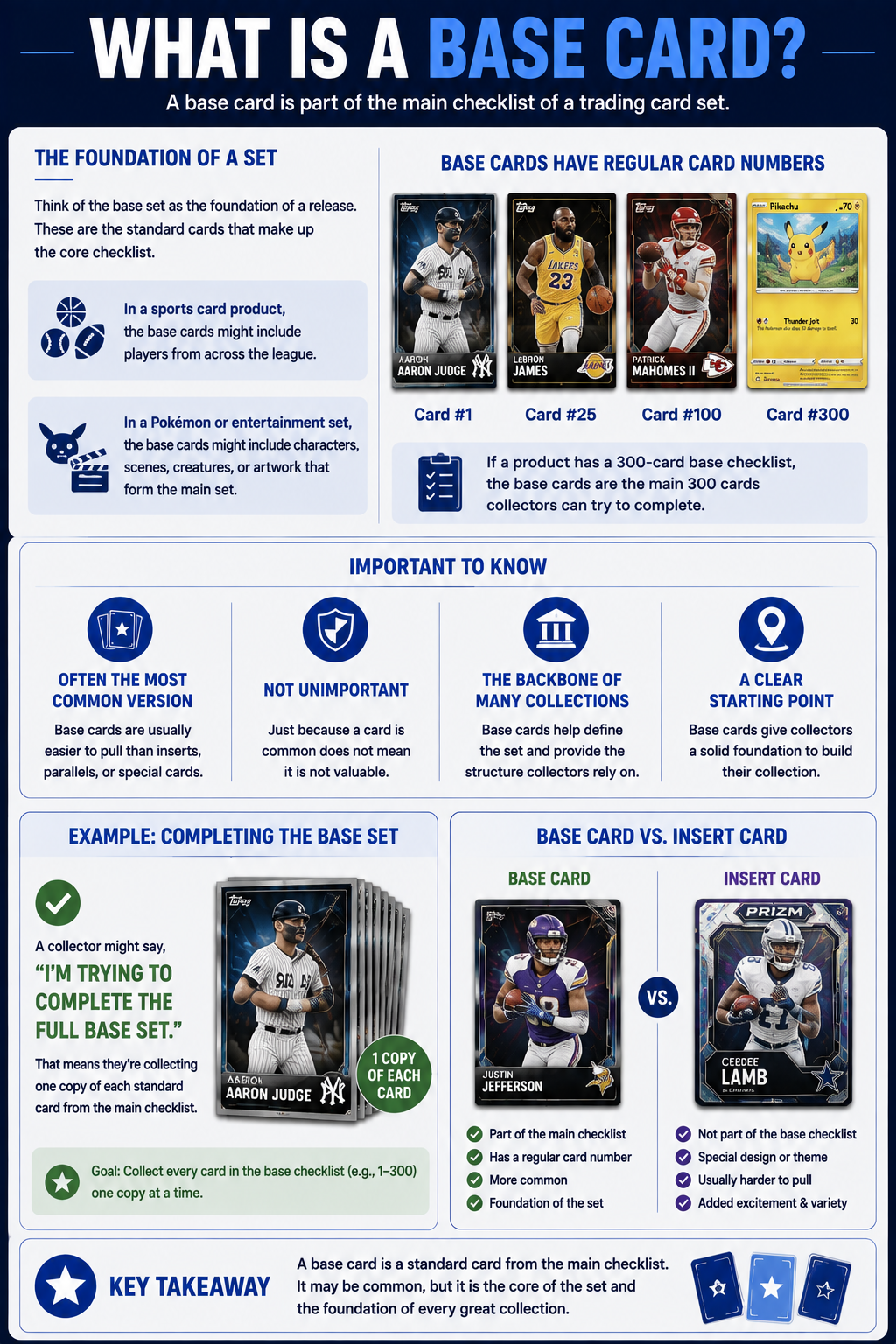
A base card is part of the main checklist of a trading card set.
Think of the base set as the foundation of a release. These are the standard cards that make up the core checklist. In a sports card product, the base cards might include players from across the league. In a Pokémon or entertainment set, the base cards might include characters, scenes, creatures, or artwork that form the main set.
Base cards usually have regular card numbers, such as:
- Card #1
- Card #25
- Card #100
- Card #300
If a product has a 300-card base checklist, the base cards are the main 300 cards collectors can try to complete.
A base card is often the most common version of a card, but that doesn’t mean it’s unimportant. Base cards are the backbone of many collections. They help define the set, provide structure, and give collectors a clear starting point.
For example, a collector might say, “I’m trying to complete the full base set.” That means they’re collecting one copy of each standard card from the main checklist.
What Is A Parallel Card?
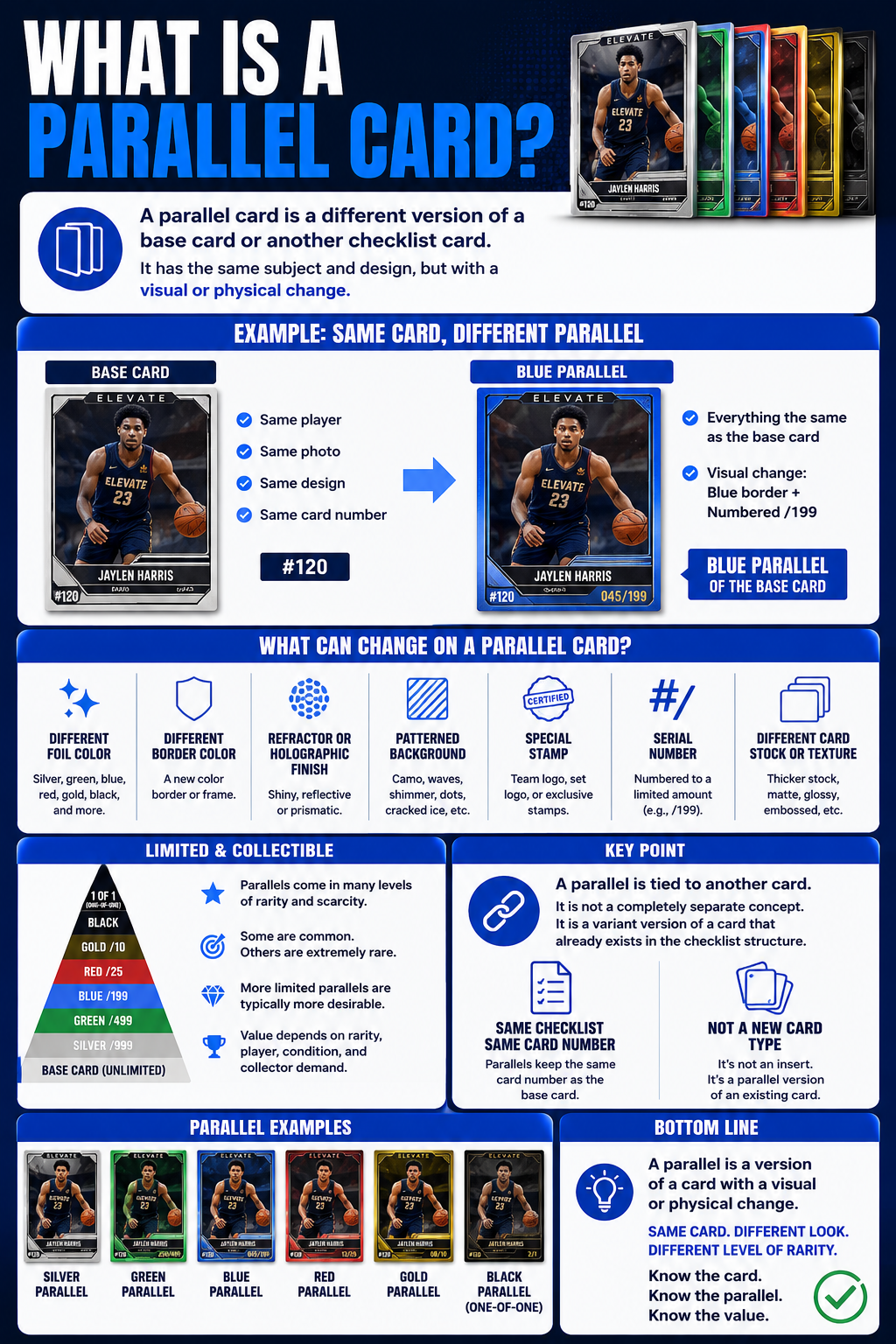
A parallel card is a different version of a base card or another checklist card.
The easiest way to understand a parallel is this: it usually has the same subject and design as another card, but with a visual or physical change.
That change might include:
- A Different Foil Color
- A Different Border Color
- A Refractor Or Holographic Finish
- A Patterned Background
- A Special Stamp
- A Serial Number
- A Different Card Stock Or Texture
For example, imagine a base card of a basketball player numbered #120 in the checklist. A parallel version of that card might also show the same player, same photo, same design, and same card number, but it has a blue border and is numbered out of 199.
That would make it a Blue Parallel of the base card.
Parallels are often more limited than regular base cards. Some may be fairly common, while others may be extremely rare. A product might include many parallel levels, such as silver, green, blue, red, gold, black, or one-of-one versions.
The key point is that a parallel is usually tied to another card. It is not a completely separate concept on its own. It’s a variant version of a card that already exists in the checklist structure.
What Is An Insert Card?
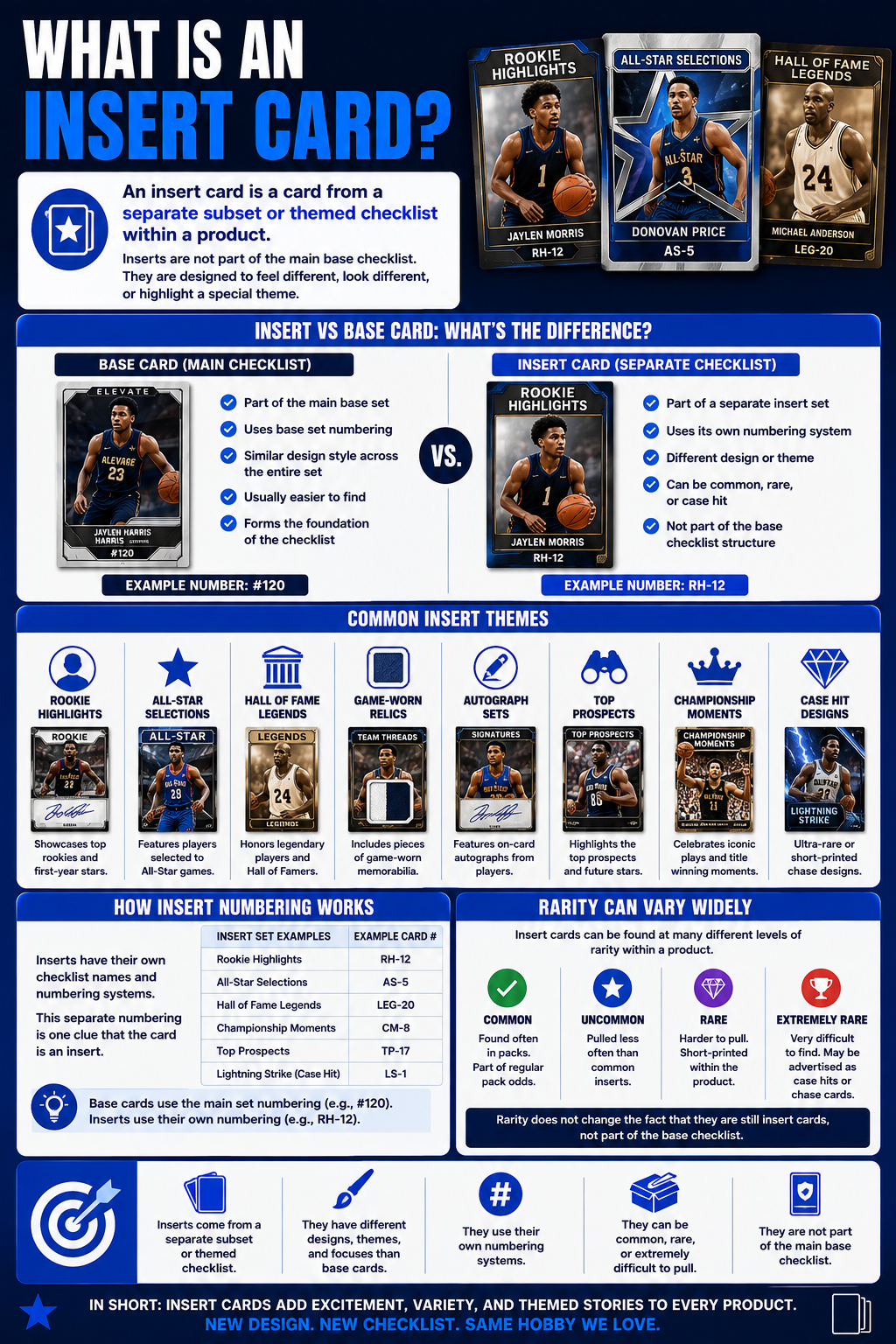
An insert card is a card from a separate subset or themed checklist within a product.
Inserts are not part of the main base checklist. They are usually designed to feel different, look different, or highlight a special theme. They might focus on top rookies, legendary players, award winners, big moments, team leaders, artwork, autographs, memorabilia, or creative concepts.
Common insert themes might include:
- Rookie Highlights
- All-Star Selections
- Hall Of Fame Legends
- Game-Worn Relics
- Autograph Sets
- Top Prospects
- Championship Moments
- Case Hit Designs
Insert cards often have their own checklist names and numbering systems. Instead of being card #120 in the base set, an insert might be numbered something like RH-12, AS-5, or LEG-20.
That separate numbering is one clue that the card is an insert rather than a base card.
Inserts can be common, uncommon, rare, or extremely difficult to pull. Some inserts are found often in packs, while others are advertised as case hits or short-printed chase cards.
Base Card Vs Parallel Vs Insert: The Simple Difference
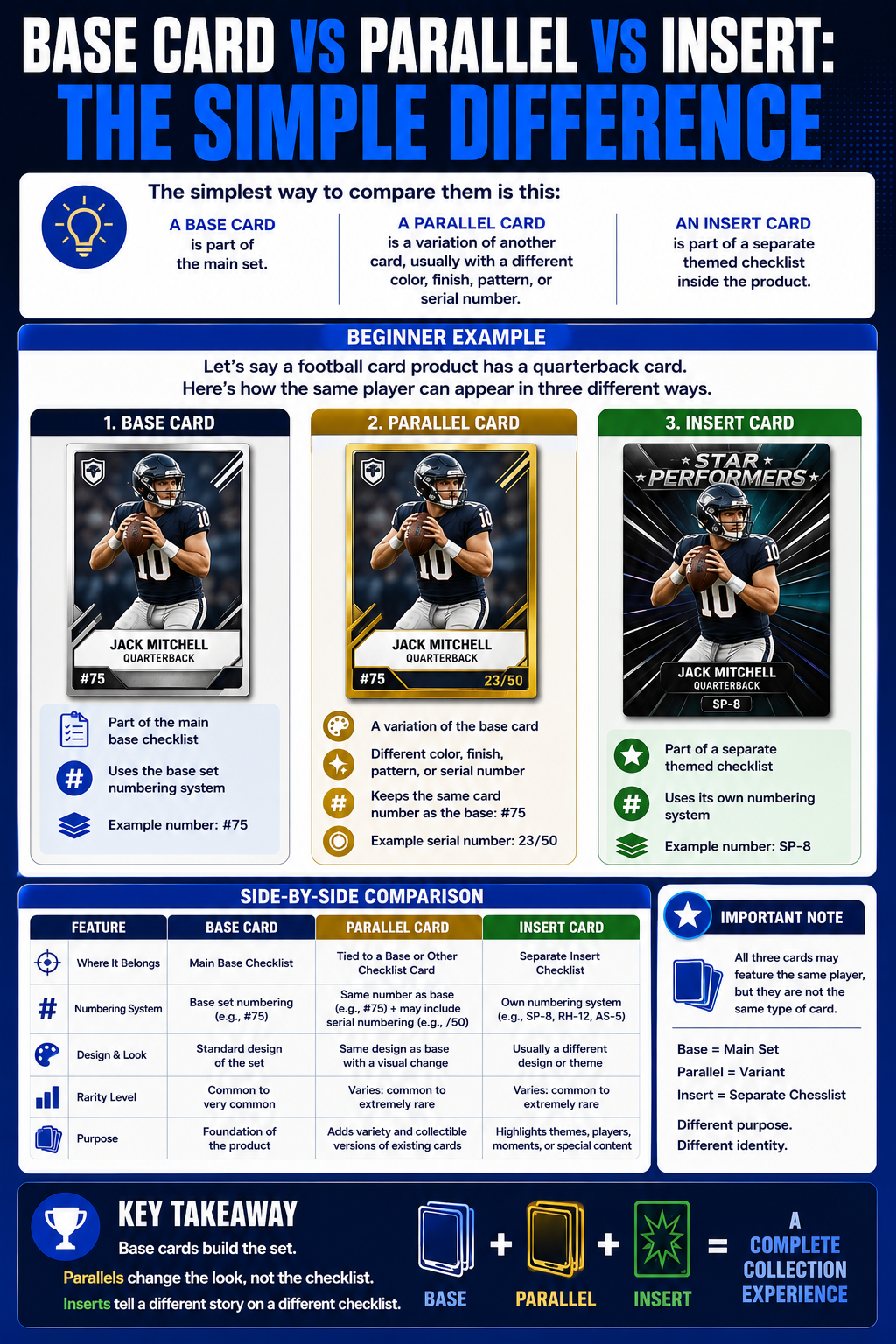
The simplest way to compare them is this:
A base card is part of the main set.
A parallel card is a variation of another card, usually with a different color, finish, pattern, or serial number.
An insert card is part of a separate themed checklist inside the product.
Here’s a beginner-friendly example.
Let’s say a football card product has a base card of a quarterback. The standard card is numbered #75.
That product might also include:
- Base Card: Quarterback card #75 from the main checklist
- Parallel Card: The same quarterback card #75 with a gold border, numbered /50
- Insert Card: A separate “Star Performers” quarterback card numbered SP-8
All three cards may feature the same player, but they are not the same type of card.
The base card belongs to the main checklist. The parallel is a special version of that base card. The insert belongs to a different themed checklist.
How To Spot A Base Card
Base cards are usually the easiest cards to identify once you know what to look for.
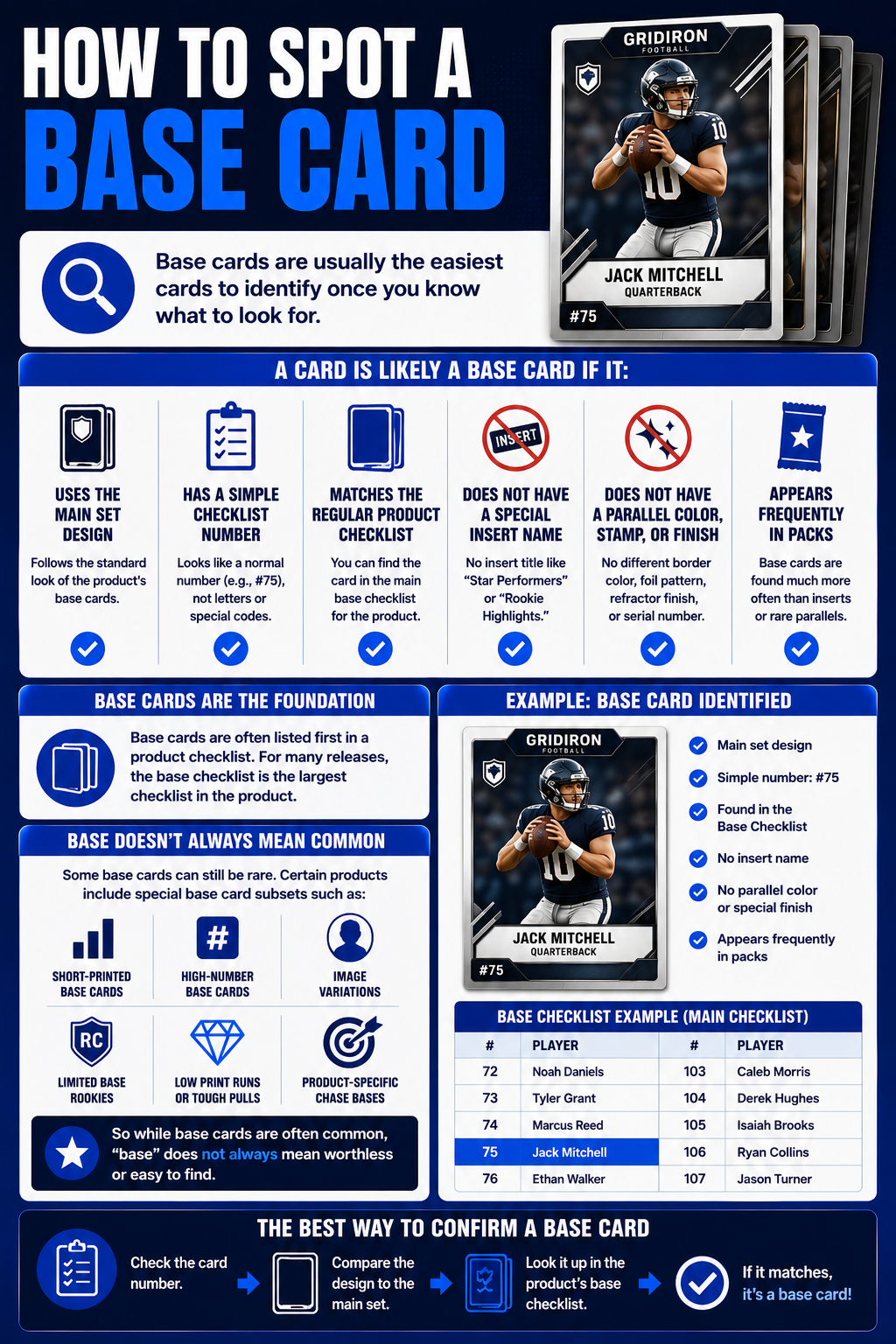
A card is likely a base card if it:
- Uses The Main Set Design
- Has A Simple Checklist Number
- Matches The Regular Product Checklist
- Does Not Have A Special Insert Name
- Does Not Have A Parallel Color, Stamp, Or Finish
- Appears Frequently In Packs
Base cards are often listed first in a product checklist. For many releases, the base checklist is the largest checklist in the product.
That said, some base cards can still be rare. Certain products include short-printed base cards, high-number base cards, image variations, or limited base rookies. So while base cards are often common, “base” does not always mean worthless or easy to find.
The best way to confirm a base card is to compare the card number, design, and checklist placement.
How To Spot A Parallel Card
Parallel cards can be trickier because they often look very close to the regular base card.
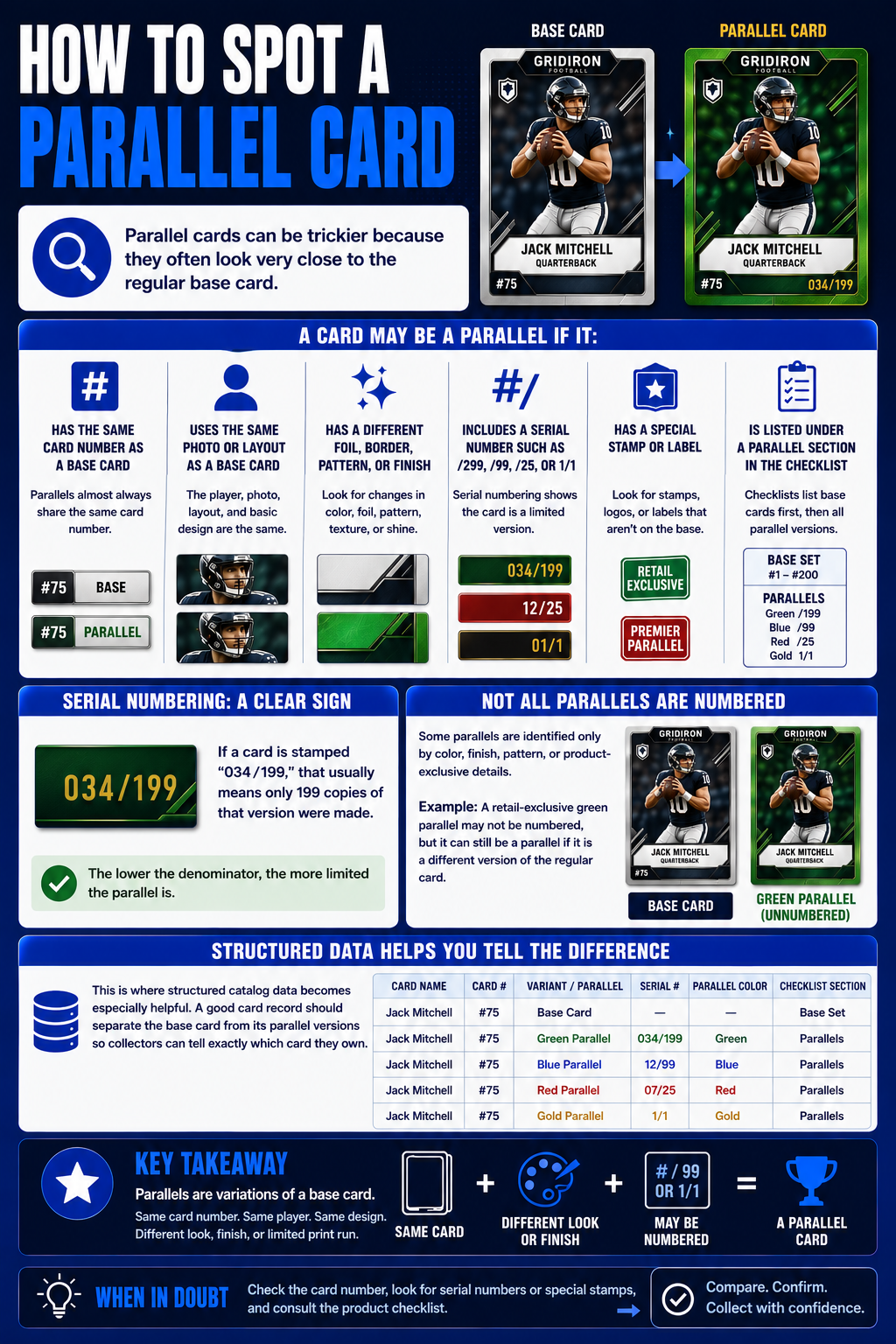
A card may be a parallel if it:
- Has The Same Card Number As A Base Card
- Uses The Same Photo Or Layout As A Base Card
- Has A Different Foil, Border, Pattern, Or Finish
- Includes A Serial Number Such As /299, /99, /25, Or 1/1
- Has A Special Stamp Or Label
- Is Listed Under A Parallel Section In The Checklist
Serial numbering is one of the clearest signs. If a card is stamped “034/199,” that usually means only 199 copies of that version were made.
But not all parallels are serial numbered. Some are identified only by color, finish, pattern, or product-exclusive details. For example, a retail-exclusive green parallel may not be numbered, but it can still be a parallel if it is a different version of the regular card.
This is where structured catalog data becomes especially helpful. A good card record should separate the base card from its parallel versions so collectors can tell exactly which card they own.
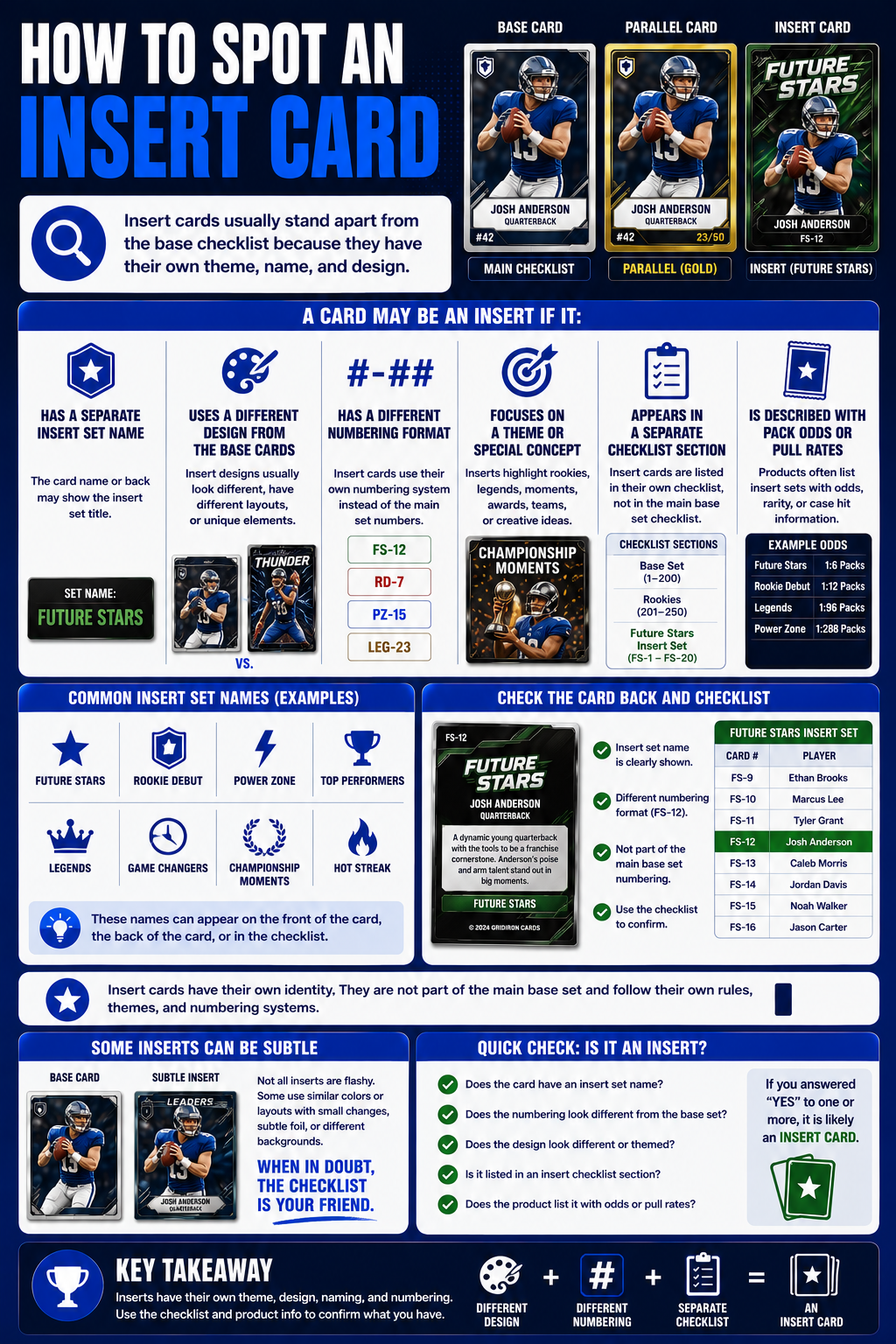
How To Spot An Insert Card
Insert cards usually stand apart from the base checklist because they have their own theme, name, and design.
A card may be an insert if it:
- Has A Separate Insert Set Name
- Uses A Different Design From The Base Cards
- Has A Different Numbering Format
- Focuses On A Theme Or Special Concept
- Appears In A Separate Checklist Section
- Is Described With Pack Odds Or Pull Rates
The card name or back of the card may include the insert set title. Examples could include names like “Future Stars,” “Rookie Debut,” “Power Zone,” “Legends,” or “Top Performers.”
Insert cards can be easy to identify when the design is completely different. But some inserts are subtle, especially in products with many subsets. When in doubt, the checklist is your friend.
Can An Insert Also Have Parallels?
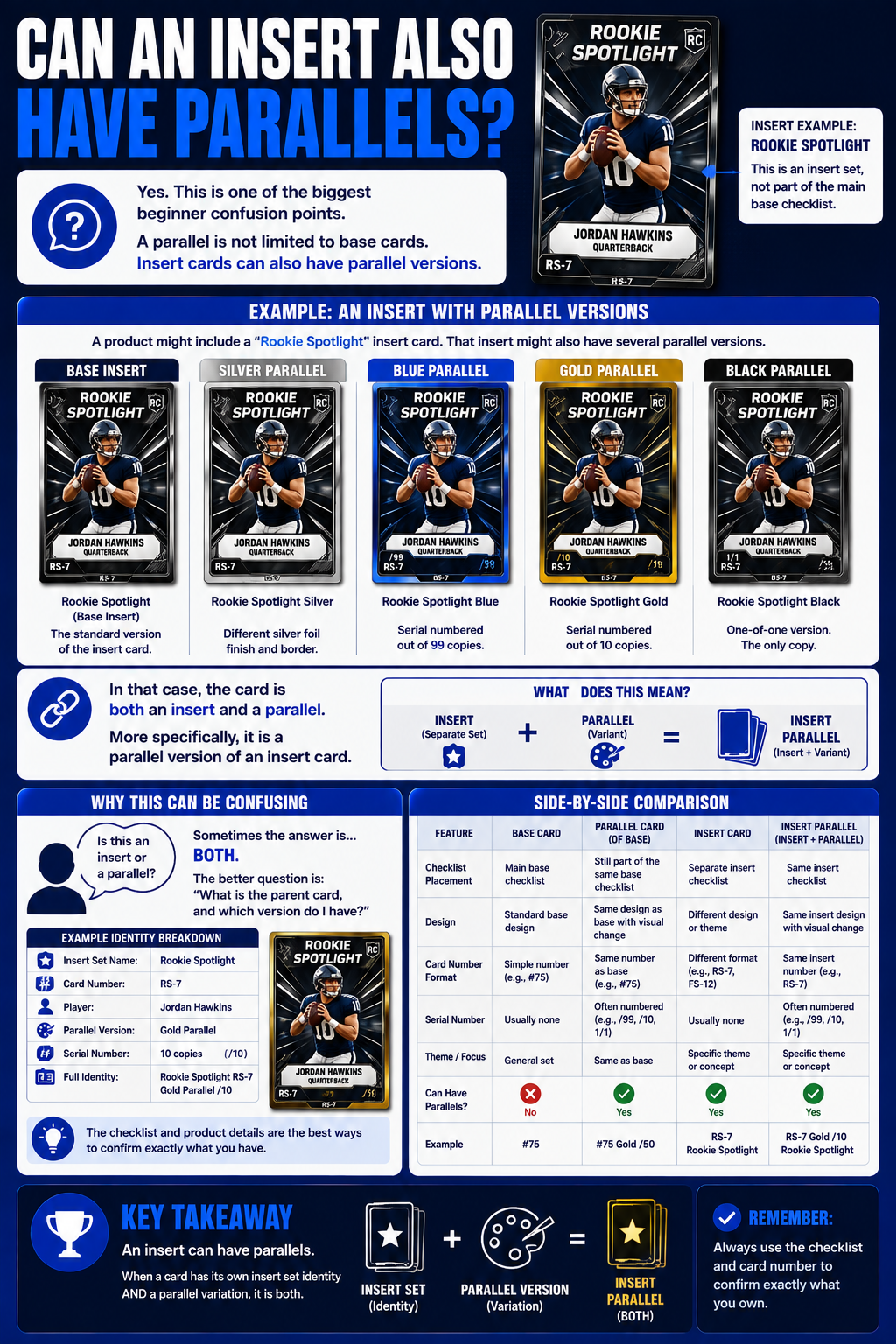
Yes. This is one of the biggest beginner confusion points.
A parallel is not limited to base cards. Insert cards can also have parallel versions.
For example, a product might include a “Rookie Spotlight” insert card. That insert might also have several parallel versions:
- Rookie Spotlight Silver
- Rookie Spotlight Blue /99
- Rookie Spotlight Gold /10
- Rookie Spotlight Black 1/1
In that case, the card is both an insert and a parallel.
More specifically, it is a parallel version of an insert card.
This is why card identity can get complicated. A collector might ask, “Is this an insert or a parallel?” Sometimes the answer is both. The better question is, “What is the parent card, and which version do I have?”
Can A Base Card Be Rare?
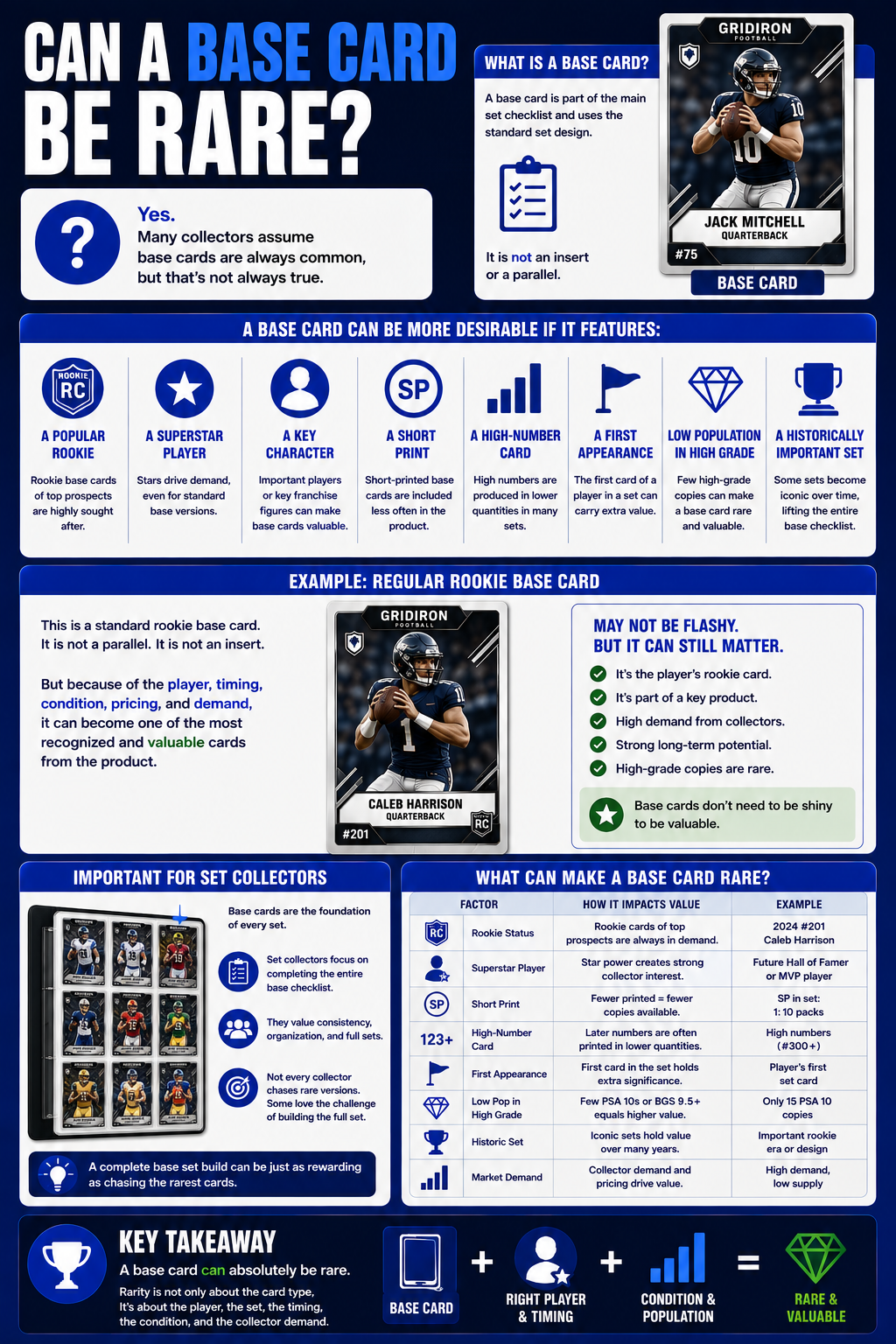
Yes. Many collectors assume base cards are always common, but that’s not always true.
A base card can be more desirable if it features:
- A Popular Rookie
- A Superstar Player
- A Key Character
- A Short Print
- A High-Number Card
- A First Appearance
- A Low Population In High Grade
- A Historically Important Set
For example, a regular rookie base card of a major player can become one of the most recognized cards from a product. It may not be a parallel or insert, but it can still matter because of the player, timing, condition, pricing, and demand.
Base cards are also important for set collectors. Some collectors care less about chasing rare versions and more about completing the full base checklist.
Are Parallels Always More Valuable Than Base Cards?
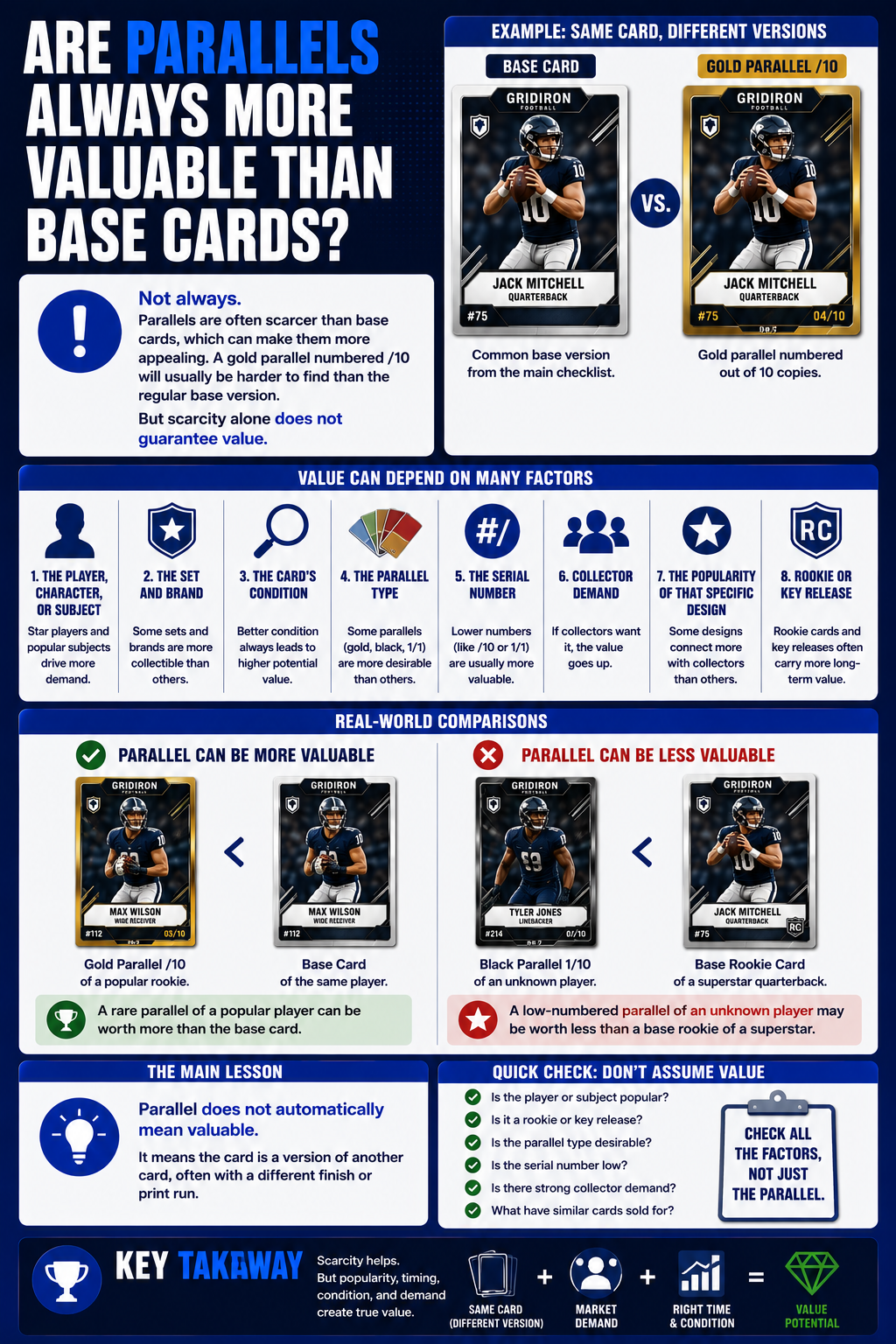
Not always.
Parallels are often scarcer than base cards, which can make them more appealing. A gold parallel numbered /10 will usually be harder to find than the regular base version. But scarcity alone does not guarantee value.
Value can depend on:
- The Player, Character, Or Subject
- The Set And Brand
- The Card’s Condition
- The Parallel Type
- The Serial Number
- Collector Demand
- The Popularity Of That Specific Design
- Whether The Card Is A Rookie Or Key Release
Some parallels are very desirable. Others are overlooked. A low-numbered parallel of an unknown player may not be worth as much as a base rookie card of an all-time great.
The main lesson is simple: parallel does not automatically mean valuable. It means the card is a version of another card, often with a different finish or print run.
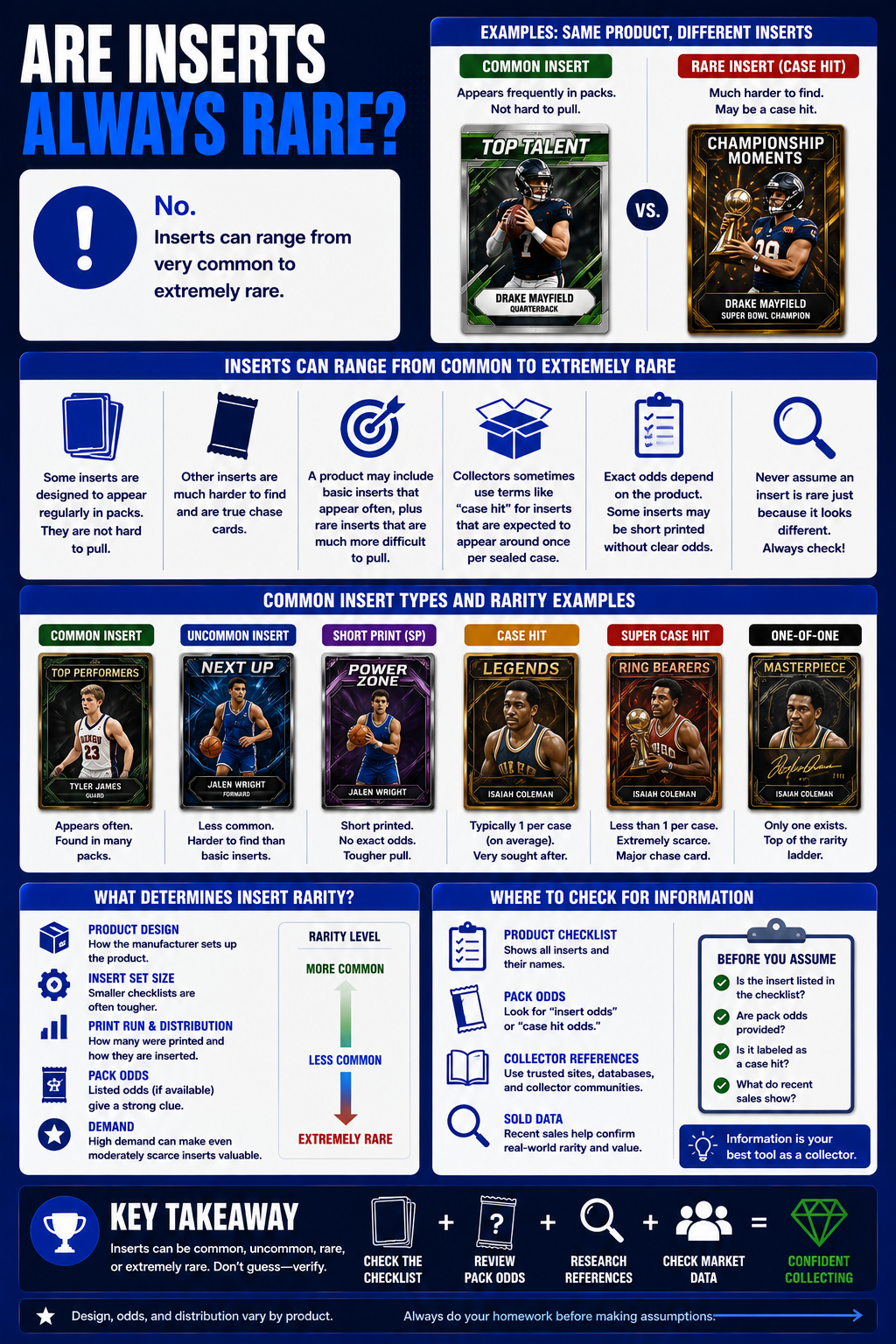
Are Inserts Always Rare?
No. Inserts can range from very common to extremely rare.
Some inserts are designed to appear regularly in packs. Others are much harder to find. A product may include basic inserts that appear every few packs, plus rare inserts that are much more difficult to pull.
Collectors sometimes use terms like “case hit” for inserts that are expected to appear around once per sealed case, though exact odds depend on the product. Other inserts may be short printed without clear odds.
That means you should never assume an insert is rare just because it looks different. Check the product checklist, pack odds, and collector references when possible.
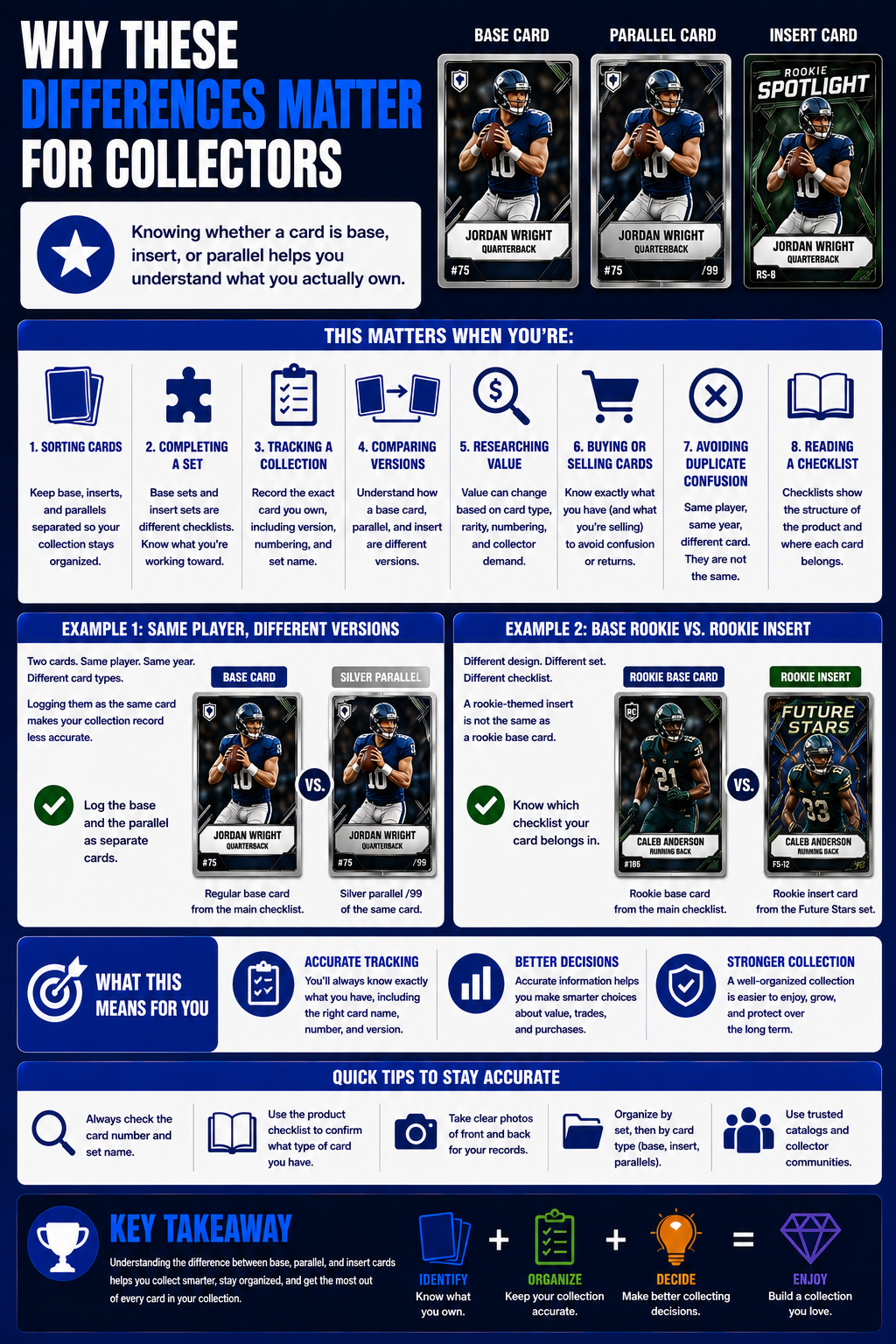
Why These Differences Matter For Collectors
Knowing whether a card is base, insert, or parallel helps you understand what you actually own.
This matters when you’re:
- Sorting Cards
- Completing A Set
- Tracking A Collection
- Comparing Versions
- Researching Value
- Buying Or Selling Cards
- Avoiding Duplicate Confusion
- Reading A Checklist
For example, two cards may feature the same player and same year, but one might be a regular base card and the other might be a silver parallel. If you log them as the same card, your collection record becomes less accurate.
The same thing happens with inserts. A collector might think they have a rookie base card when they actually have a rookie-themed insert. That doesn’t make the card bad, but it does mean it belongs in a different checklist category.
Accurate card identification helps collectors make better decisions.
Common Beginner Mistakes
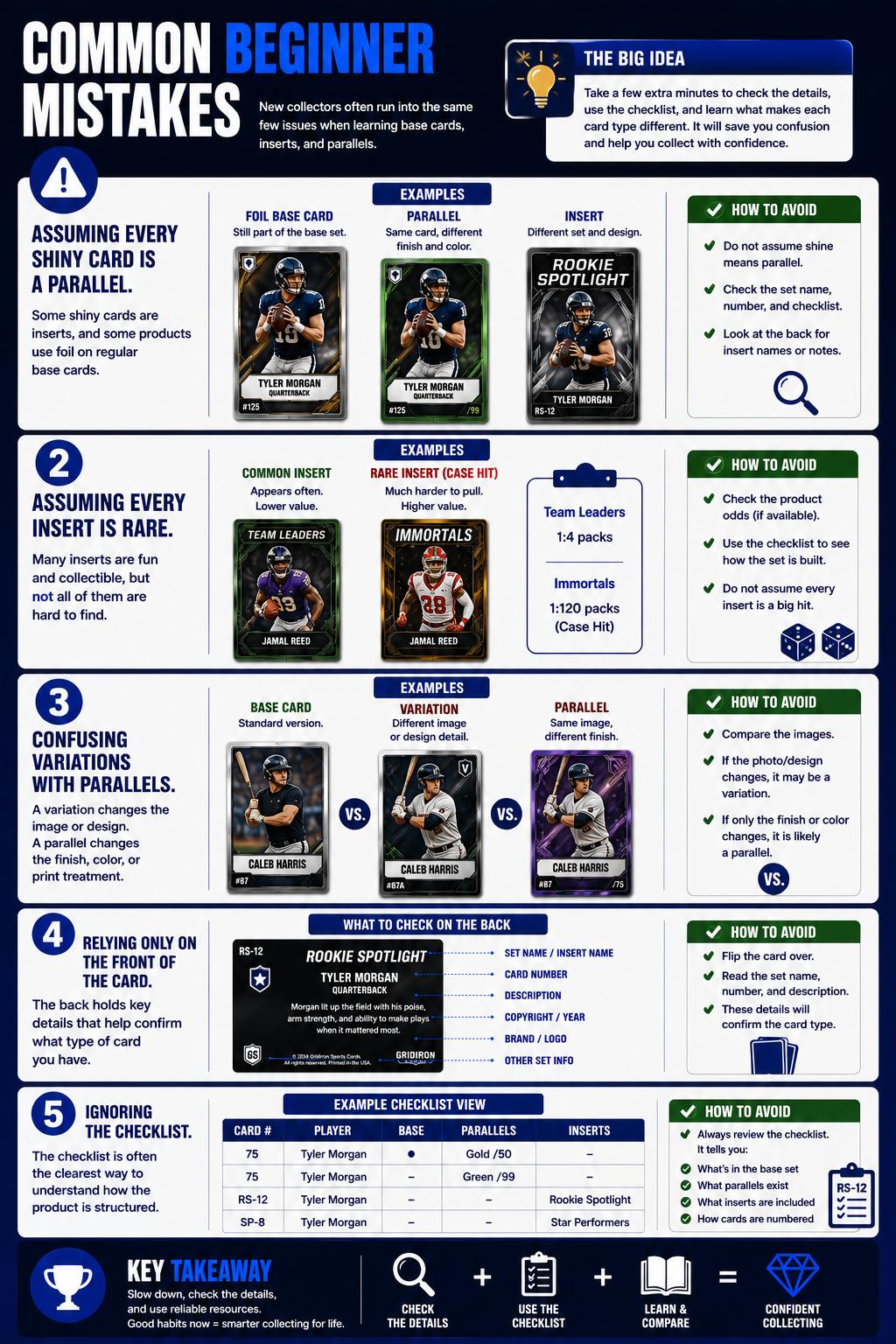
New collectors often run into the same few issues when learning base cards, inserts, and parallels.
One common mistake is assuming every shiny card is a parallel. Some shiny cards are inserts, and some products use foil on regular base cards.
Another mistake is assuming every insert is rare. Many inserts are fun and collectible, but not all of them are hard to find.
Collectors also sometimes confuse variations with parallels. A variation may use a different image, nickname, logo, or design detail, while a parallel usually changes the finish, color, pattern, or print treatment of an existing card.
A fourth mistake is relying only on the front of the card. The back of the card, card number, checklist name, copyright line, and set information can all help confirm what type of card it is.
Finally, collectors sometimes ignore the checklist. The checklist is often the clearest way to understand how the product is structured.
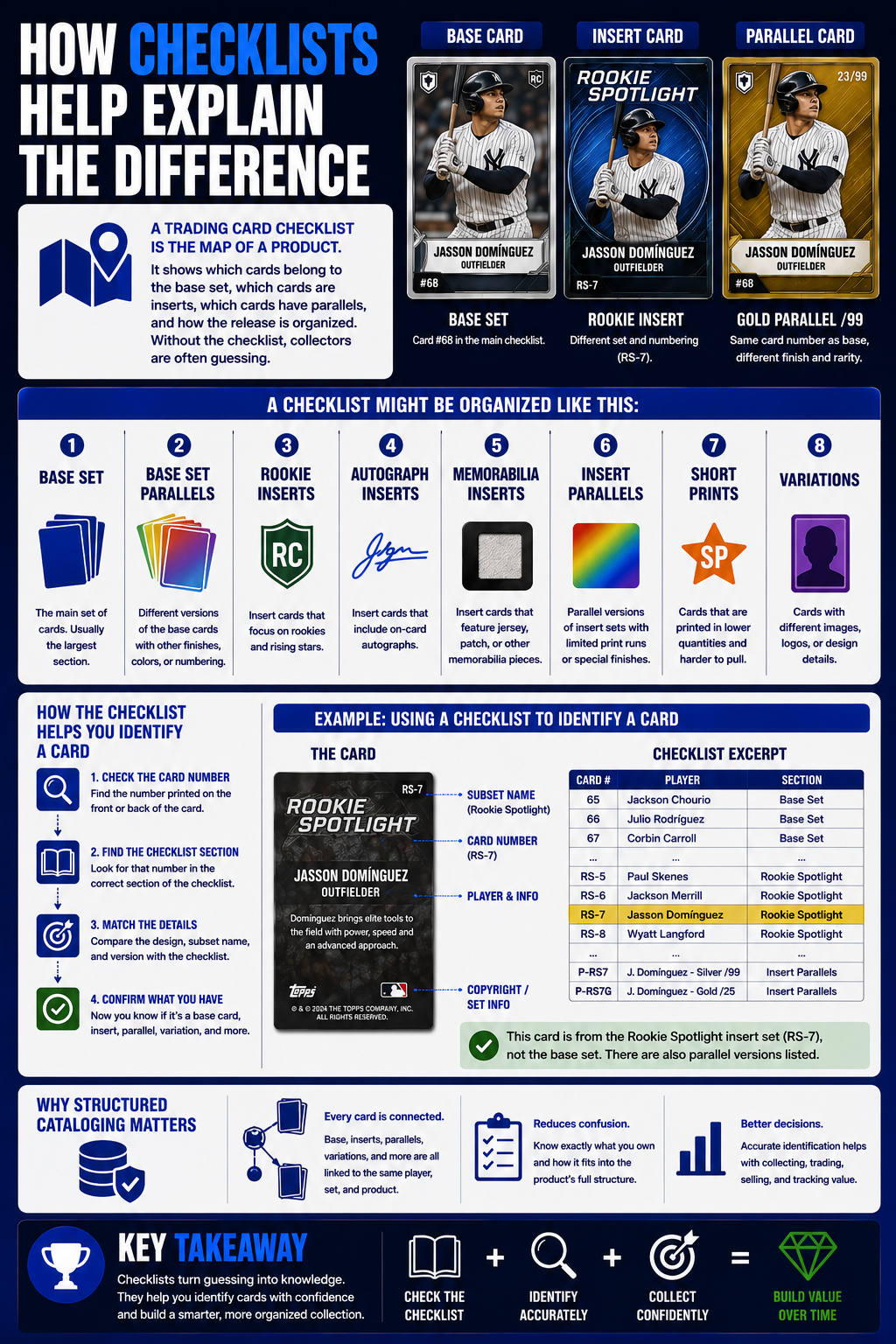
How Checklists Help Explain The Difference
A trading card checklist is the map of a product.
It shows which cards belong to the base set, which cards are inserts, which cards have parallels, and how the release is organized. Without the checklist, collectors are often guessing.
A checklist might be organized like this:
- Base Set
- Base Set Parallels
- Rookie Inserts
- Autograph Inserts
- Memorabilia Inserts
- Insert Parallels
- Short Prints
- Variations
Once you understand that structure, identifying cards becomes easier. You can look at the card number, design, and subset name, then match it to the correct checklist section.
This is exactly why structured cataloging matters. Trading cards are not just loose images or names. They are connected records within products, sets, checklists, and versions.
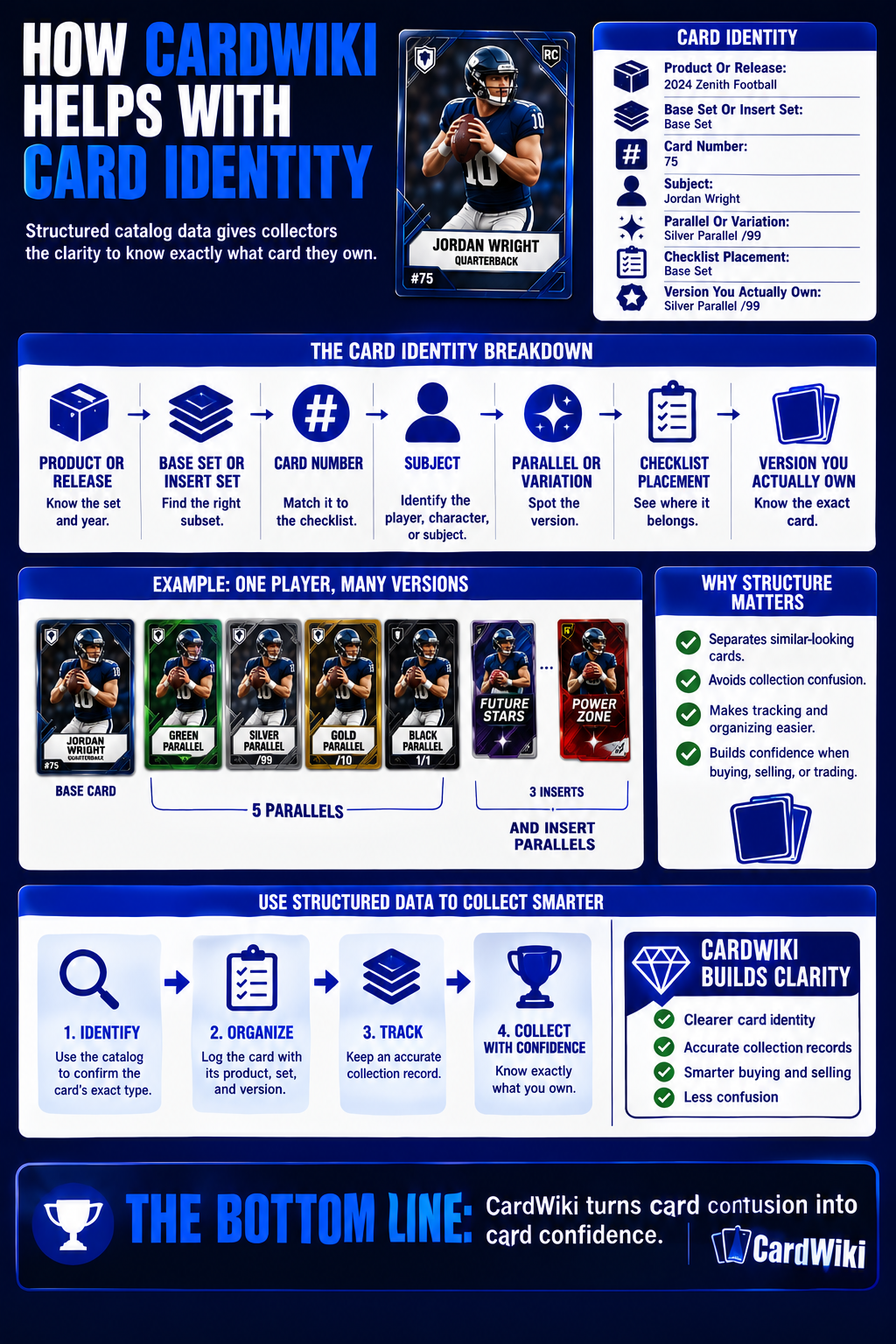
How CardWiki Helps With Card Identity
CardWiki is built around structured catalog data because collectors need more than a card name.
To understand a card clearly, you often need to know:
- The Product Or Release
- The Base Set Or Insert Set
- The Card Number
- The Subject
- The Parallel Or Variation
- The Checklist Placement
- The Version You Actually Own
That structure helps separate similar-looking cards and gives collectors more confidence when tracking their holdings.
For example, a player might have a base card, five parallels, three inserts, and several insert parallels in the same product. Without structure, those cards can blur together. With structured catalog records, each card can have its own identity.
That matters whether you’re building a full set, organizing a personal collection, or simply trying to figure out what came out of a pack.
A Simple Collector Example
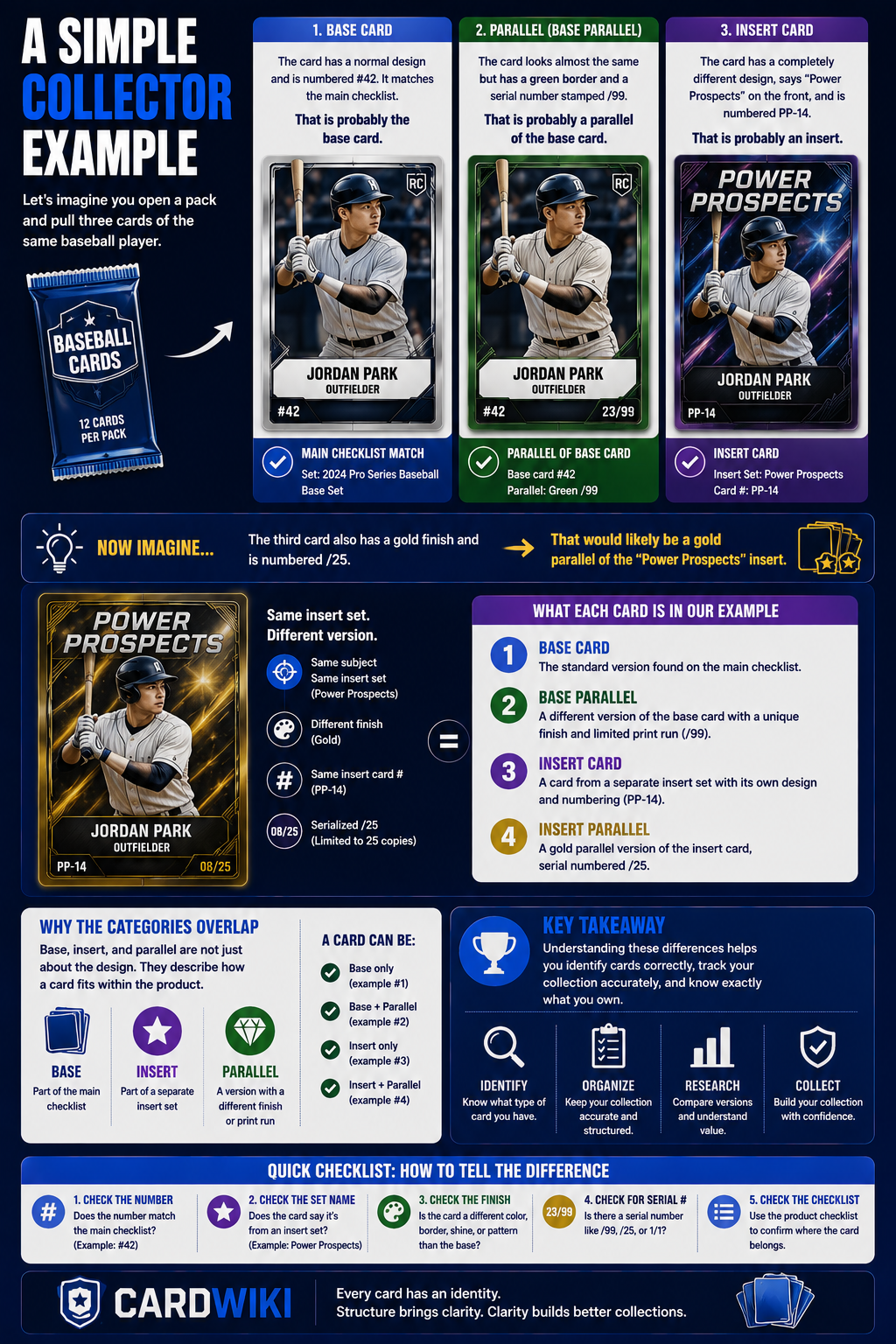
Let’s imagine you open a pack and pull three cards of the same baseball player.
The first card has a normal design and is numbered #42. It matches the main checklist. That is probably the base card.
The second card looks almost the same but has a green border and a serial number stamped /99. That is probably a parallel of the base card.
The third card has a completely different design, says “Power Prospects” on the front, and is numbered PP-14. That is probably an insert.
Now imagine the third card also has a gold finish and is numbered /25. That would likely be a gold parallel of the “Power Prospects” insert.
This example shows why the categories overlap. Base, insert, and parallel are not just about how exciting a card looks. They describe where the card sits in the product’s structure.
Which Type Should You Collect?
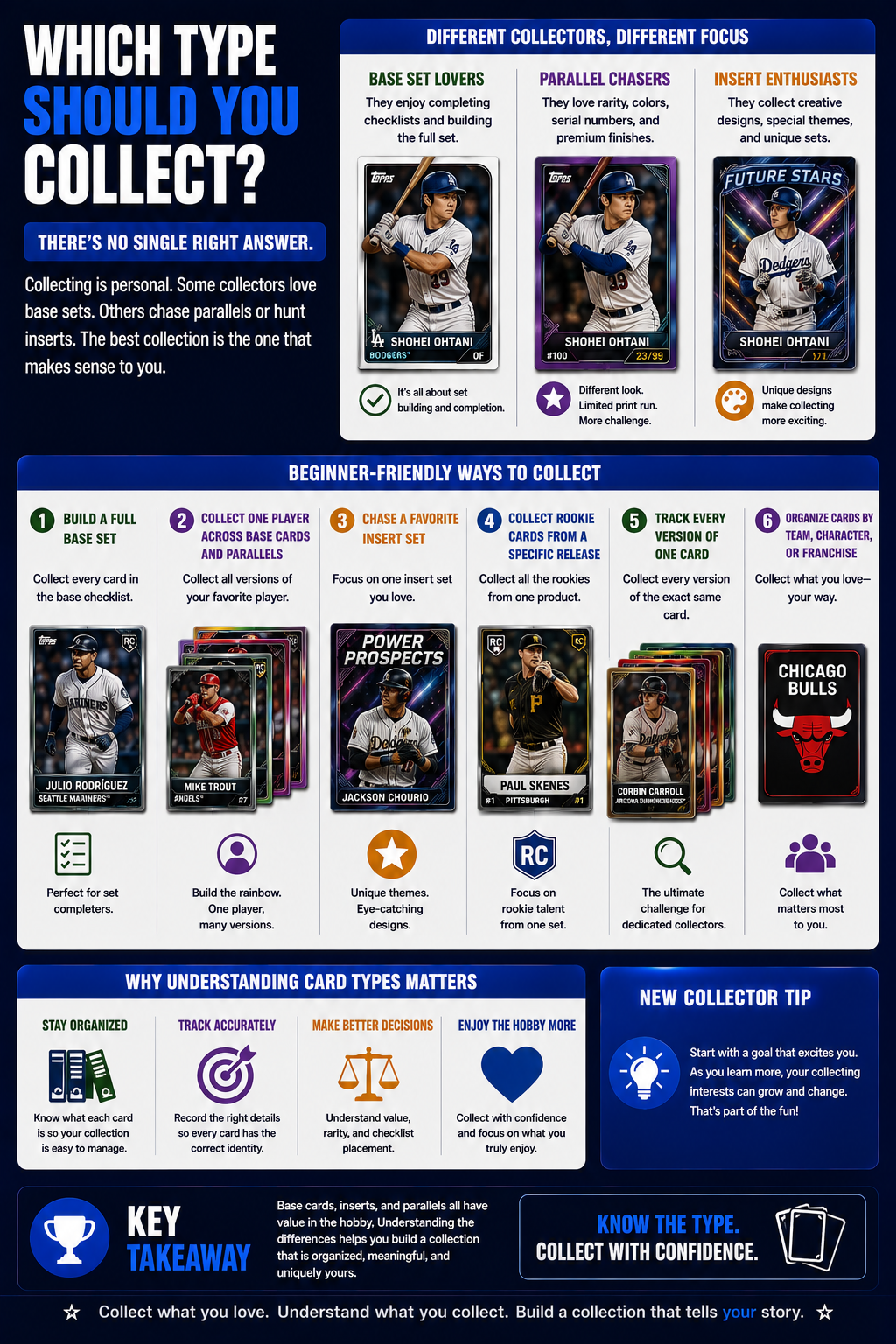
There’s no single right answer.
Some collectors love base sets because they enjoy completing checklists. Others chase parallels because they like rarity, color matching, serial numbers, or premium finishes. Some focus on inserts because they like creative designs or special themes.
A beginner-friendly way to collect is to choose a goal:
- Build A Full Base Set
- Collect One Player Across Base Cards And Parallels
- Chase A Favorite Insert Set
- Collect Rookie Cards From A Specific Release
- Track Every Version Of One Card
- Organize Cards By Team, Character, Or Franchise
The best collection is the one that makes sense to you. The important thing is understanding what each card is so your collection stays organized and meaningful.
Final Thoughts
Base cards, inserts, and parallels are three of the most important building blocks in modern trading card collecting.
A base card belongs to the main checklist. A parallel is a different version of a card, often with a new color, finish, pattern, or serial number. An insert is part of a separate themed checklist inside the product.
Once you understand those differences, packs, checklists, collection apps, and card listings become much easier to read.
You don’t need to memorize every hobby term at once. Start with the structure. Find the main checklist, identify the card number, look for insert names, and compare any special colors or finishes. Over time, base cards, inserts, and parallels will become much easier to recognize.
If you’re trying to understand your cards more clearly, CardWiki can help you explore structured catalog records, compare card identities, and track your collection with more confidence.
FAQs
What Is The Difference Between A Base Card And An Insert Card?
A base card is part of the main checklist. An insert card belongs to a separate themed checklist within the same product.
What Is The Difference Between A Base Card And A Parallel Card?
A base card is the standard version. A parallel card is a different version of that card, often with another color, finish, pattern, or serial number.
Can A Parallel Also Be An Insert?
Yes. Inserts can have parallel versions too. That means a card can be both an insert and a parallel.
Are Base Cards Worth Collecting?
Yes. Base cards are important for set building, rookie collecting, player collections, and understanding the structure of a release.
Are Insert Cards Always Valuable?
No. Some inserts are rare and valuable, while others are common. Design, demand, subject, condition, and scarcity all matter.
Are Parallel Cards Always Numbered?
No. Many parallels are serial numbered, but some are identified only by color, finish, pattern, or product type.
How Can I Tell If My Card Is A Parallel?
Compare it to the regular version in the checklist. Look for a different color, foil, border, pattern, stamp, or serial number.
How Can I Tell If My Card Is An Insert?
Look for a separate insert name, unique design, different numbering format, or checklist section outside the main base set.
Why Do Checklists Matter For Base Cards, Inserts, And Parallels?
Checklists show how a product is organized. They help collectors identify whether a card is base, insert, parallel, variation, or another type of card.