
What We're Building: The CardWiki Public Catalog
A closer look at the CardWiki Public Catalog, why structured card data matters, and how we are building an open reference layer for modern trading cards.
The Trading Card Industry Doesn't Suffer from a Lack of Information
If you've been around the hobby for a while, you know the issue isn't that information is missing.
Checklists exist. Product pages exist. Release calendars exist. Forums, marketplaces, and collector communities fill in a lot of gaps. The issue is structure.
Data is spread across sources, formatted differently, and often inconsistent when you try to line things up across sets, years, manufacturers, and valuation. Naming conventions drift. Parallel hierarchies aren't always clear. Even something as simple as identifying the full scope of a set can require cross-referencing multiple places. You might find a listing on a marketplace, a price on a guide, a cert on a grading company's pop report. Unfortunately, they usually aren’t talking about the same thing in the same language.
Most of us have just learned to live with that. CardWiki is building something to change that.
What We Mean by a "Catalog"
We're not using the word loosely.
A catalog, in this context, is a structured system where each card has a clear identity, each set has a defined structure, and the relationships between cards are consistent and traceable. Think of it as the Wikipedia of the trading card hobby: a place where every card gets a proper identity, grounded in real evidence, maintained by a community that actually cares about getting it right.
Collectors have always relied on some form of cataloging. Printed references, official checklists, and long-standing hobby conventions have served that role for decades. The idea itself isn't new. What's missing is a consistent, open, system-level implementation of it — one built for the scale and complexity of the modern hobby.
What the CardWiki Public Catalog Is
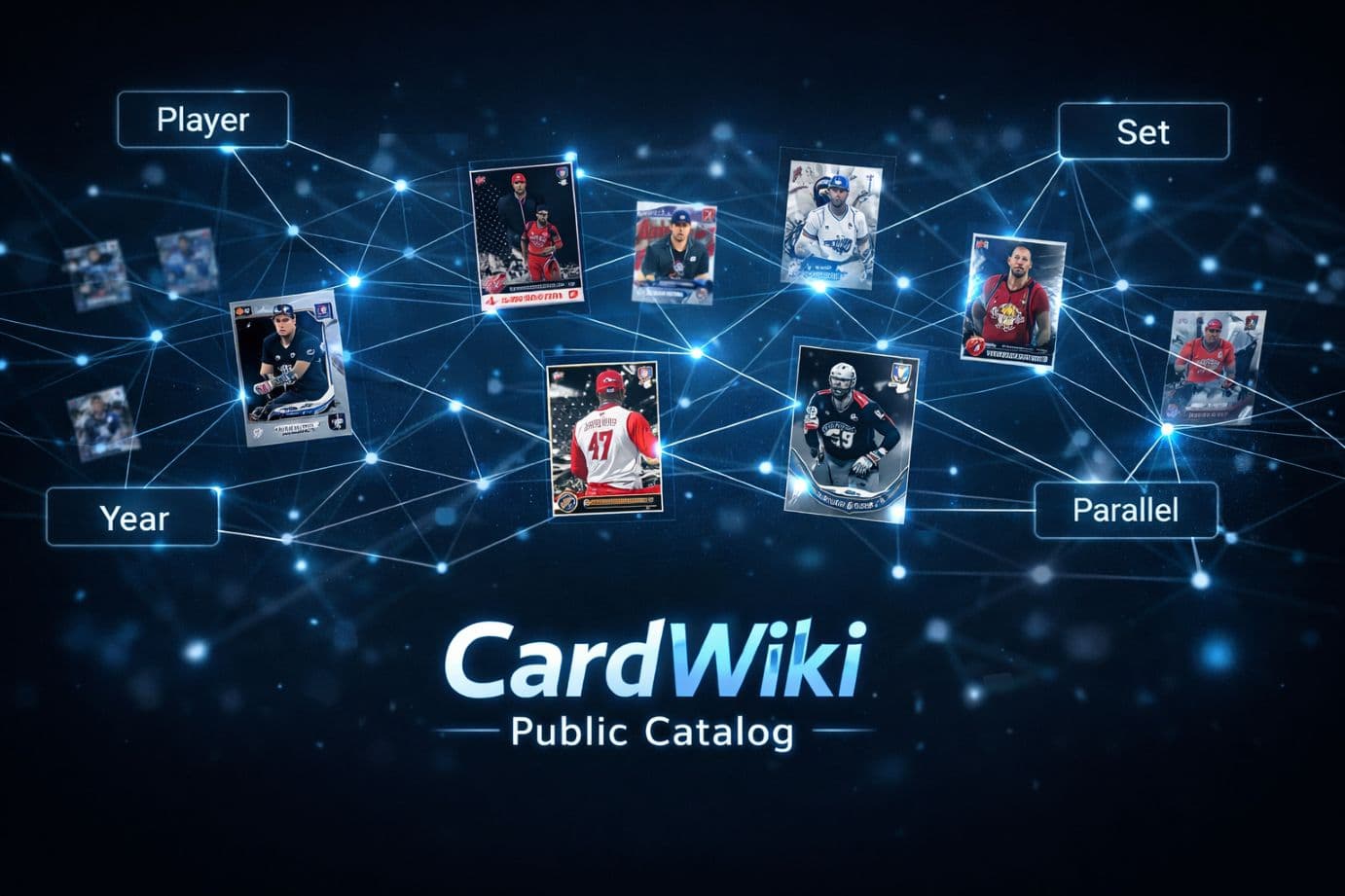
The CardWiki Public Catalog is an attempt to build that structure in a way that holds up across modern collecting. We organize the card universe from the ground up, starting with the way manufacturers actually structure their products — by manufacturer, brand, product family, league, release year, configuration, and the parallel and variant layers that make modern cards so complex and so interesting.
At the core is what we call the CardWiki Canonical ID (CWID): a stable, normalized identity for every unique card where every parallel, every numbered variant, every configuration. Not a listing title, not a search string. An actual identity that resolves cleanly across markets, platforms, and grading companies.
Alongside that, we're building evidence trails by attaching images, sources, checklists, and references to every record so you can see why something is what it is, not just that someone said so. Confidence scores surface where data is well-established versus where it needs more verification. The goal is a catalog where the truth is a trail, not a claim. The public catalog is growing daily. New sets, cards, and player collections are being added on an ongoing basis, and that pace will accelerate as the community grows.
Why Structure Matters at This Stage of the Hobby
The scale of the hobby has changed dramatically.
Modern set releases include large base sets across multiple series, extensive parallel trees, and variations that aren't always obvious without context. The best and rarest cards are limited to certain box types or subsets with overlapping naming conventions across products and years. For experienced collectors, none of this is surprising. But it creates real friction and plenty of confusion, especially for new collectors.
Comparing cards across sets is harder than it should be. Tracking a collection across multiple products takes more effort. Building anything on top of the data requires significant normalization work just to get started. Structure reduces that friction. It doesn't change the cards. It makes the information around them more reliable for you, for the tools you use, and for everyone who comes after.
What You Can Do With a Free Account
Once you create a free CardWiki account, you can start building your private collection immediately — logging what you own, what grade it's in, where it's stored, and what you paid for it. Your holdings are yours. Private by default. No one sees your collection unless you choose to share it.
Beyond personal organization, there's an opportunity to help build something bigger. The hardest part of assembling a card catalog at scale isn't the common stuff. It's the rare parallels, the short prints, the numbered variants that most databases get wrong or skip entirely. We've built a mining rewards system that compensates collectors for the contributions that matter most. When you opt in, your card data helps populate the public catalog, and you earn recognition and rewards for the data points that are hardest to get right.
We’ll be releasing the initial details about the rewards system shortly and early contributors get the most credit. The structure you help build will be visible to every collector who comes after you.
Built in Public, Still in Progress
CardWiki is in public beta, and we want to be upfront about what that means.
Coverage is incomplete in many places. Some structures are still being refined. Data models will continue to evolve as edge cases surface. We're not presenting this as a finished system. We're building it in the open, with the expectation that it improves through use and community contribution.
What that also means is that this is the best possible time to get involved. A structured catalog only works if it reflects how the hobby actually operates — how collectors interpret parallels and variations, how sets are understood in practice and not just on paper, where naming conventions break down or conflict. Early users help surface those realities and we’ll be here to listen. We want to hear your ideas, issues, and needs as trading card collectors.
The goal isn't to impose structure from the outside. It's to build something that aligns with how experienced collectors already think about cards, just in a more consistent and usable format.
The Long-Term Goal: A Universal Open Card Database
The long-term goal is straightforward.
A universal, open database of trading cards that maintains consistent identities across cards and sets, handles the complexity of modern releases without breaking down, and can serve as a reliable reference layer for collectors and tools alike. A shared foundation of structure to an array of authority sources.
The hobby has had foundational references before. They were valuable because they introduced consistency. We think there's room for a modern version of that idea, built digitally, built openly, and built with the ability to evolve as the hobby does.
What You Can Do Now
If you're curious about what we're building: -Create a free account at cardwiki.ai -Explore the catalog as it exists today -Add your cards to your holdings -Opt in to mining rewards and help us build the definitive public trading card database
If you run into inconsistencies, gaps, or anything that doesn't look right, we want to know: support@cardwiki.ai That feedback is part of how this improves. Most experienced collectors already have a system. CardWiki is meant to complement that system — making the data easier to work with and helping you find every card you're looking for. We have a long way to go, and we're glad to be building it with you.
— The CardWiki Team
CardWiki is currently in public beta. New sets, cards, and player collections are being added to the public catalog daily. Features are rolling out on a continuing basis.