
How To Identify A Trading Card: Year, Set, Player, Number, And Variation
Learn how to identify a trading card by checking the year, set, player, card number, and variation so you know exactly what you own.

Learning how to identify a trading card is one of the most important skills in collecting. At first, it sounds easy. You look at the player, check the front, maybe read the back, and assume you know what you have.
Then the hobby gets more complicated. Don't worry, at CardWiki, we're here to help!
Two cards can feature the same player, same photo, same design, and even the same card number, but still be different versions. One might be a base card. Another might be a parallel. Another might be a variation, short print, numbered version, autograph, or patch card. That is where beginners can get stuck.
The good news is that card identification gets much easier when you know what to check, after you've covered the basics on how to start collecting trading cards. You do not need to guess. You need a simple process.
The five big pieces are:
- Year
- Set
- Player
- Card Number
- Variation
- (Prices matter, too)
Once those details are clear, you can understand what card you own, how it fits into the release, and how to track it correctly.
Why Trading Card Identification Matters
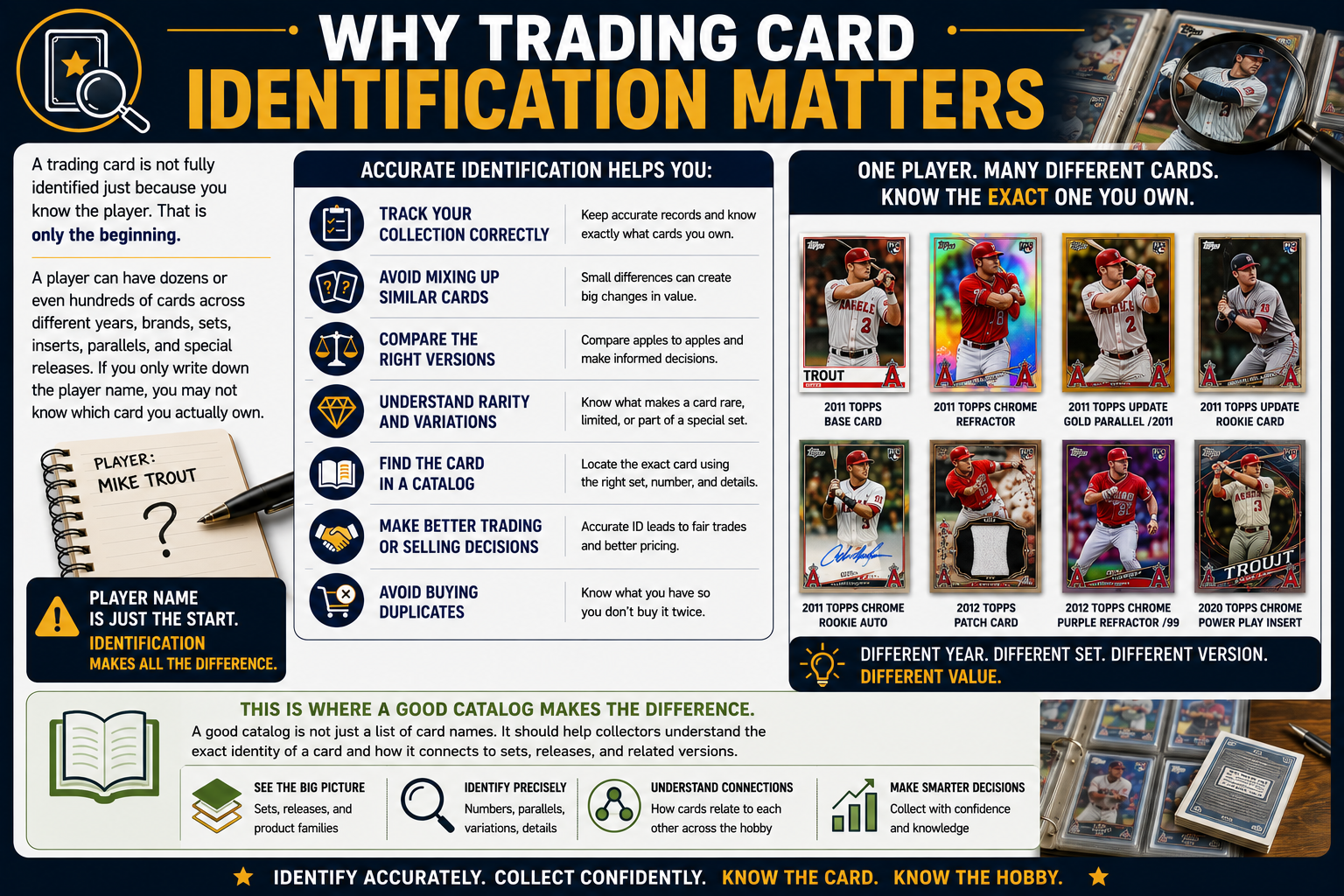
A trading card is not fully identified just because you know the player. That is only the beginning.
A player can have dozens or even hundreds of cards across different years, brands, sets, inserts, parallels, and special releases. If you only write down the player name, you may not know which card you actually own.
Accurate identification helps you:
- Track Your Collection Correctly
- Avoid Mixing Up Similar Cards
- Compare The Right Versions
- Understand Rarity And Variations
- Find The Card In A Catalog
- Make Better Trading Or Selling Decisions
- Avoid Buying Duplicates
This is also where CardWiki’s catalog purpose comes in. A good catalog is not just a list of card names. It should help collectors understand the exact identity of a card and how it connects to sets, releases, and related versions.
Start With The Player
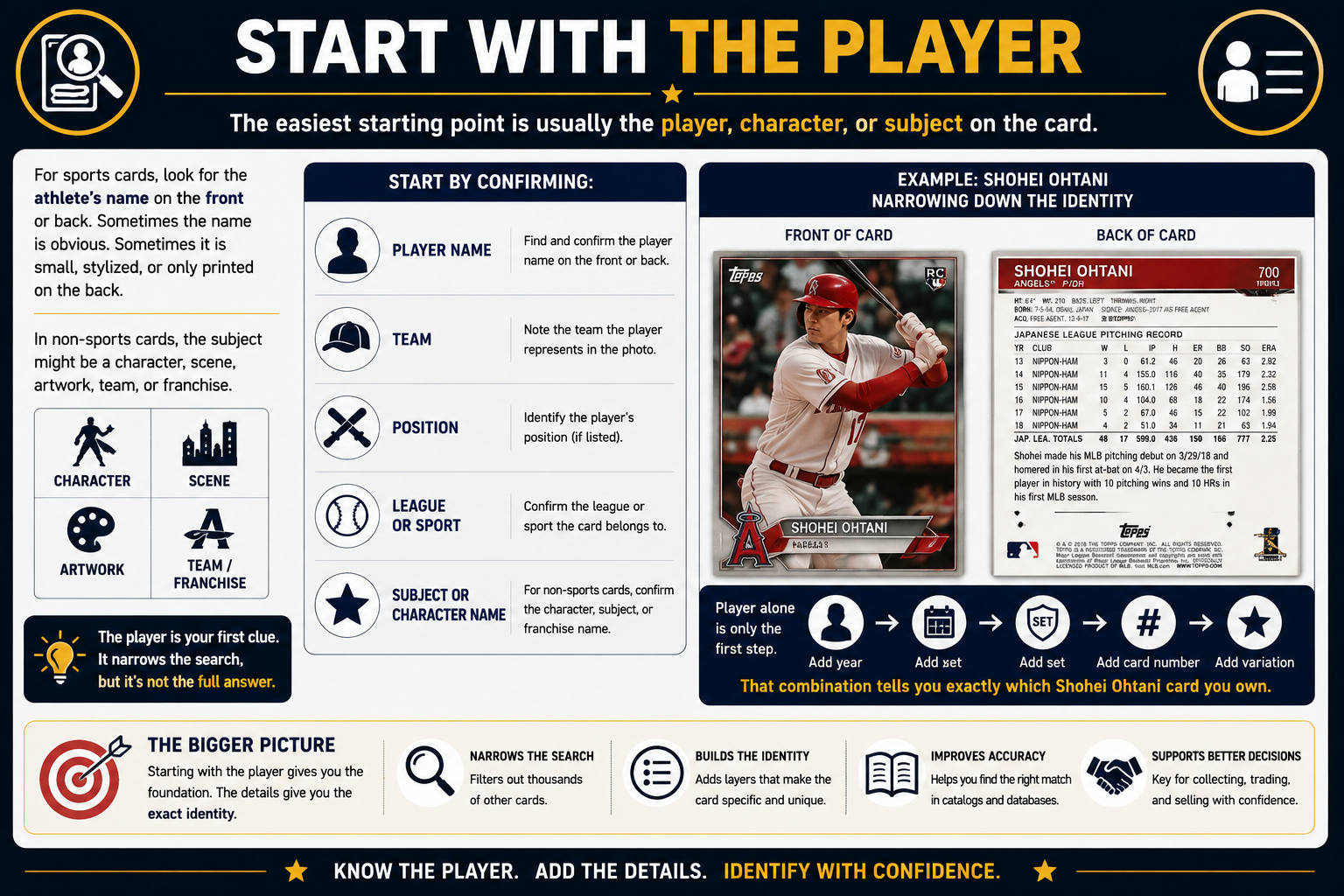
The easiest starting point is usually the player, character, or subject on the card.
For sports cards, look for the athlete’s name on the front or back. Sometimes the name is obvious. Sometimes it is small, stylized, or only printed on the back. In non-sports cards, the subject might be a character, scene, artwork, team, or franchise.
Start by confirming:
- Player Name
- Team
- Position
- League Or Sport
- Subject Or Character Name
This gives you the first layer of identity. It narrows your search, but it does not finish the job.
For example, knowing you have a Shohei Ohtani card is helpful. Knowing the year, set, card number, and variation is what tells you which Shohei Ohtani card you own.
Find The Year
The year is usually one of the most important clues.
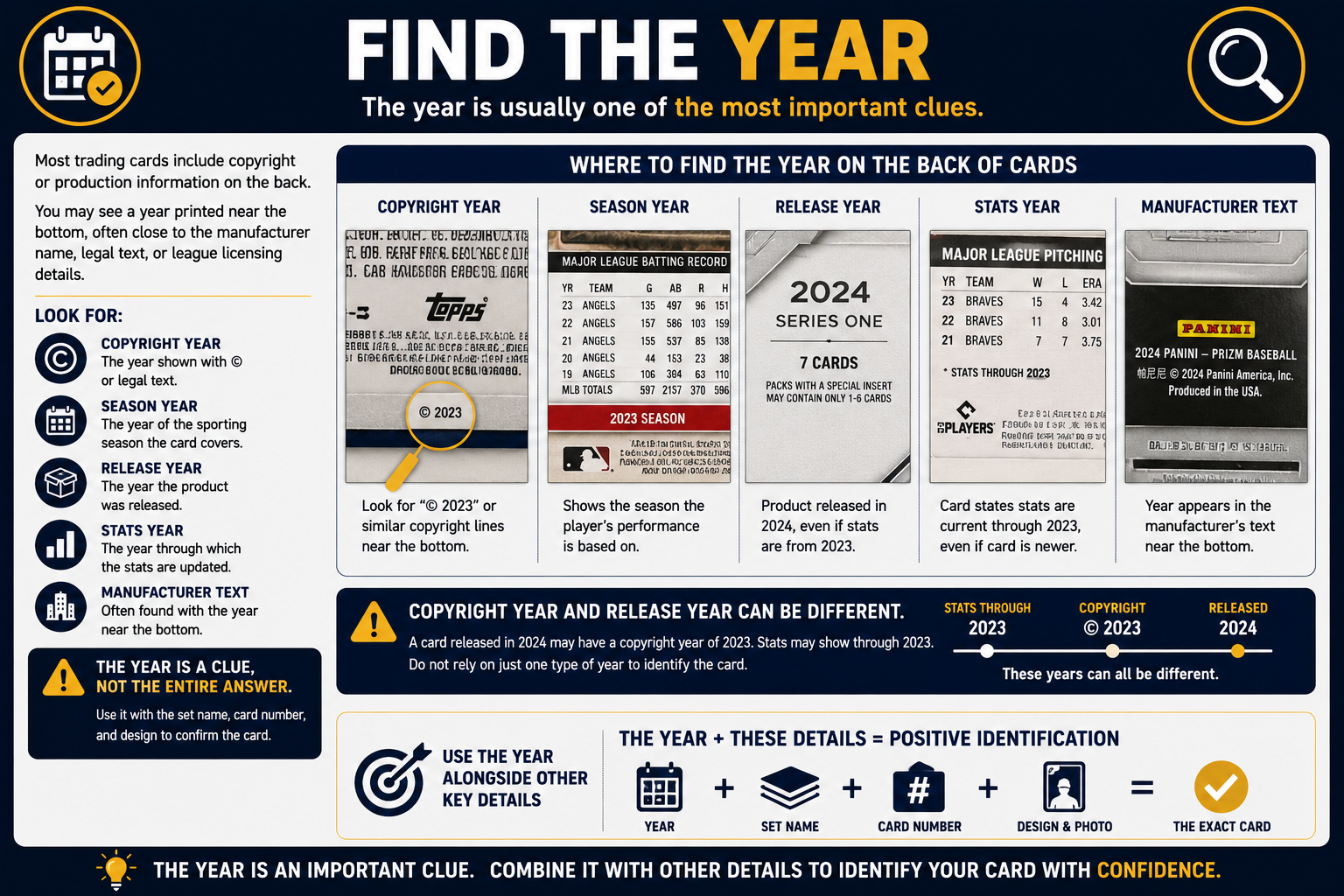
Most trading cards include copyright or production information on the back. You may see a year printed near the bottom, often close to the manufacturer name, legal text, or league licensing details.
Look for:
- Copyright Year
- Season Year
- Release Year
- Stats Year
- Manufacturer Text
Be careful here. The copyright year and the card’s release year can sometimes feel confusing. A card released for a 2024 product may include stats through 2023, or a copyright line that does not perfectly match what a beginner expects.
That is why the year is a clue, not the entire answer.
Use the year alongside the set name, card number, and design. Together, those details will help confirm the card.
Identify The Set
The set tells you where the card belongs.
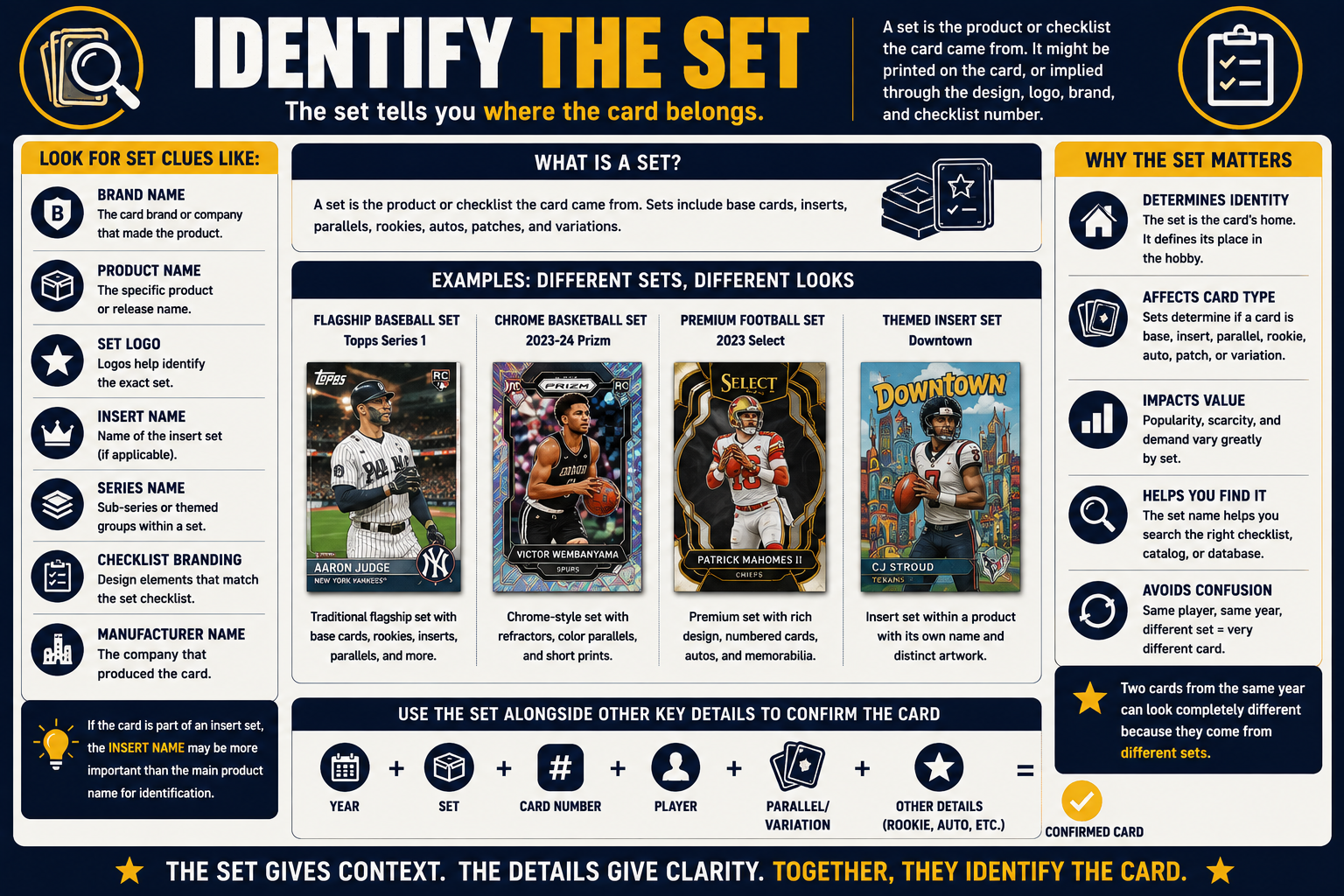
A set is the product or checklist the card came from. It might be printed clearly on the front or back, or it might be implied through the design, logo, brand, and checklist number.
Look for set clues like:
- Brand Name
- Product Name
- Set Logo
- Insert Name
- Series Name
- Checklist Branding
- Manufacturer Name
Examples might include a flagship baseball set, a chrome-style basketball release, a premium football product, or a themed insert set inside a larger product.
This matters because two cards from the same year can look very different depending on the set. It also matters because the set often determines whether the card is base, insert, parallel, rookie, auto, patch, or variation.
If the card is part of an insert set, the insert name may be more important than the main product name for identification.
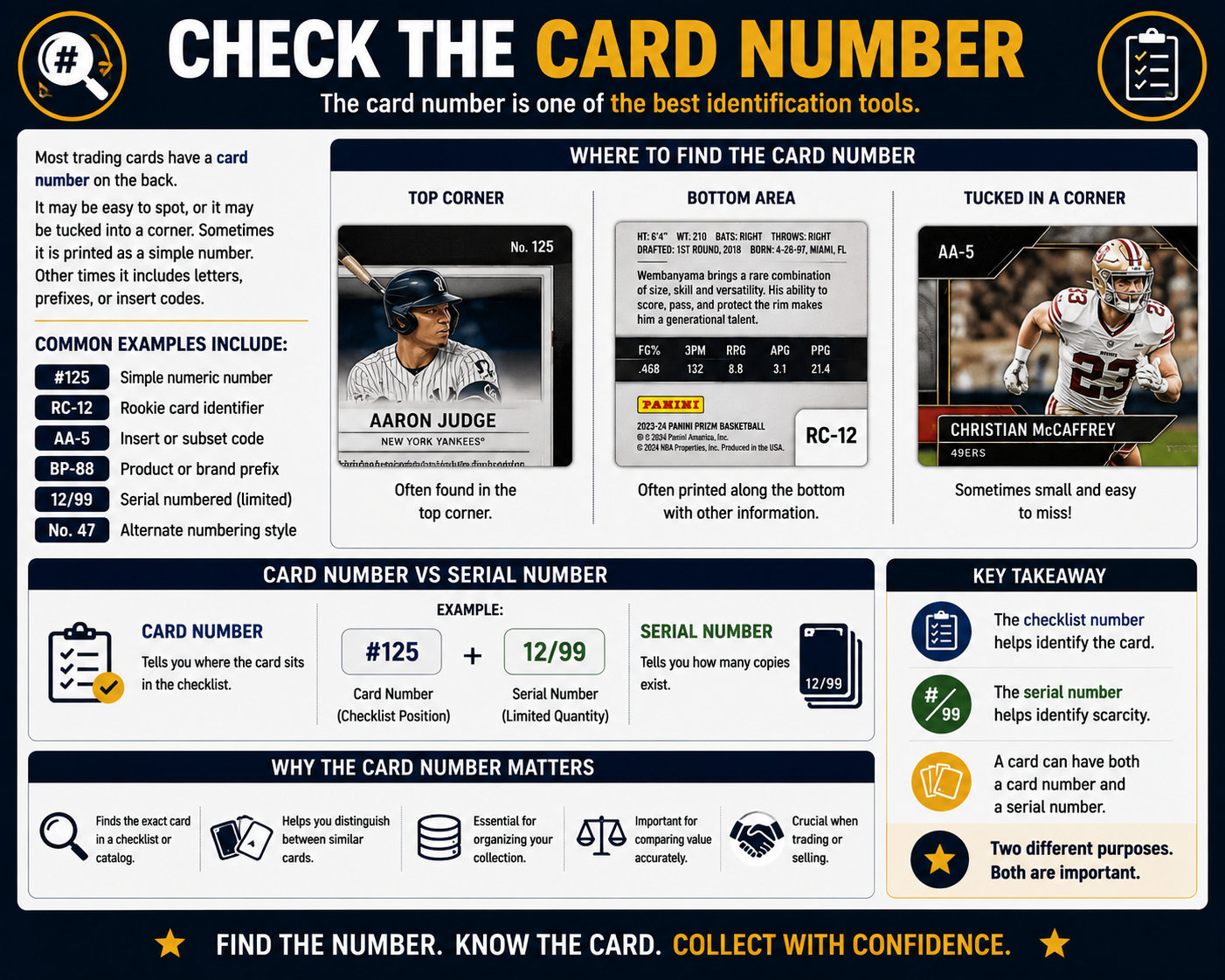
Check The Card Number
The card number is one of the best identification tools.
Most trading cards have a card number on the back. It may be easy to spot, or it may be tucked into a corner. Sometimes it is printed as a simple number. Other times it includes letters, prefixes, or insert codes.
Common examples include:
- #125
- RC-12
- AA-5
- BP-88
- 12/99
- No. 47
There is an important difference between a card number and a serial number.
The card number tells you where the card sits in the checklist. The serial number tells you how many copies exist.
For example:
- Card Number: #125
- Serial Number: 12/99
Those are not the same thing. A card can have both.
The checklist number helps identify the card. The serial number helps identify scarcity.
Check Whether The Card Is Base Or Insert
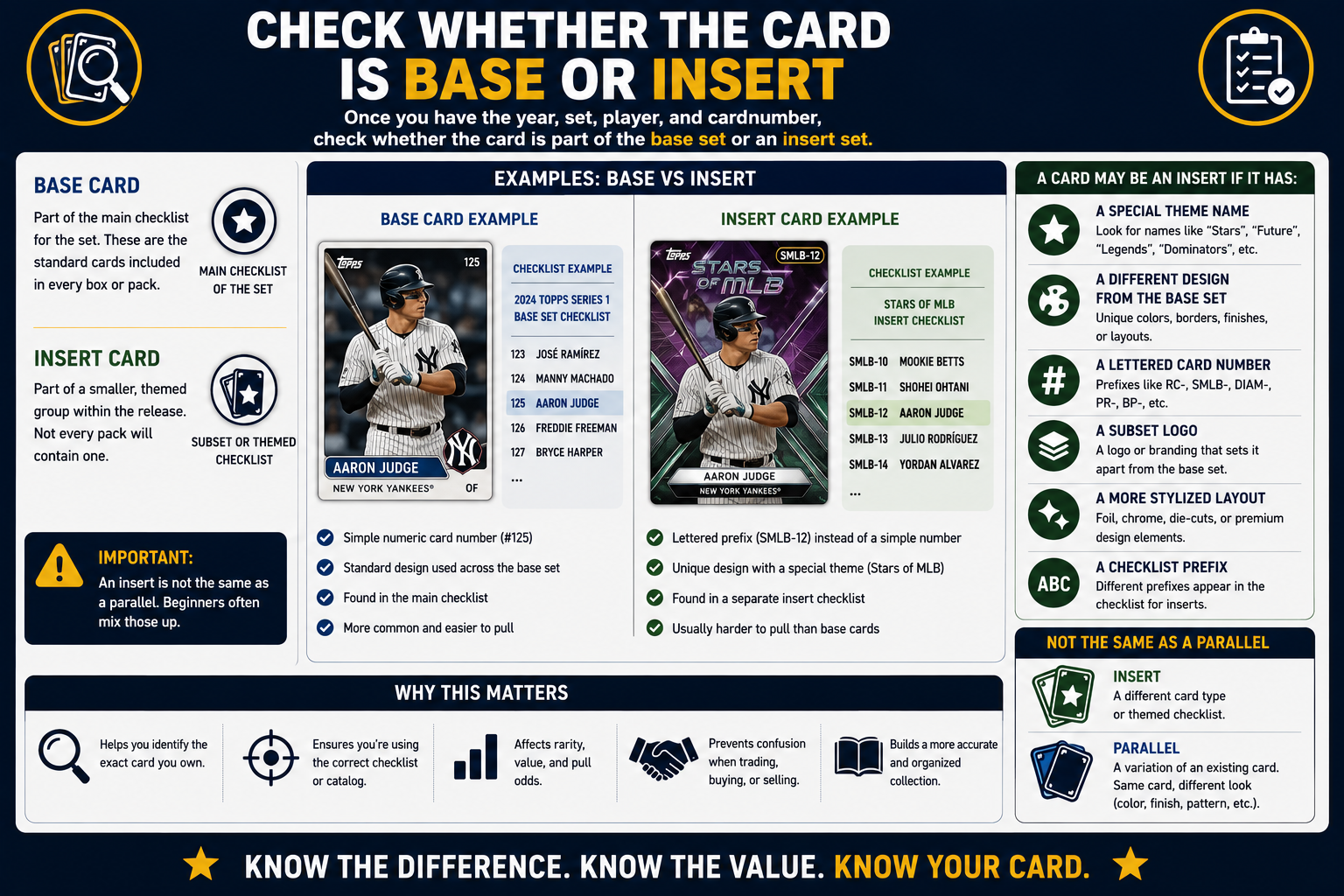
Once you have the year, set, player, and card number, check whether the card is part of the base set or an insert set.
A base card is usually part of the main checklist. An insert card is usually part of a smaller themed group within the release.
Base cards often have simple checklist numbers, while inserts may use special prefixes, names, or designs.
A card may be an insert if it has:
- A Special Theme Name
- A Different Design From The Base Set
- A Lettered Card Number
- A Subset Logo
- A More Stylized Layout
- A Checklist Prefix
This matters because an insert is not the same as a parallel. Beginners often mix those up.
An insert is a different card type or themed checklist. A parallel is usually a variation of an existing card.
Look For Parallels
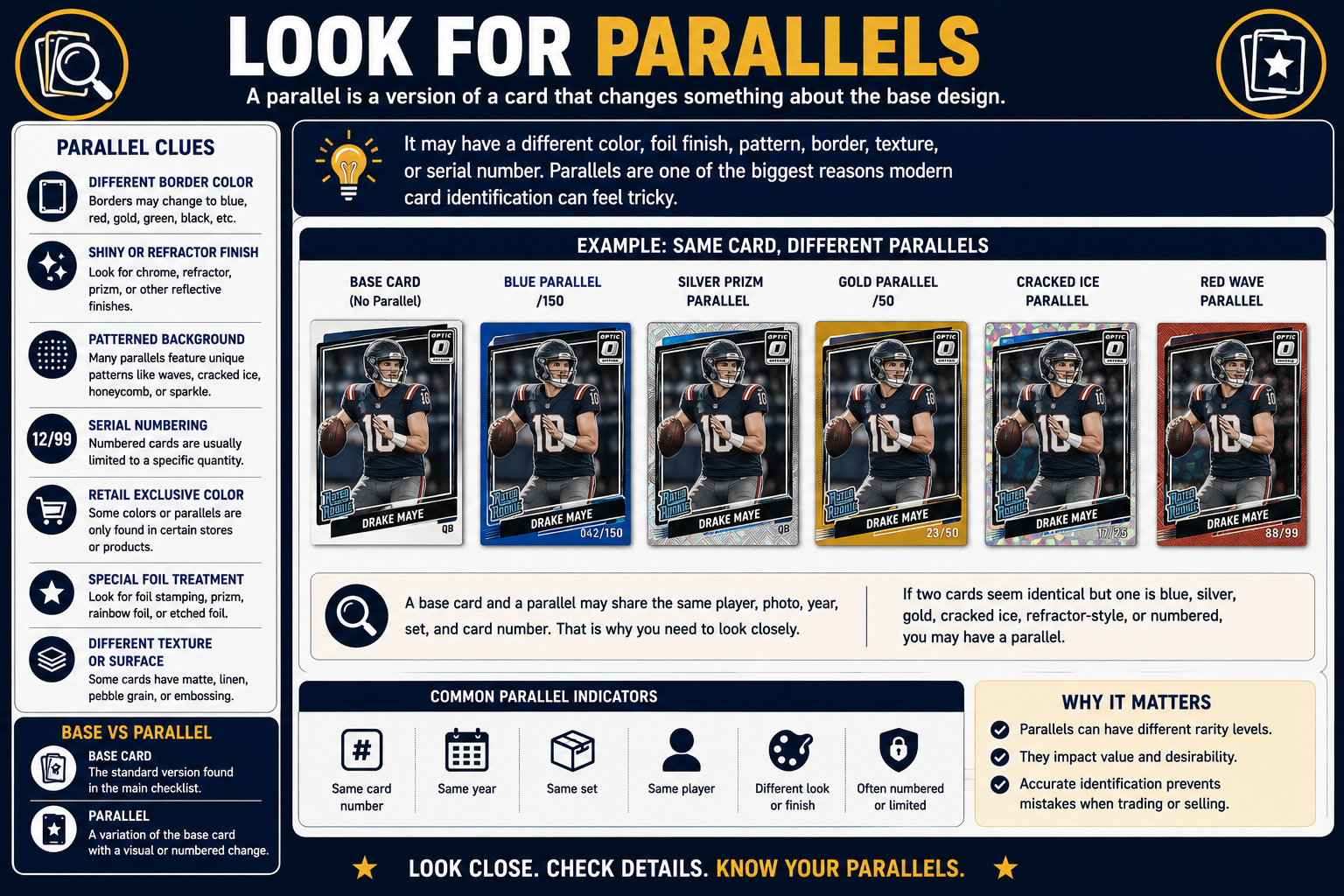
A parallel is a version of a card that changes something about the base design.
It may have a different color, foil finish, pattern, border, texture, or serial number. Parallels are one of the biggest reasons modern card identification can feel tricky.
Look for parallel clues like:
- Different Border Color
- Shiny Or Refractor Finish
- Patterned Background
- Serial Numbering
- Retail Exclusive Color
- Special Foil Treatment
- Different Texture Or Surface
A base card and a parallel may share the same player, photo, year, set, and card number. That is why you need to look closely.
If two cards seem identical but one is blue, silver, gold, cracked ice, refractor-style, or numbered, you may have a parallel.
Check For Serial Numbering
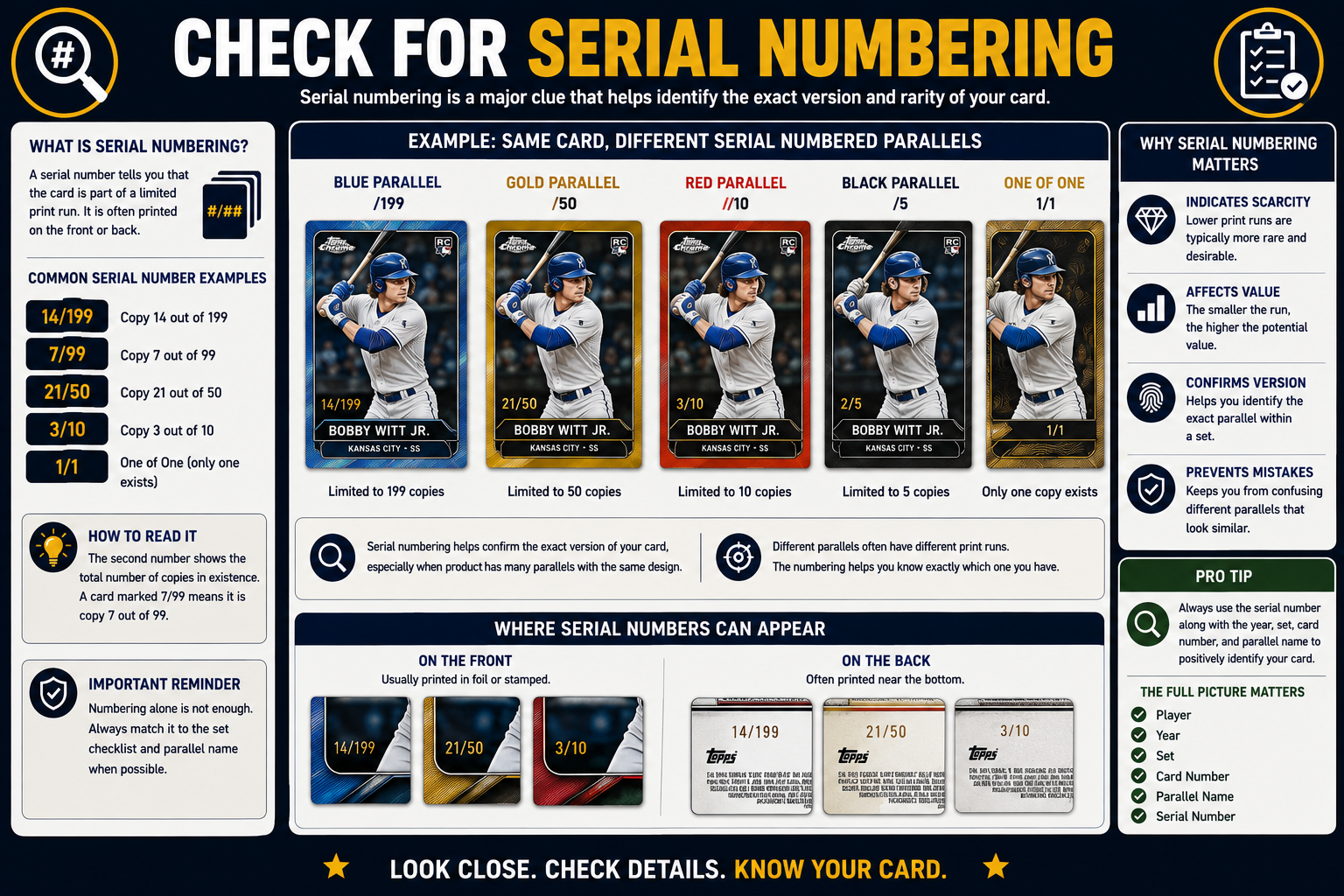
Serial numbering is a major clue.
A serial number tells you that the card is part of a limited print run. It is often printed on the front or back and may look like this:
- 14/199
- 7/99
- 21/50
- 3/10
- 1/1
The second number tells you the total number of copies. A card marked 7/99 means it is copy 7 out of 99.
Serial numbering can help identify the exact version, especially when a product has many parallels. A gold parallel might be /10, while a blue parallel might be /199. The numbering helps confirm which one you have.
Still, numbering alone is not enough. You should match it to the set checklist and parallel name when possible.
Look For Variations
Variations are one of the most confusing parts of card identification.
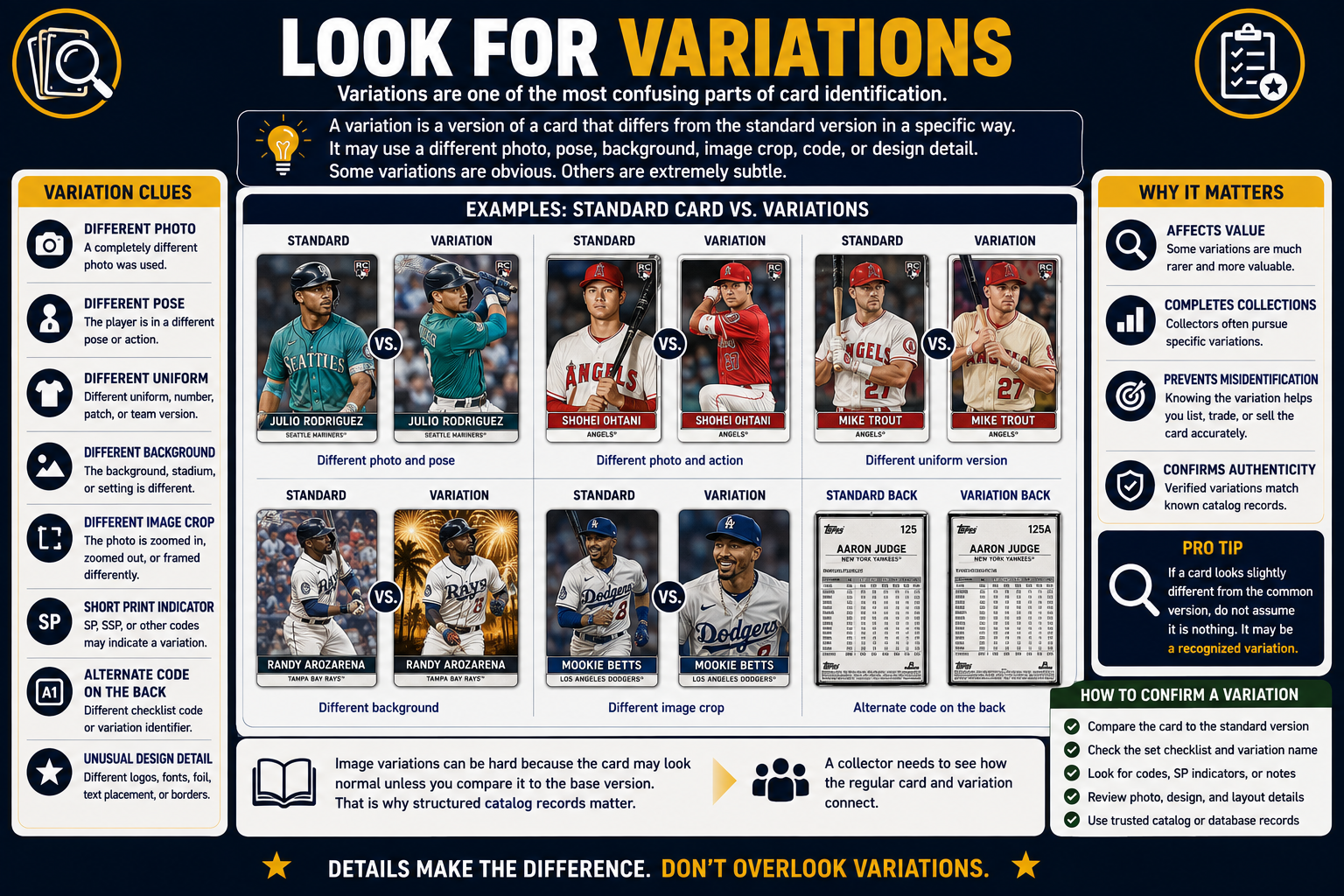
A variation is a version of a card that differs from the standard version in a specific way. It may use a different photo, pose, background, image crop, code, or design detail. Some variations are obvious. Others are extremely subtle.
Variation clues may include:
- Different Photo
- Different Pose
- Different Uniform
- Different Background
- Different Image Crop
- Short Print Indicator
- Alternate Code On The Back
- Unusual Design Detail
Image variations can be hard because the card may look normal unless you compare it to the base version. That is why structured catalog records matter. A collector needs to see how the regular card and variation connect.
If a card looks slightly different from the common version, do not assume it is nothing. It may be a recognized variation.
Check For Rookie Symbols
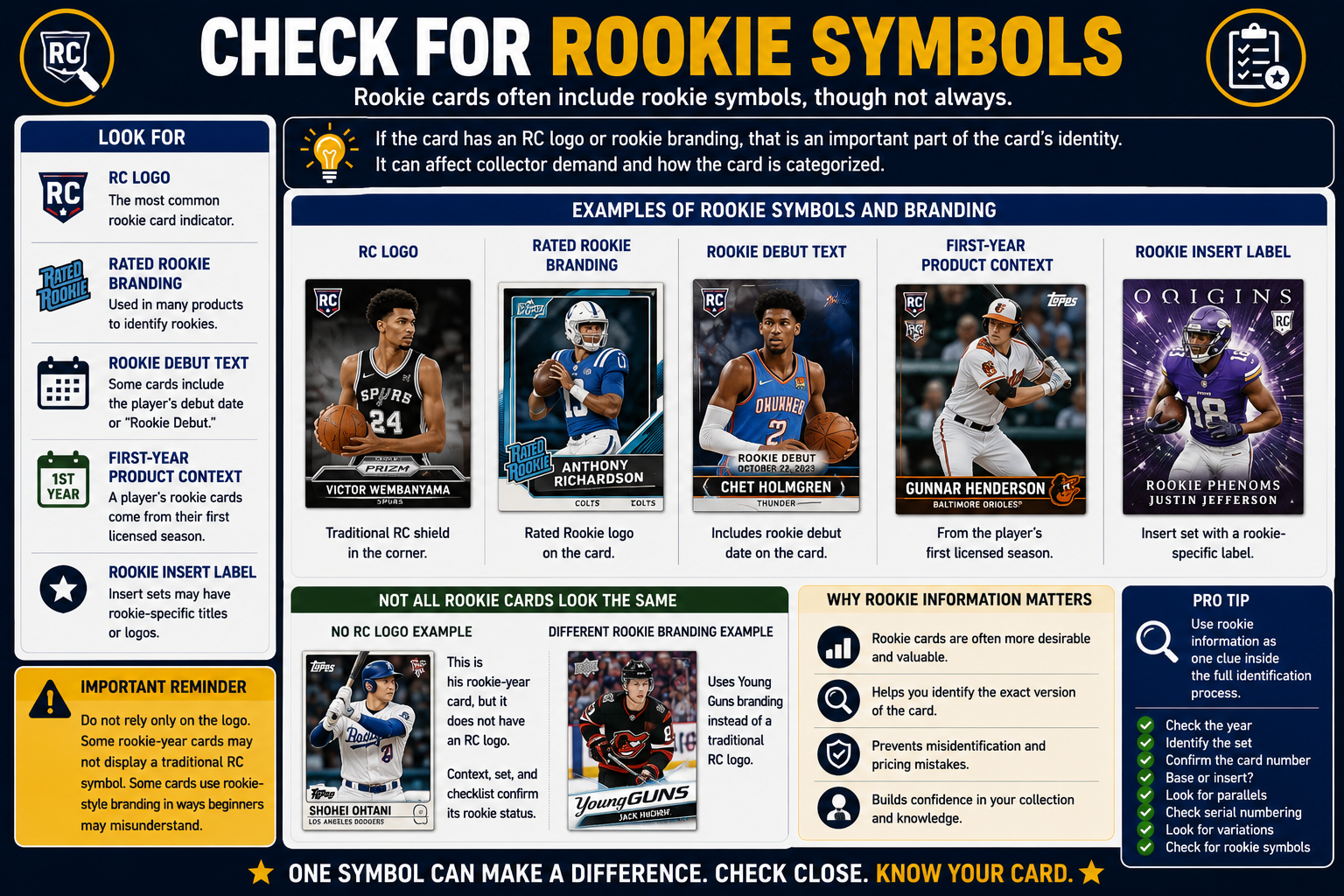
Rookie cards often include rookie symbols, though not always.
If the card has an RC logo or rookie branding, that is an important part of the card’s identity. It can affect collector demand and how the card is categorized.
Look for:
- RC Logo
- Rated Rookie Branding
- Rookie Debut Text
- First-Year Product Context
- Rookie Insert Label
That said, do not rely only on the logo. Some rookie-year cards may not display a traditional RC symbol, while some cards use rookie-style branding in ways beginners may misunderstand.
Use rookie information as one clue inside the full identification process.
Check For Autographs And Patch Details
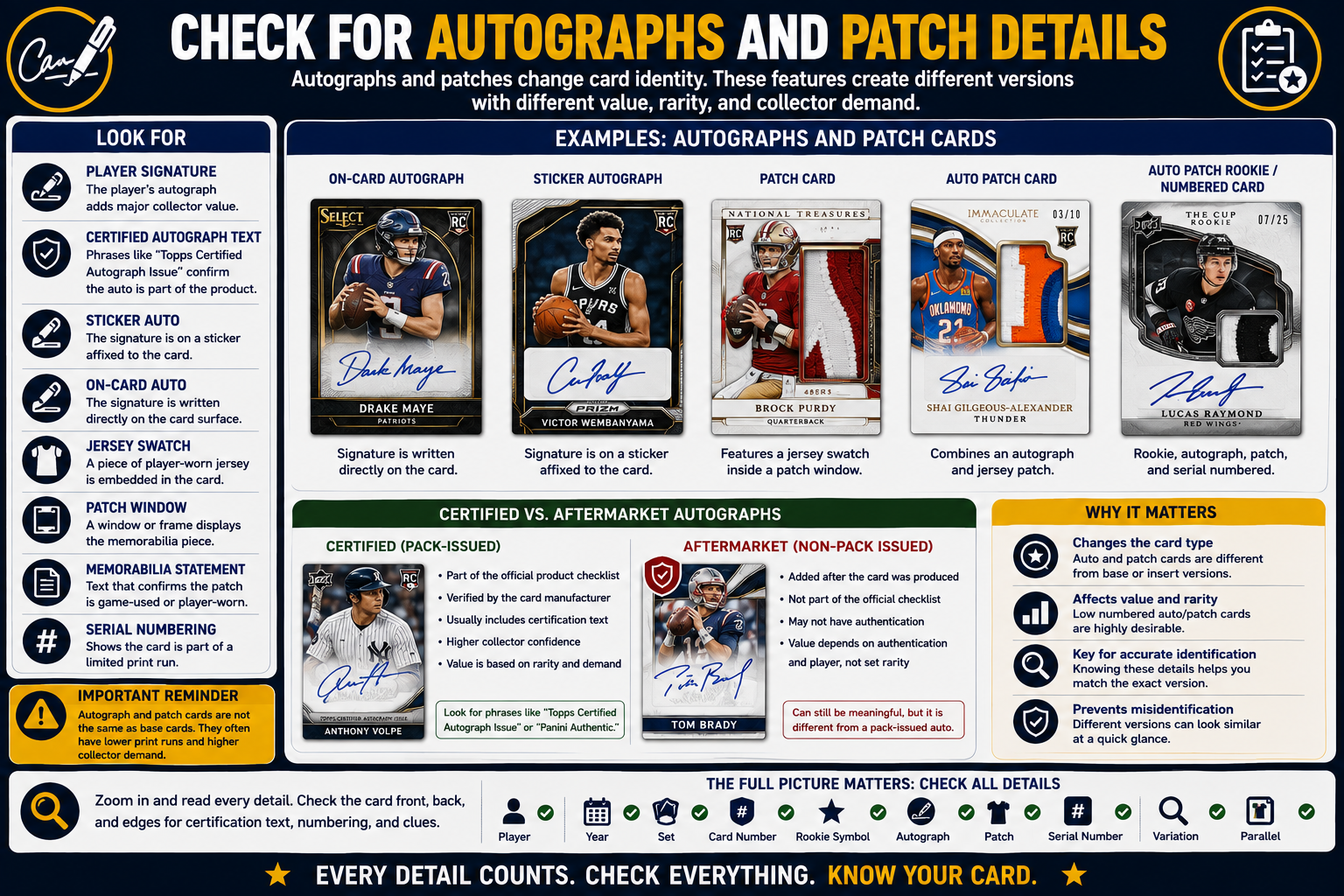
Autographs and patches change card identity.
An autograph card is not the same as the unsigned version. A patch card is not the same as the standard base card. A card that combines rookie status, autograph, memorabilia, and a low serial number may be a very different collectible from the regular version.
Look for:
- Player Signature
- Certified Autograph Text
- Sticker Auto
- On-Card Auto
- Jersey Swatch
- Patch Window
- Memorabilia Statement
- Serial Numbering
Also check whether the autograph is certified by the card manufacturer or added later. Certified autos are usually part of the product checklist. Aftermarket signatures can still be meaningful, but they are different from pack-issued autograph cards.
Use The Back Of The Card
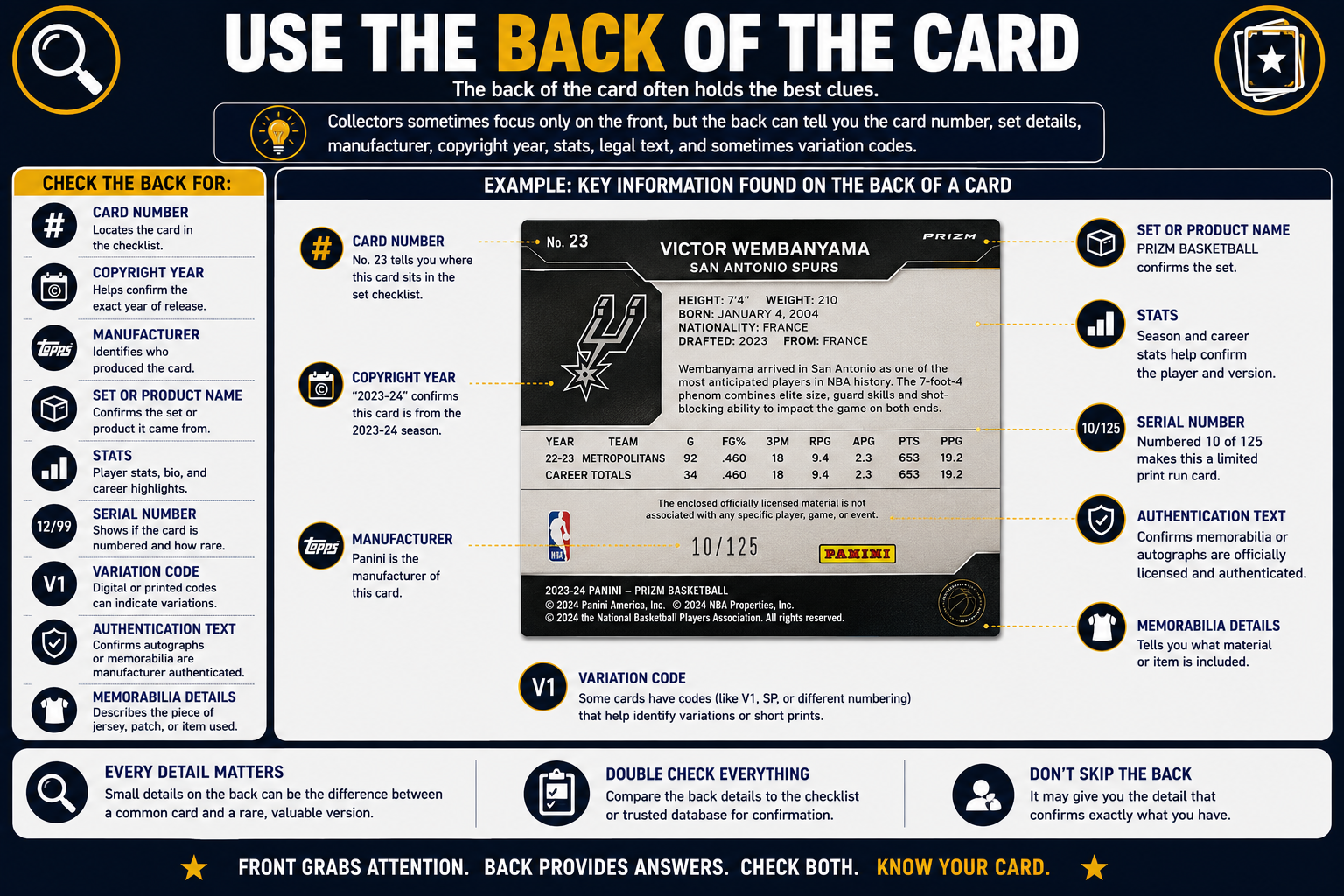
The back of the card often holds the best clues.
Collectors sometimes focus only on the front, but the back can tell you the card number, set details, manufacturer, copyright year, stats, legal text, and sometimes variation codes.
Check the back for:
- Card Number
- Copyright Year
- Manufacturer
- Set Or Product Name
- Stats
- Serial Number
- Variation Code
- Authentication Text
- Memorabilia Details
If you are trying to identify a card, do not skip the back. It may give you the detail that confirms exactly what you have.
Compare Against A Trusted Catalog
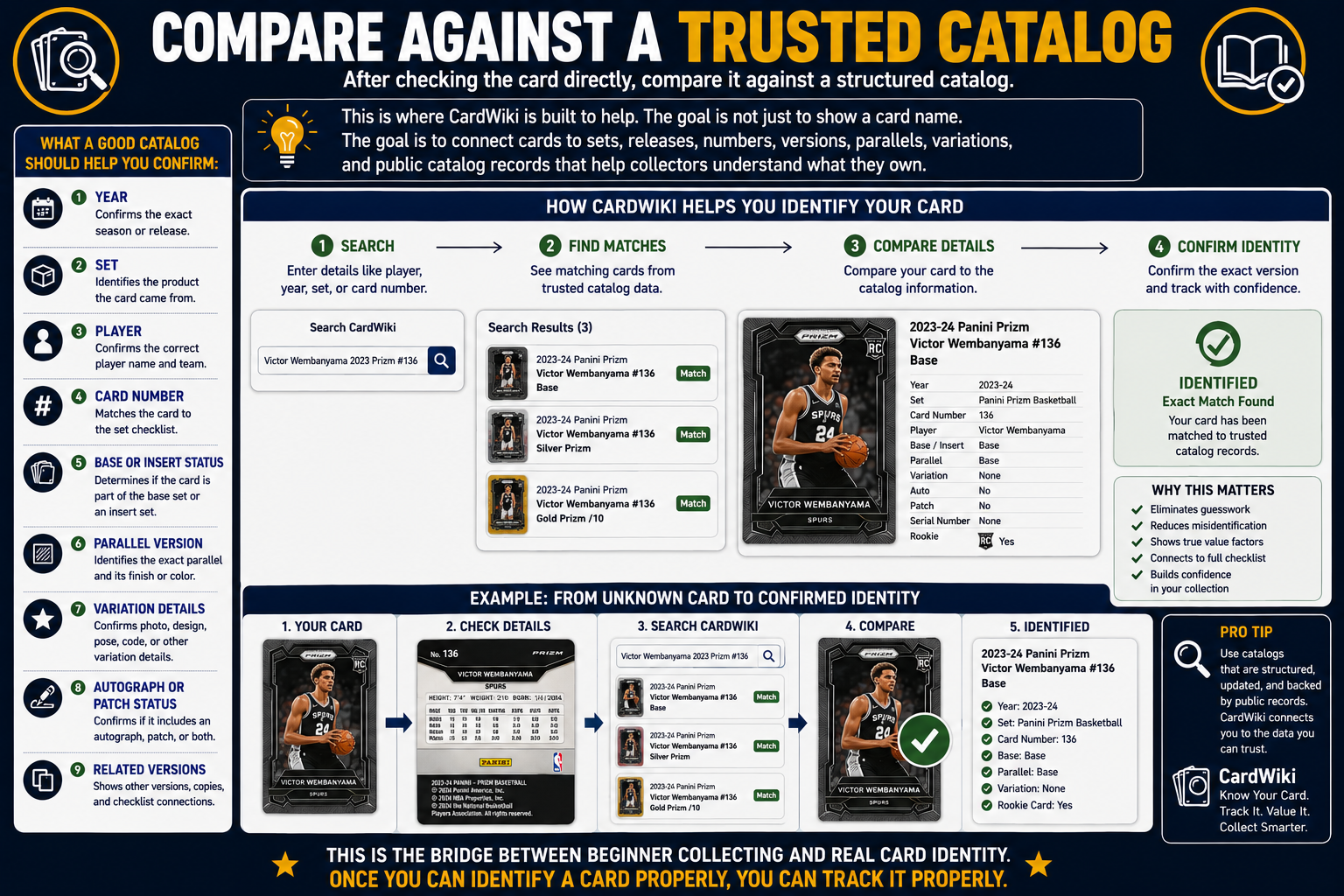
After checking the card directly, compare it against a structured catalog.
This is where CardWiki is built to help. The goal is not just to show a card name. The goal is to connect cards to sets, releases, numbers, versions, parallels, variations, and public catalog records that help collectors understand what they own.
A good catalog should help you confirm:
- Year
- Set
- Player
- Card Number
- Base Or Insert Status
- Parallel Version
- Variation Details
- Autograph Or Patch Status
- Related Versions
This is the bridge between beginner collecting and real card identity. Once you can identify a card properly, you can track it properly.
A Simple Trading Card Identification Checklist
Use this process when you are trying to identify a card.
- Find The Player Or Subject
- Check The Team, Sport, Or Franchise
- Look For The Year
- Identify The Set Or Product
- Find The Card Number
- Check Whether It Is Base Or Insert
- Look For Parallel Colors Or Finishes
- Check For Serial Numbering
- Look For Rookie Symbols
- Check For Autographs Or Patch Details
- Compare The Front And Back
- Look For Variation Clues
- Confirm It In A Structured Catalog
- Track It In Your Collection
You do not need to solve every card instantly. The goal is to build a repeatable process.
Common Beginner Mistakes When Identifying Cards
Most collectors make mistakes early. That is normal.
Common mistakes include:
- Identifying A Card Only By Player Name
- Ignoring The Card Number
- Confusing A Serial Number With A Card Number
- Missing A Parallel
- Confusing Inserts With Parallels
- Assuming Every Rookie Logo Means Major Value
- Forgetting To Check The Back
- Treating Similar Cards As The Same Version
- Not Comparing Against A Checklist
- Not Tracking The Final Identification
The biggest mistake is rushing. A card that looks obvious at first can turn out to be a different version once you check the details.
Why Card Identity Matters For Your Collection
Card identity is the difference between “I have a LeBron card” and “I know exactly which LeBron card I own.”
When you know the exact card identity, you can organize your collection better, avoid duplicates, compare versions, research value, submit corrections, and understand where your card fits inside the hobby.
A clear card identity also makes your collection more useful over time. Instead of random stacks, you have structured records. Instead of guessing, you have context.
That is what a real trading card catalog should make easier.
Final Thoughts
Learning how to identify a trading card is one of the best beginner skills you can build before you dive into grading and other elements.
Start with the basics: year, set, player, number, and variation. Then look deeper for parallels, serial numbering, inserts, rookie symbols, autos, patches, and card-back details.
The more you practice, the easier it gets. You will start noticing small details that used to slip by. You will understand why similar-looking cards are not always the same. You will become more confident in what you own.
CardWiki exists for that exact reason: to help collectors understand cards clearly, track them accurately, and connect their collections to a structured catalog built for the way the hobby actually works.
If you are trying to identify your cards, CardWiki is a trading card database app that can help you explore the catalog, understand versions, and track your collection with more confidence.
FAQs
How Do I Identify A Trading Card?
Start with the player, year, set, card number, and variation. Then check for parallels, serial numbering, rookie symbols, autographs, patches, and card-back details.
Where Is The Card Number On A Trading Card?
The card number is usually on the back of the card, often near the corner or bottom. It may be a simple number or include letters.
How Do I Know What Set My Card Is From?
Check the card design, back text, logo, manufacturer, year, and card number. Comparing it to a structured catalog can help confirm the set.
What Is The Difference Between A Card Number And A Serial Number?
A card number identifies the card’s place in the checklist. A serial number shows how many copies of that version exist.
How Do I Know If My Card Is A Parallel?
Compare it to the base version. Look for different colors, foil, patterns, finishes, retail-exclusive designs, or serial numbering.
How Do I Know If My Card Is A Variation?
Look for a different photo, pose, background, image crop, code, or other design detail compared to the standard version.
Why Does The Back Of The Card Matter?
The back often includes the card number, year, manufacturer, set clues, stats, variation codes, serial numbering, and authentication details.
Can CardWiki Help Me Identify My Cards?
Yes. CardWiki helps collectors connect cards to structured catalog records, sets, releases, versions, and collection tracking.


