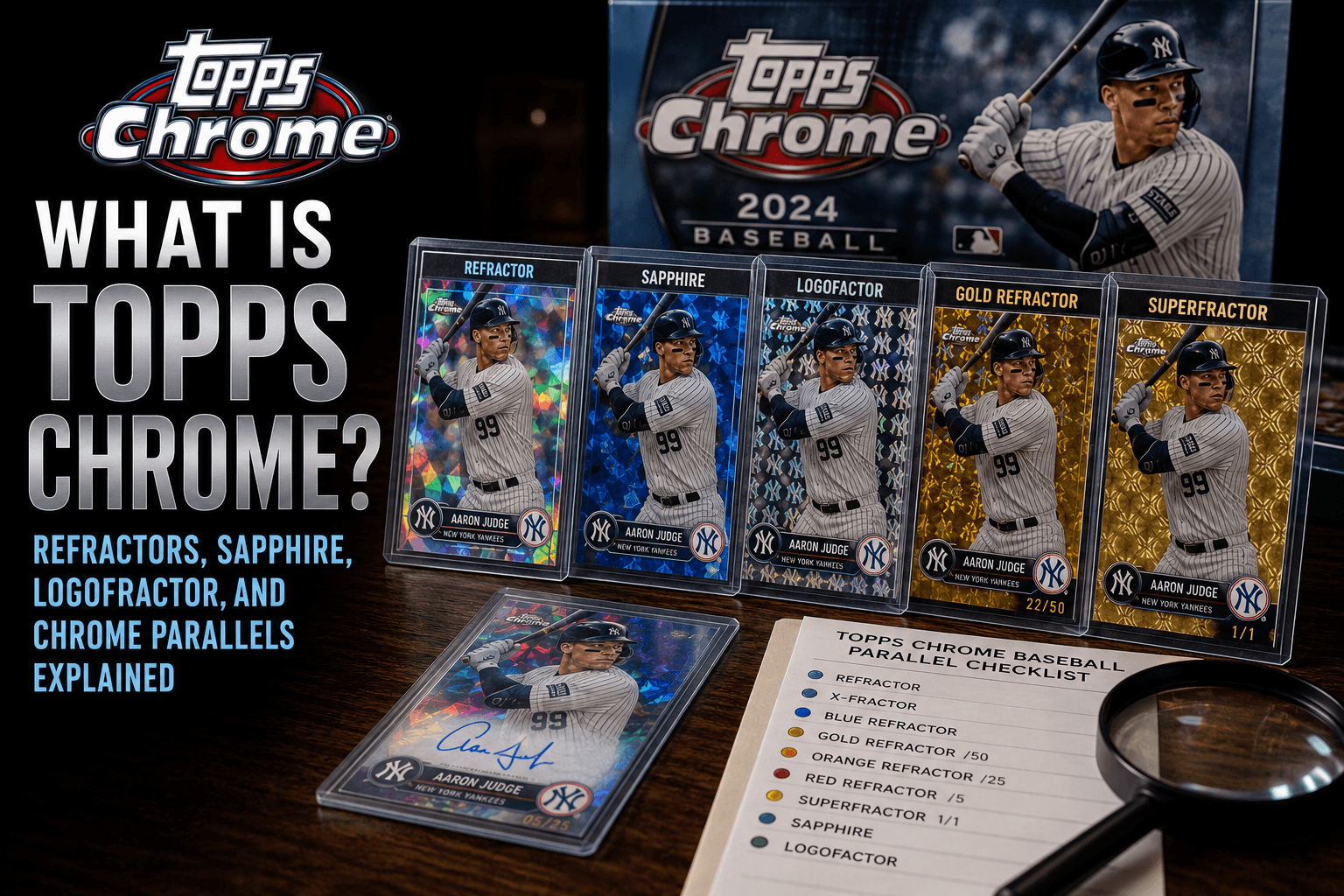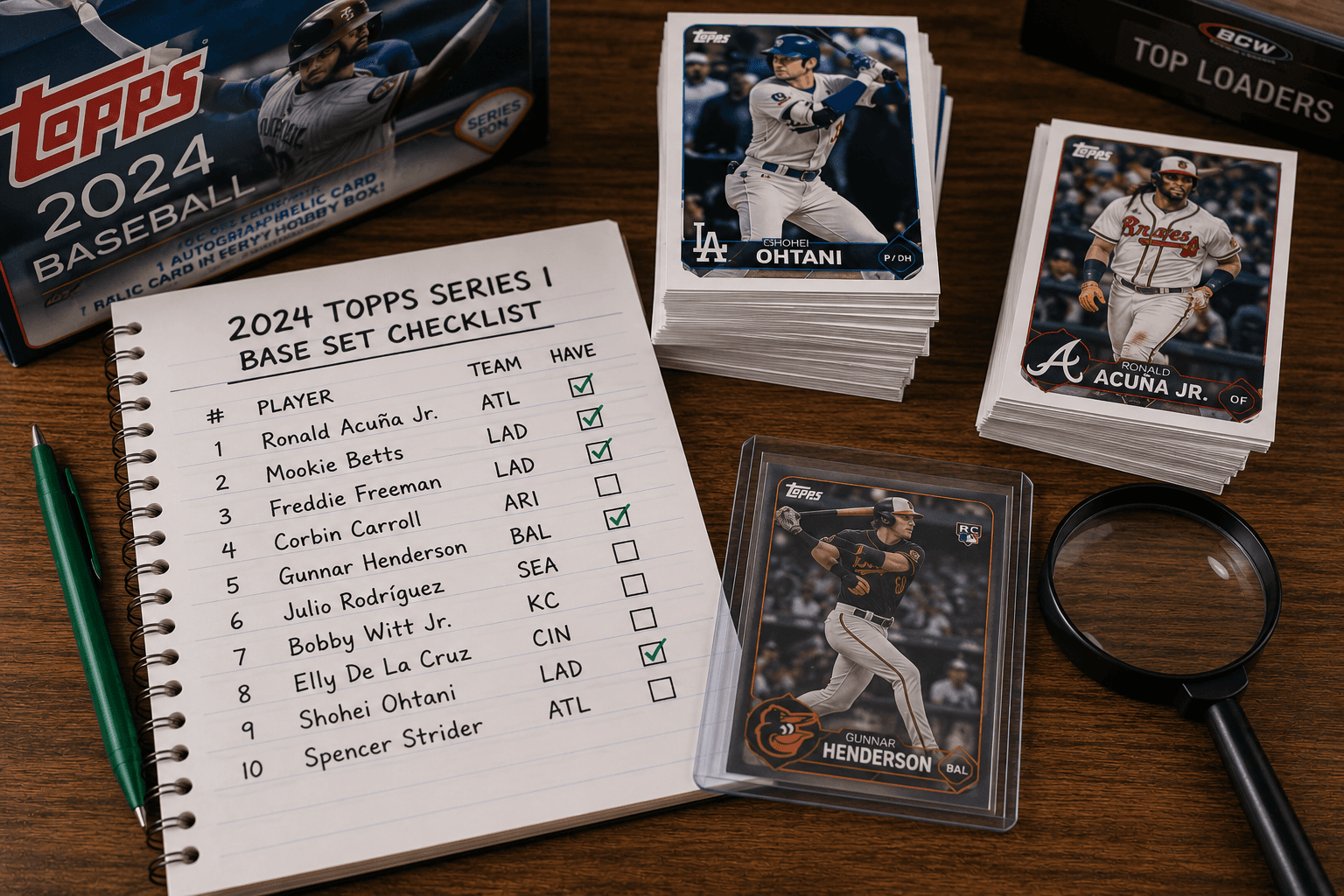
How to Tell What Set a Trading Card Is From
Wondering what set your card is from? Learn how to check the year, brand, card number, logos, design, inserts, parallels, and checklist details.
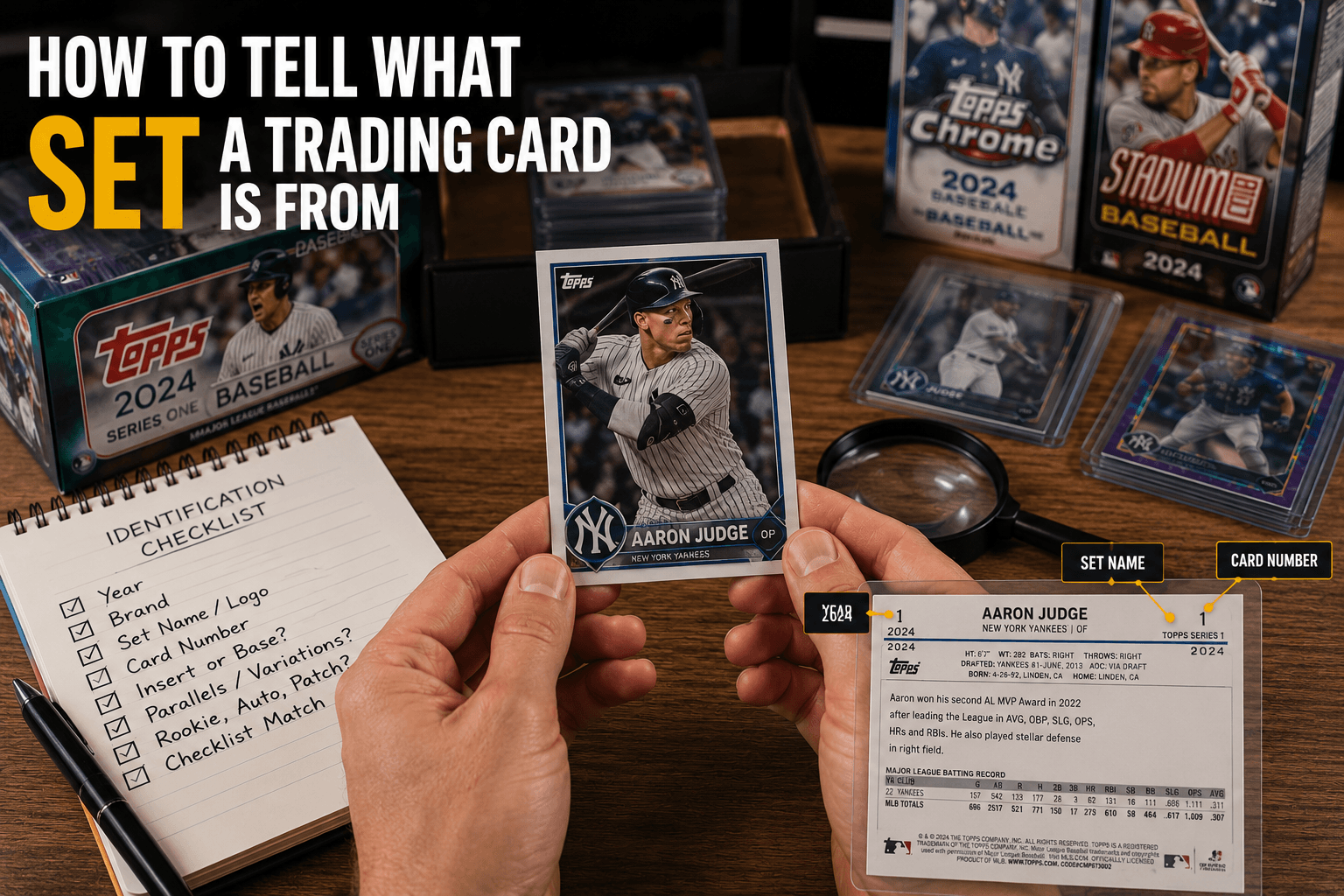
One of the most common questions collectors ask is simple: what set is my card from?
It sounds like it should be easy to answer. Sometimes it is. A card may clearly show the brand, year, product name, and card number right on the front or back. Other times, the answer takes a little more digging. Modern cards can include base sets, inserts, parallels, retail exclusives, short prints, image variations, autos, patches, and cards that share the same player or design across multiple releases.
That is why knowing the set matters so much.
The set tells you where the card belongs. It helps you understand the release, checklist, card number, version, rarity, and how the card connects to other cards. It also helps you track your collection correctly instead of guessing.
CardWiki is built around this exact problem. A card should not just be a loose name in a list. It should connect to a set, a release, a checklist, and a clear card identity. That's why we created this amazing database for our users!
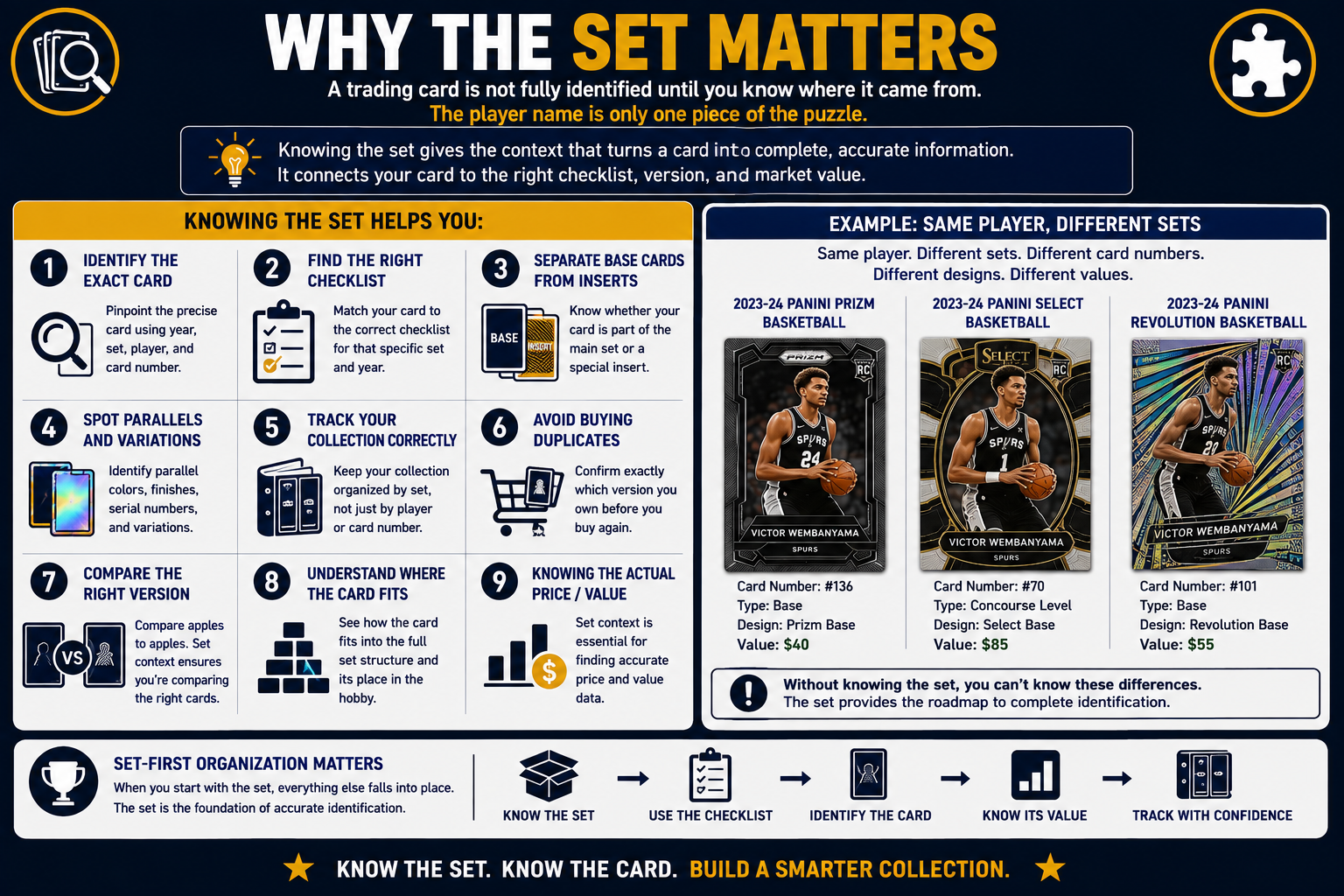
Why The Set Matters
A trading card is not fully identified until you know where it came from. The player name is only one piece of the puzzle.
Knowing the set helps you:
- Identify The Exact Card
- Find The Right Checklist
- Separate Base Cards From Inserts
- Spot Parallels And Variations
- Track Your Collection Correctly
- Avoid Buying Duplicates
- Compare The Right Version
- Understand Where The Card Fits
- Knowing The Actual Price / Value
This is why set-first organization matters. Once you know the set, the rest of the identification process becomes much easier.
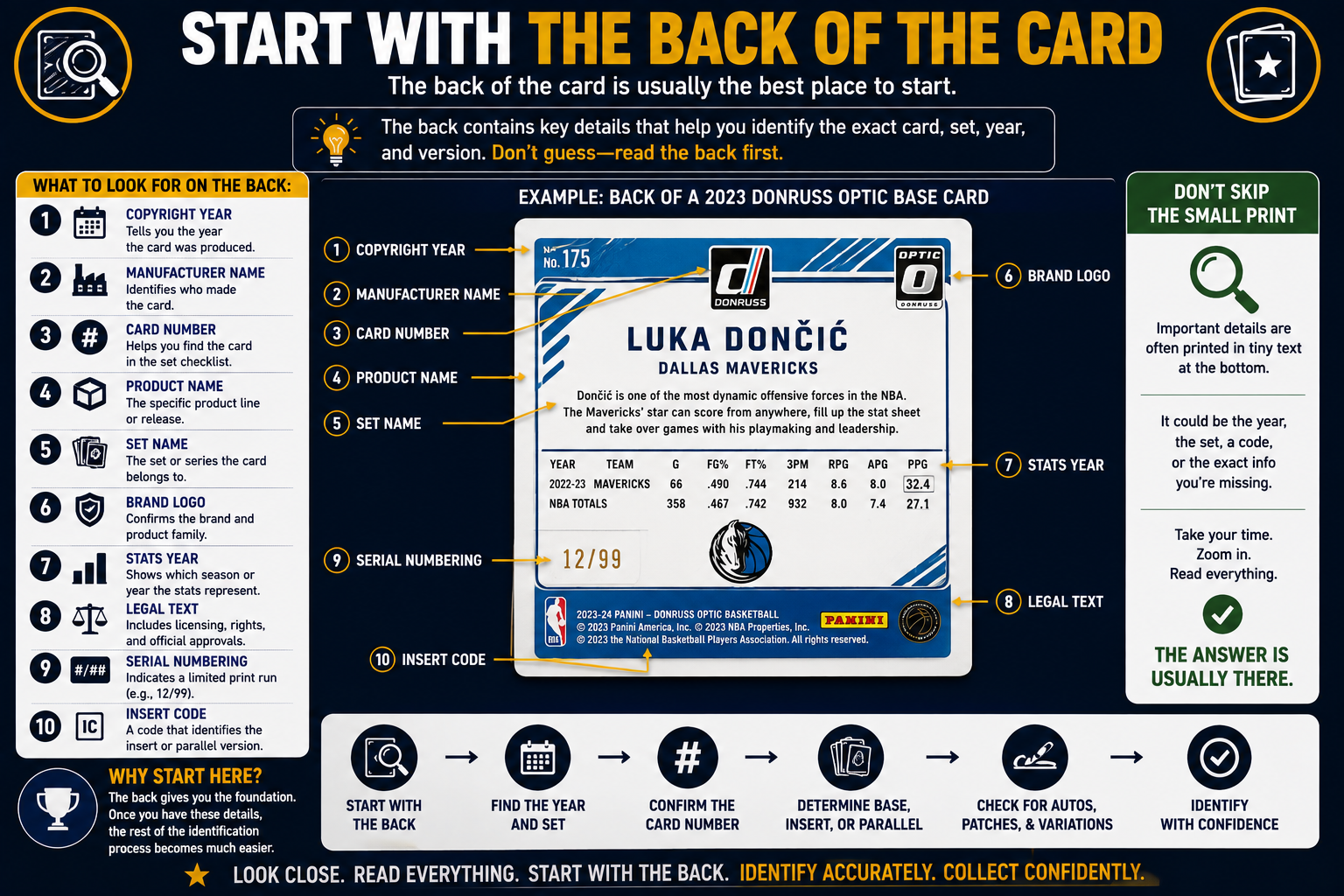
Start With The Back Of The Card
The back of the card is usually the best place to start.
Look for:
- Copyright Year
- Manufacturer Name
- Card Number
- Product Name
- Set Name
- Brand Logo
- Stats Year
- Legal Text
- Serial Numbering
- Insert Code
Do not skip the small print. Sometimes the answer is hiding near the bottom.
Check The Manufacturer Or Brand
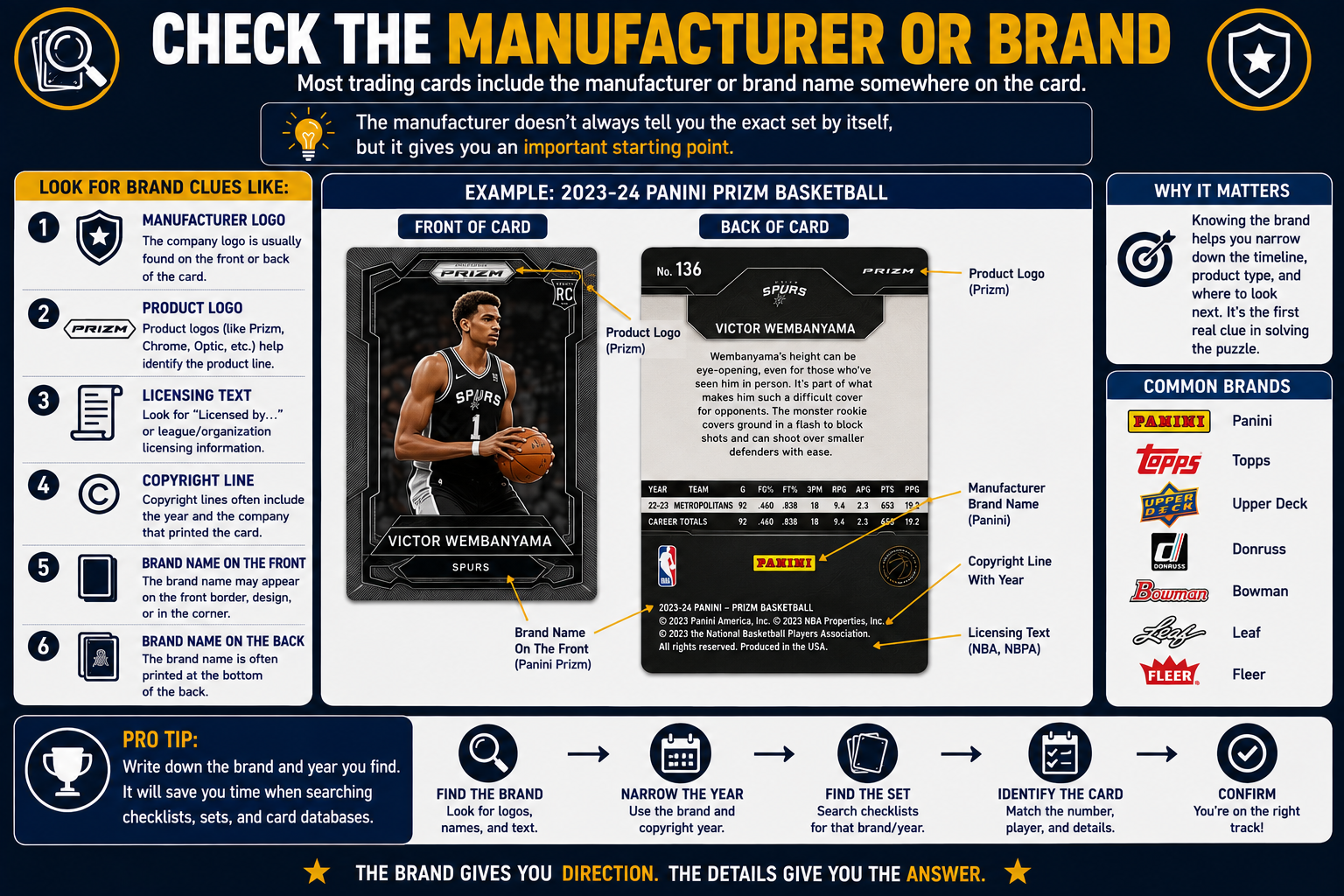
Most trading cards include the manufacturer or brand name somewhere on the card.
Look for brand clues like:
- Manufacturer Logo
- Product Logo
- Licensing Text
- Copyright Line
- Brand Name On The Front
- Brand Name On The Back
The manufacturer does not always tell you the exact set by itself, but it gives you an important starting point.
Find The Year
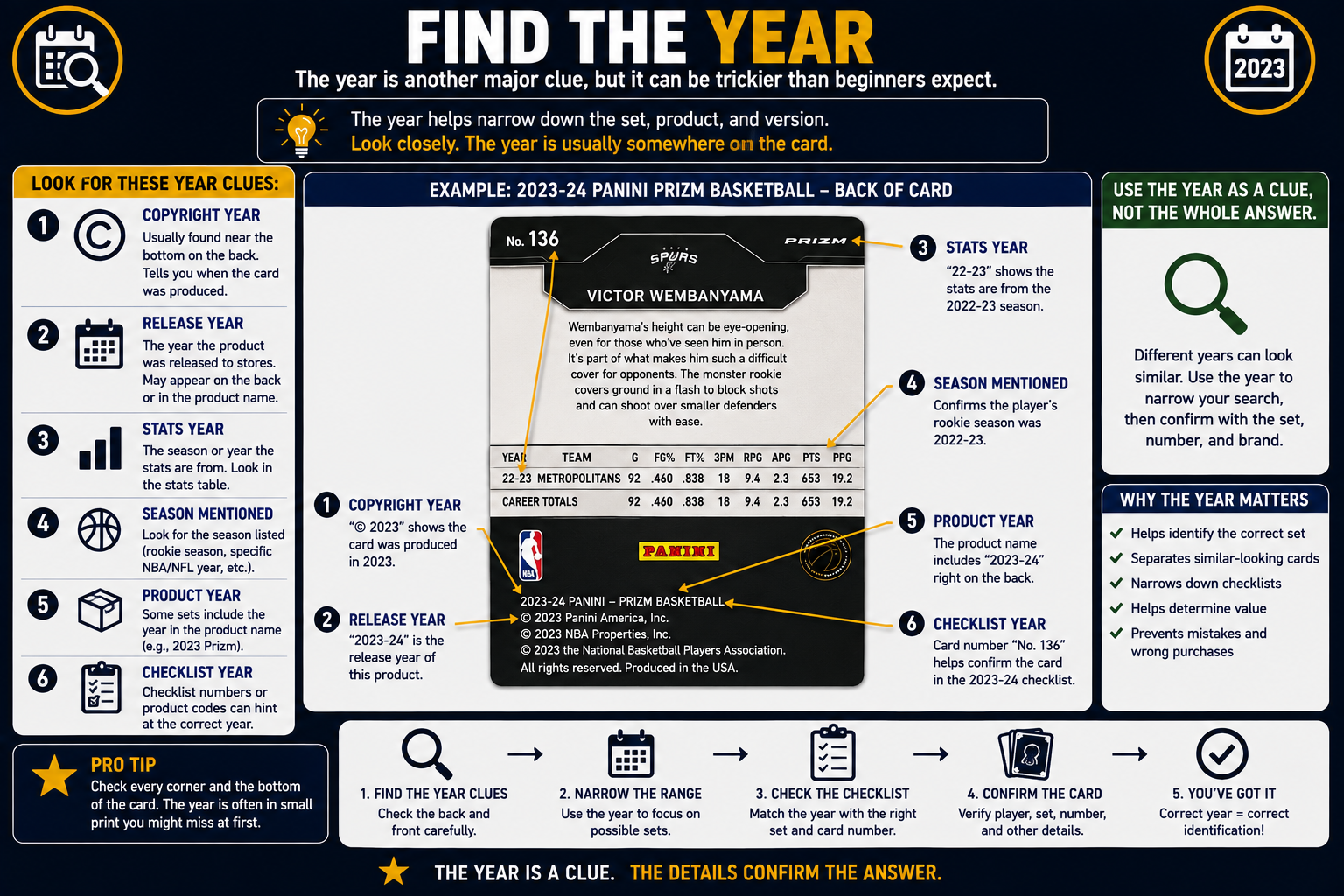
The year is another major clue, but it can be trickier than beginners expect.
Look for:
- Copyright Year
- Release Year
- Stats Year
- Season Mentioned
- Product Year
- Checklist Year
Use the year as a clue, not the whole answer.
Look For The Card Number
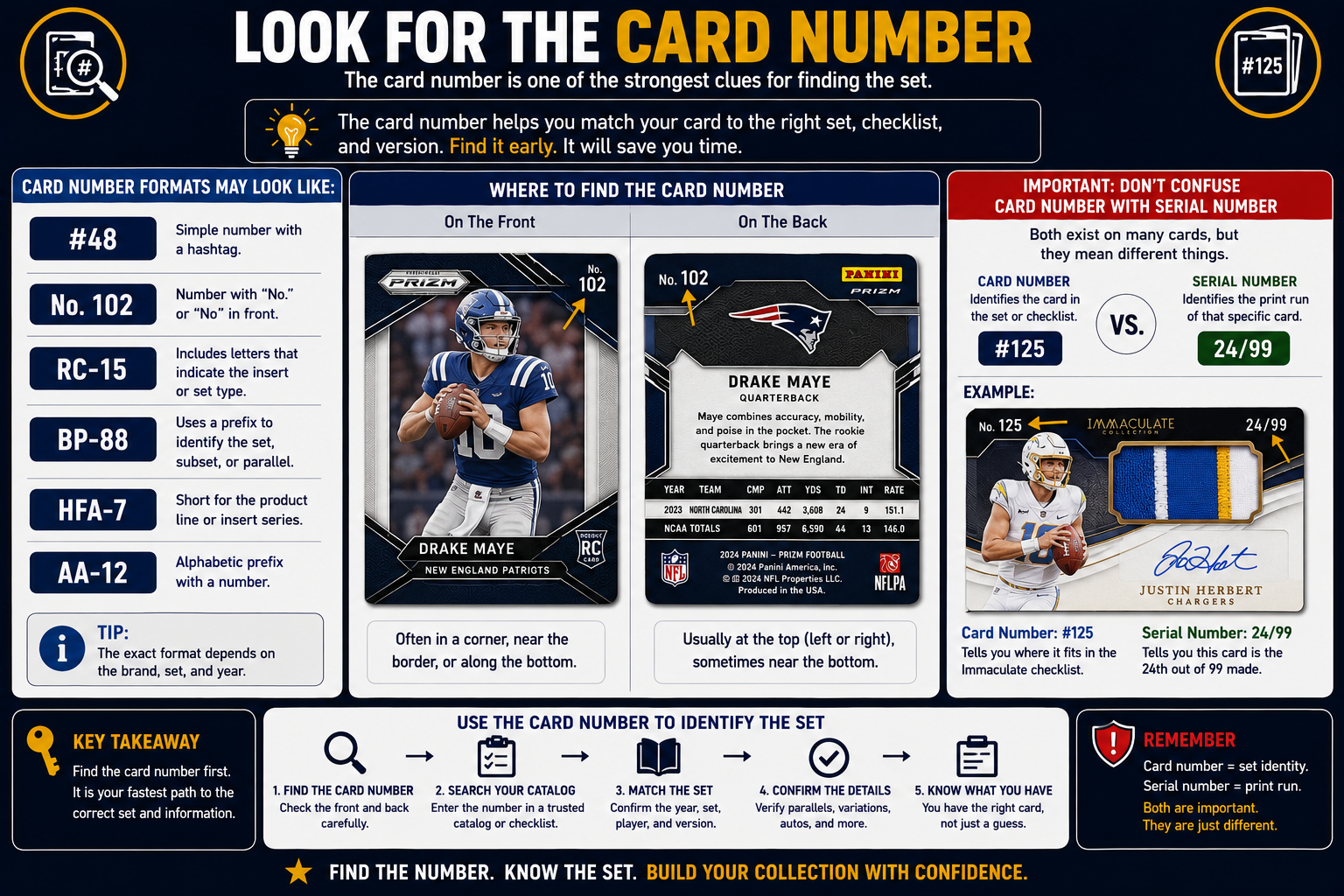
The card number is one of the strongest clues for finding the set.
A card number may look like:
- #48
- No. 102
- RC-15
- BP-88
- HFA-7
- AA-12
One important warning: do not confuse the card number with the serial number.
Example:
- Card Number: #125
- Serial Number: 24/99
Both matter, but they mean different things.
Use The Design As A Clue
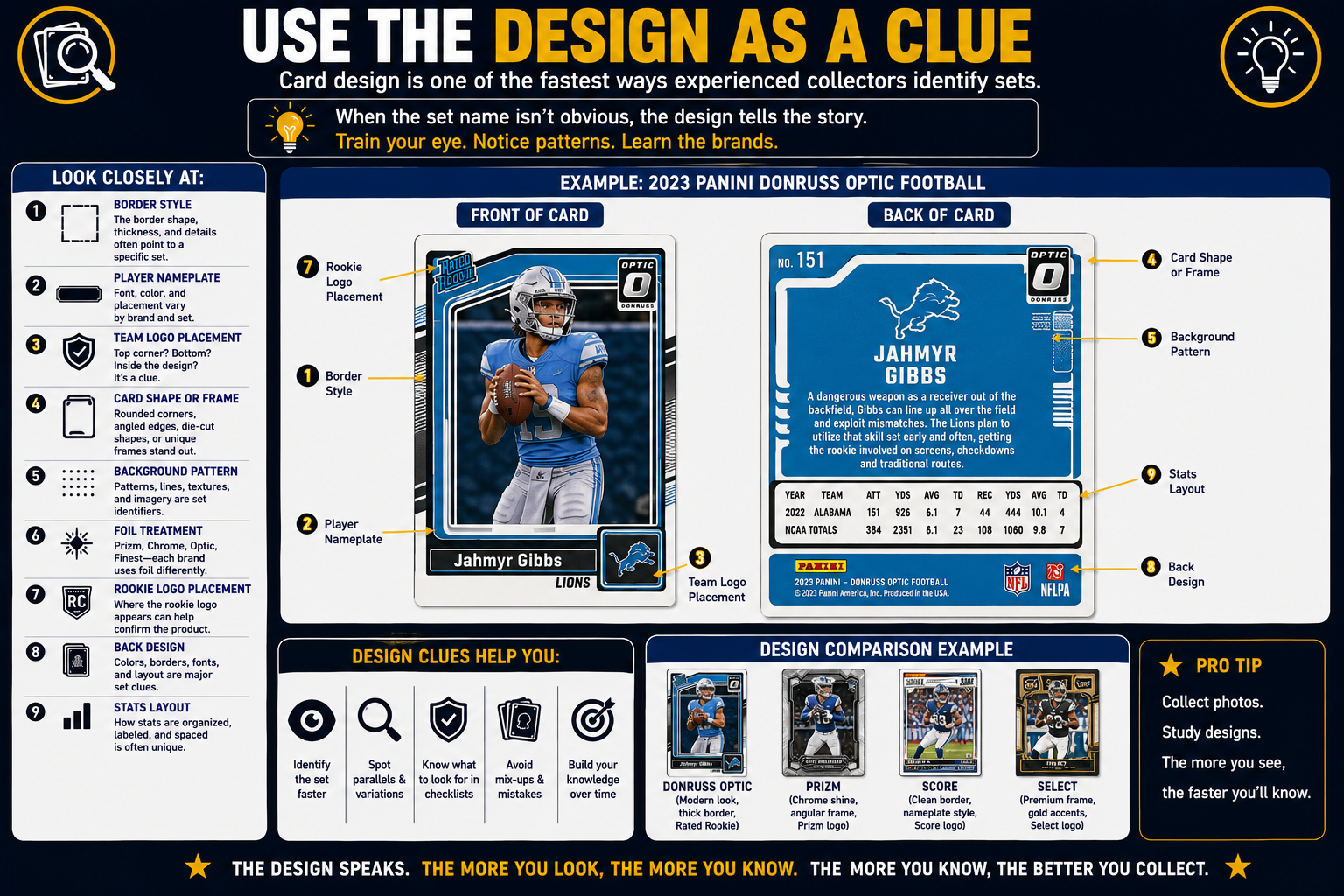
Card design is one of the fastest ways experienced collectors identify sets.
Look closely at:
- Border Style
- Player Nameplate
- Team Logo Placement
- Card Shape Or Frame
- Background Pattern
- Foil Treatment
- Rookie Logo Placement
- Back Design
- Stats Layout
Design is especially useful when the product name is not obvious on the card.
Determine Whether It Is A Base Card Or Insert
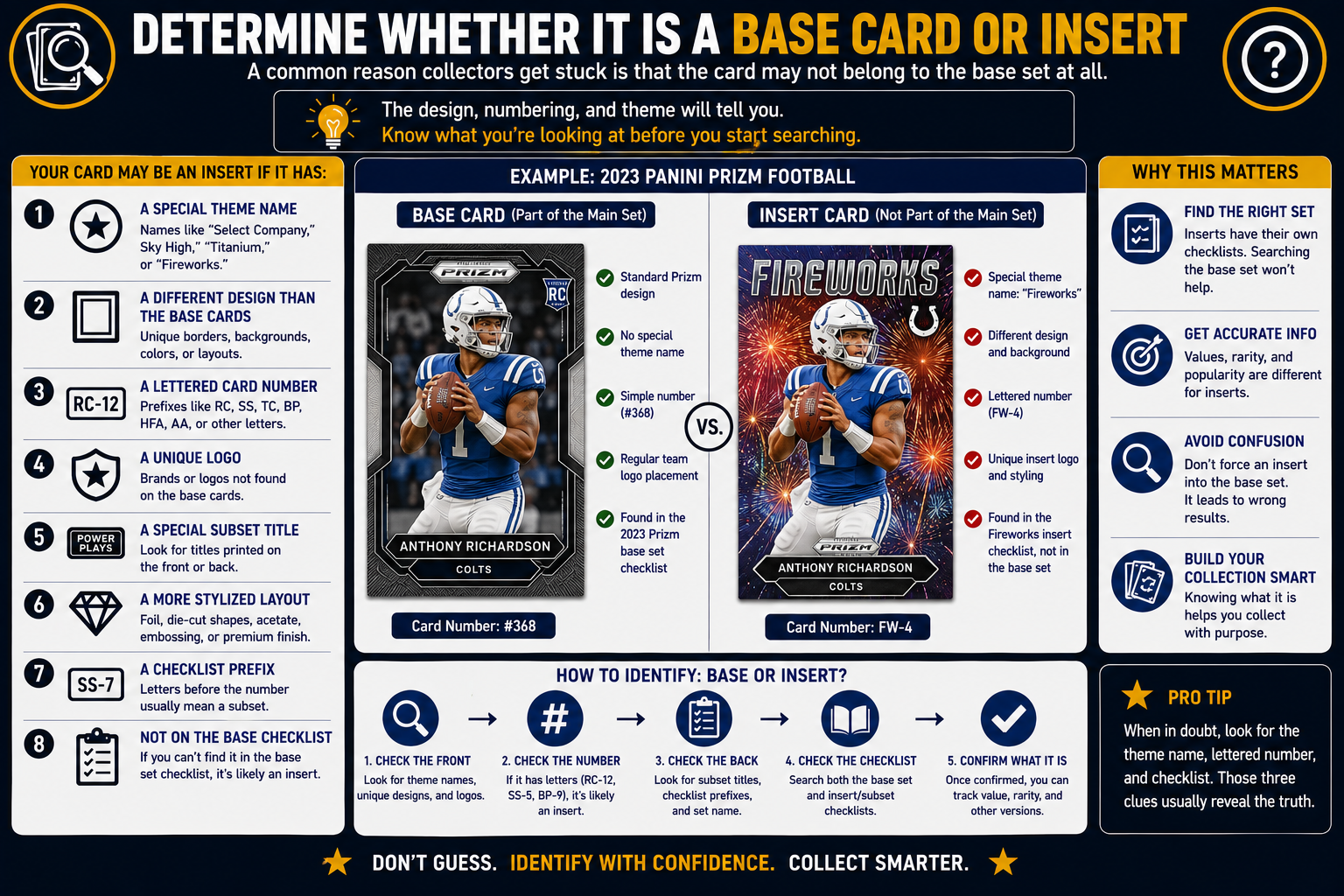
A common reason collectors get stuck is that the card may not belong to the base set at all.
Your card may be an insert if it has:
- A Special Theme Name
- A Different Design Than The Base Cards
- A Lettered Card Number
- A Unique Logo
- A Special Subset Title
- A More Stylized Layout
- A Checklist Prefix
This matters because searching only the main base checklist may not help if your card is actually from an insert set.
Check For Parallel Clues
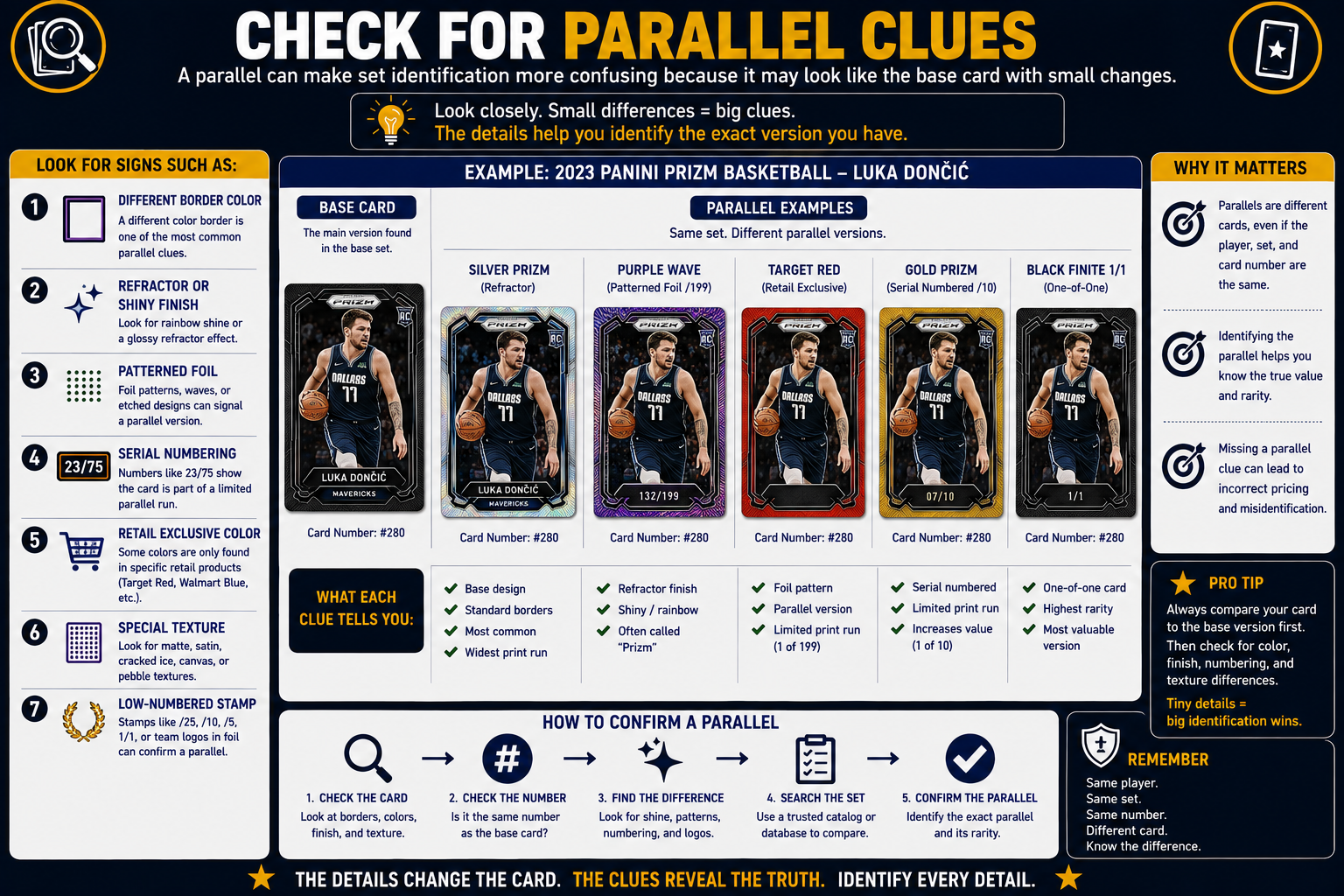
A parallel can make set identification more confusing because it may look like the base card with small changes.
Look for signs such as:
- Different Border Color
- Refractor Or Shiny Finish
- Patterned Foil
- Serial Numbering
- Retail Exclusive Color
- Special Texture
- Low-Numbered Stamp
If your card is a parallel, the set may still be the same as the base version, but the exact card identity is different.
Look For Variation Or Short Print Details
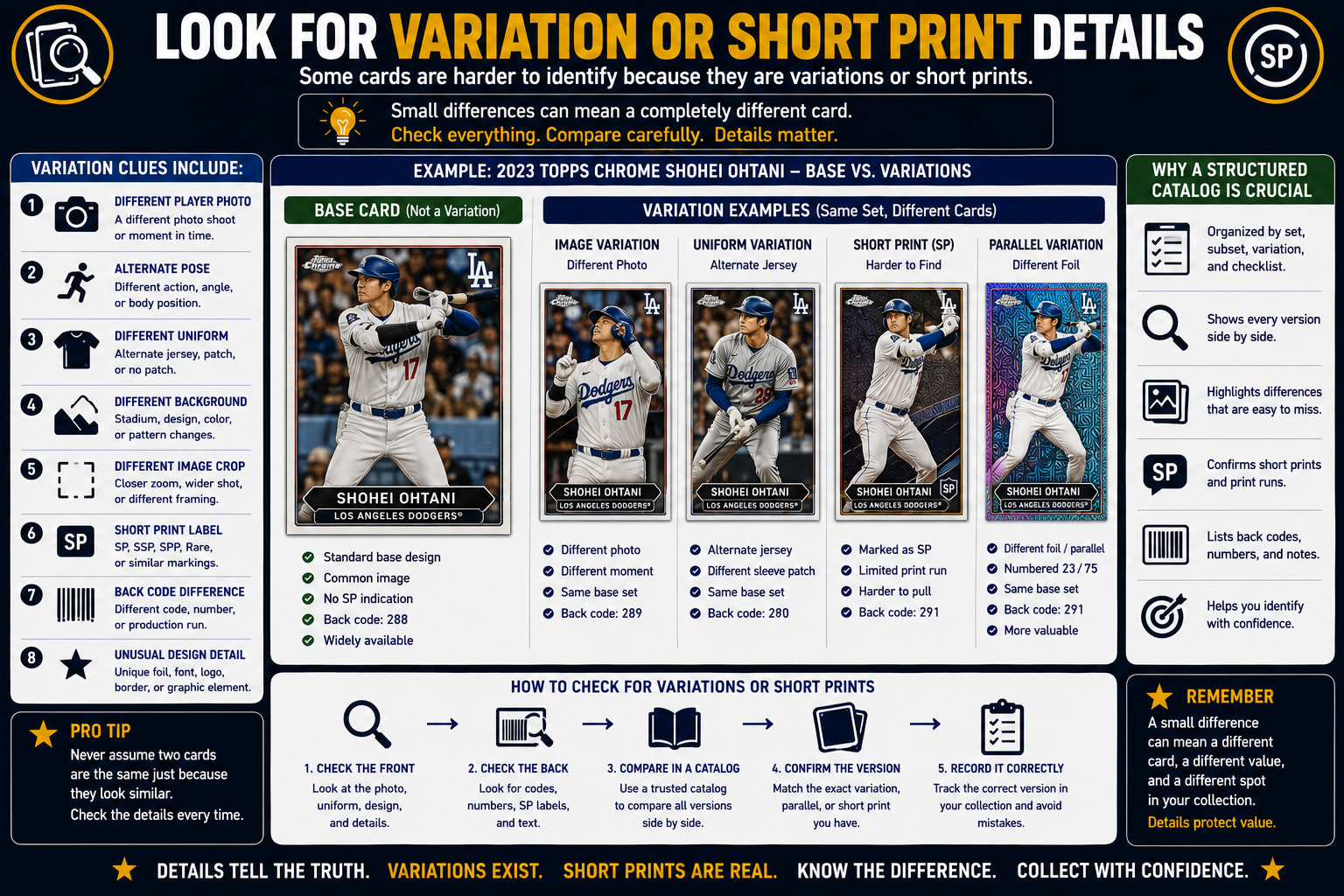
Some cards are harder to identify because they are variations or short prints.
Variation clues include:
- Different Player Photo
- Alternate Pose
- Different Uniform
- Different Background
- Different Image Crop
- Short Print Label
- Back Code Difference
- Unusual Design Detail
This is where a structured catalog becomes very useful.
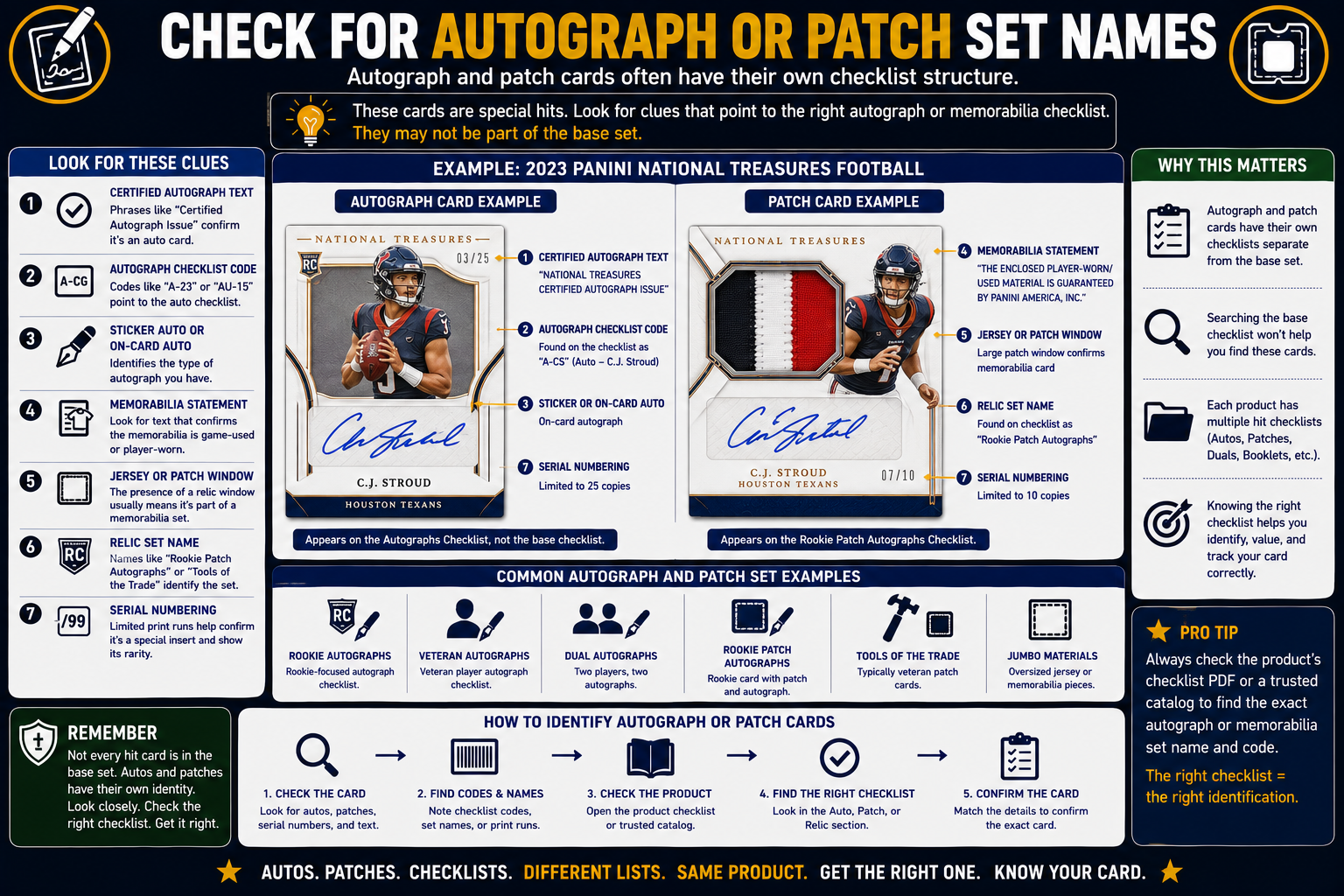
Check For Autograph Or Patch Set Names
Autograph and patch cards often have their own checklist structure.
Look for:
- Certified Autograph Text
- Autograph Checklist Code
- Sticker Auto Or On-Card Auto
- Memorabilia Statement
- Jersey Or Patch Window
- Relic Set Name
- Serial Numbering
A patch card or autograph card may not belong to the standard base checklist. It may be part of a separate hit checklist within the same product release.
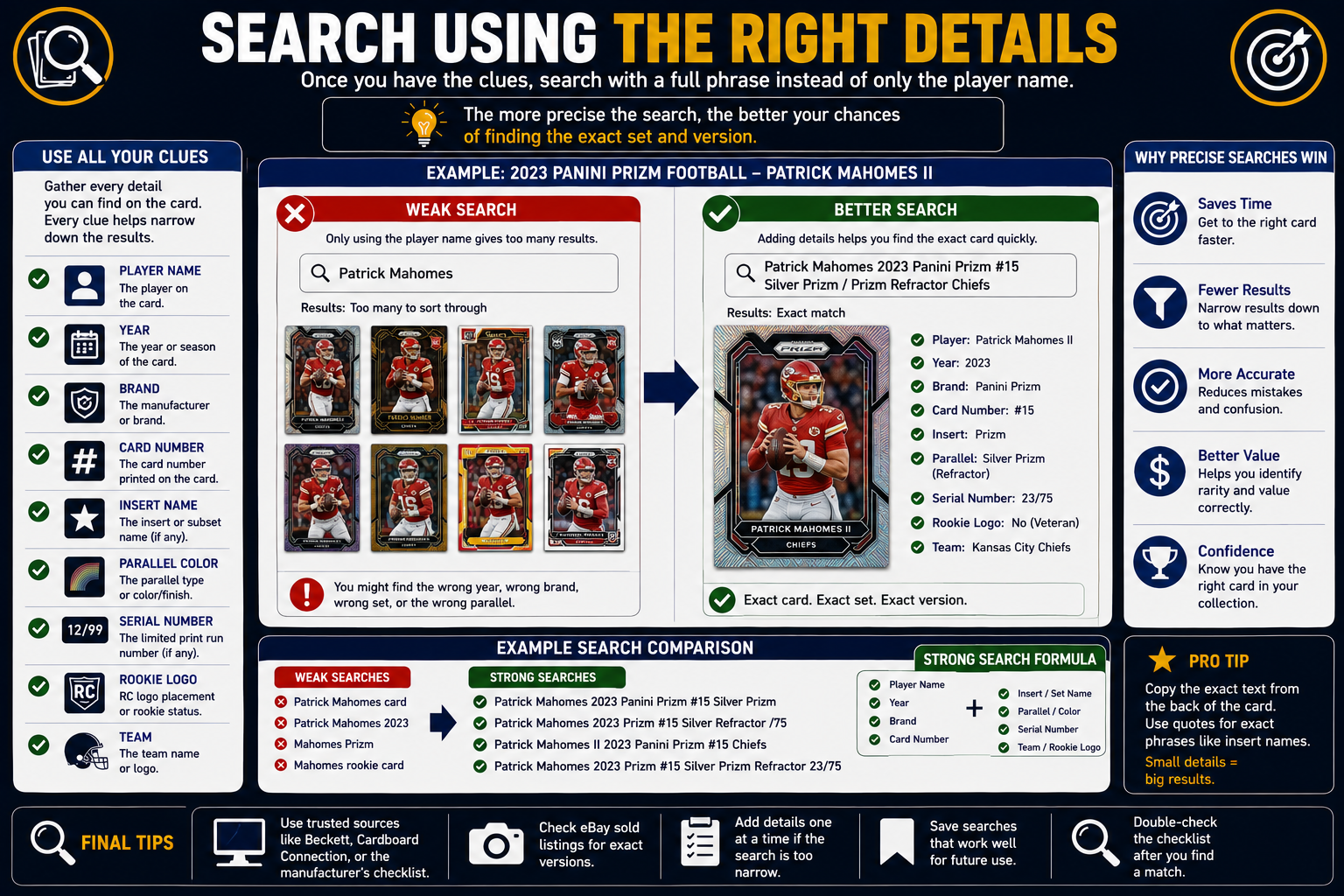
Search Using The Right Details
Once you have the clues, search with a full phrase instead of only the player name.
A weak search might be:
- Player Name
A better search might include:
- Player Name
- Year
- Brand
- Card Number
- Insert Name
- Parallel Color
- Serial Number
- Rookie Logo
- Team
The more precise the search, the better your chances of finding the exact set and version.
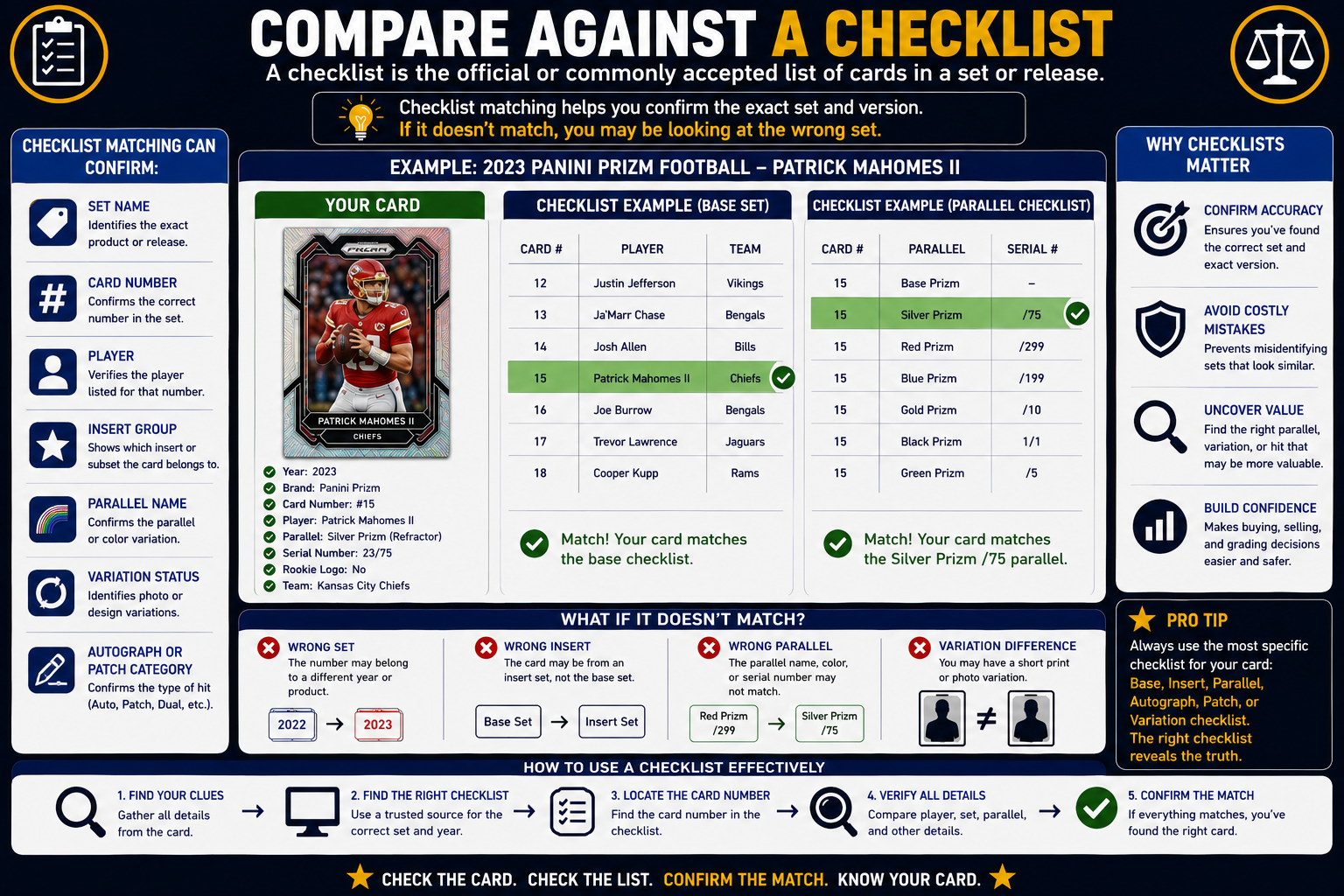
Compare Against A Checklist
A checklist is the official or commonly accepted list of cards in a set or release.
Checklist matching can help confirm:
- Set Name
- Card Number
- Player
- Insert Group
- Parallel Name
- Variation Status
- Autograph Or Patch Category
If the card number does not match the player in that checklist, you may be looking at the wrong set.
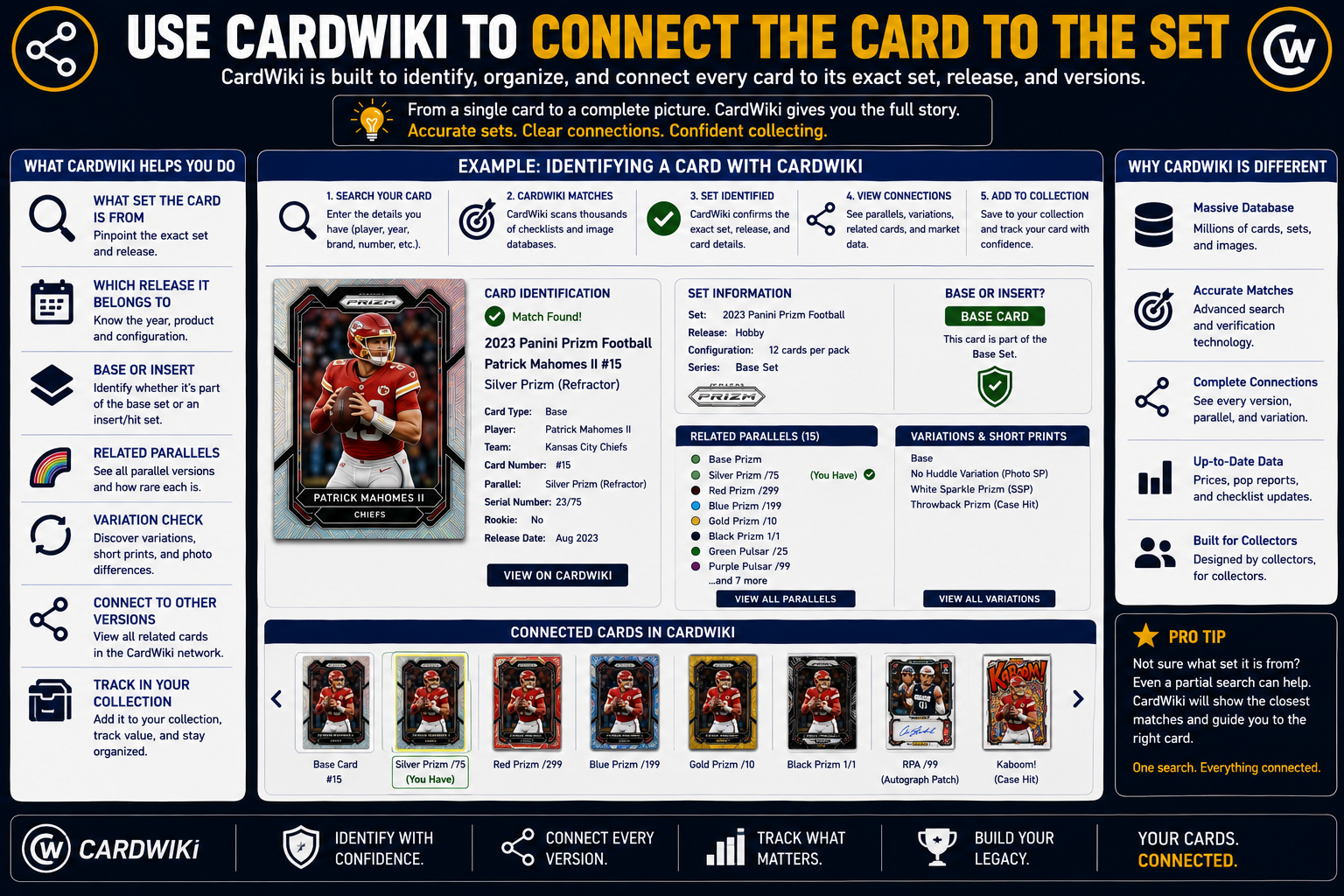
Use CardWiki To Connect The Card To The Set
This is the part CardWiki is built for.
CardWiki helps collectors understand:
- What Set The Card Is From
- Which Release It Belongs To
- Whether It Is Base Or Insert
- Whether It Has Related Parallels
- Whether It May Be A Variation
- How It Connects To Other Versions
- How To Track It In A Collection
That structure is what turns a random card into a properly identified collection record.
A Simple Checklist For Finding What Set Your Card Is From
When you are trying to answer “what set is my card from,” use this process.
- Check The Back Of The Card
- Find The Manufacturer
- Find The Year
- Locate The Card Number
- Look For Set Or Product Logos
- Check Whether It Is Base Or Insert
- Look For Parallel Clues
- Check For Serial Numbering
- Look For Variation Details
- Search With Player, Year, Brand, And Number
- Compare Against A Checklist
- Confirm The Card In A Structured Catalog
- Track The Final Identification
This process will not make every card instant, but it gives you a reliable path.
Common Mistakes Beginners Make
Most beginners make similar mistakes when trying to identify a card’s set.
Common mistakes include:
- Searching Only By Player Name
- Confusing The Copyright Year With The Set Year
- Ignoring The Card Number
- Mixing Up Card Numbers And Serial Numbers
- Missing Insert Names
- Assuming A Parallel Is A Different Set
- Overlooking Back-Of-Card Details
- Treating Similar Designs As Identical
- Not Comparing Against A Checklist
- Forgetting To Track The Final Answer
The biggest mistake is rushing. A card may look obvious until you compare the back, number, design, and checklist.
Why Set-First Cataloging Makes Collecting Easier
Set-first cataloging gives every card a home.
Instead of treating cards as random names in a list, set-first structure places each card inside the release where it belongs. That makes it easier to understand the card’s identity, compare related versions, and track your collection accurately.
A set-first catalog helps sports collectors move from “I think I have this card” to “I know exactly what this card is.”
Final Thoughts
Figuring out what set your card is from takes a little practice, but it gets easier once you know what to check.
Start with the back. Look for the year, manufacturer, card number, product name, and set clues. Compare the design. Check whether the card is base, insert, parallel, variation, auto, or patch. Then confirm it against a structured catalog.
Once you know the set, the card starts to make sense. You can track it correctly, compare it accurately, and understand where it fits in the hobby.
That is exactly why CardWiki is built around set-first catalog structure: because collectors deserve to know what they own.
If you are trying to figure out what set your card is from, CardWiki can help you explore structured catalog records, compare versions, types and and track your collection with more confidence.
FAQs
How Do I Tell What Set My Card Is From?
Check the back of the card for the manufacturer, year, card number, product name, logo, and checklist clues. Then compare it against a structured catalog.
Where Is The Set Name On A Trading Card?
The set name may appear on the front, back, logo, copyright line, insert name, or checklist number. Sometimes it is not printed clearly and must be confirmed through design and checklist matching.
Is The Copyright Year The Same As The Set Year?
Not always. The copyright year is a helpful clue, but it may not perfectly match the product year or release year.
What Is The Difference Between A Card Number And A Serial Number?
A card number identifies where the card belongs in the checklist. A serial number shows how many copies of that version exist.
Can A Parallel Be From The Same Set As A Base Card?
Yes. A parallel is usually connected to the same set or release as the base card, but it is a different version.
Why Can Two Cards From The Same Player Look Almost Identical?
They may be base and parallel versions, image variations, short prints, or cards from similar releases. Small details can change the exact identity.
Can CardWiki Help Me Find What Set My Card Is From?
Yes. CardWiki is built to connect cards to sets, releases, checklists, variations, and collection records so collectors can identify cards more clearly.