
What Is Panini Prizm? Silver Prizms, Color Parallels, and Rookie Chases Explained
Learn what Panini Prizm is, how Silver Prizms and color parallels work, and why rookie cards, numbering, and exact identification matter to collectors.
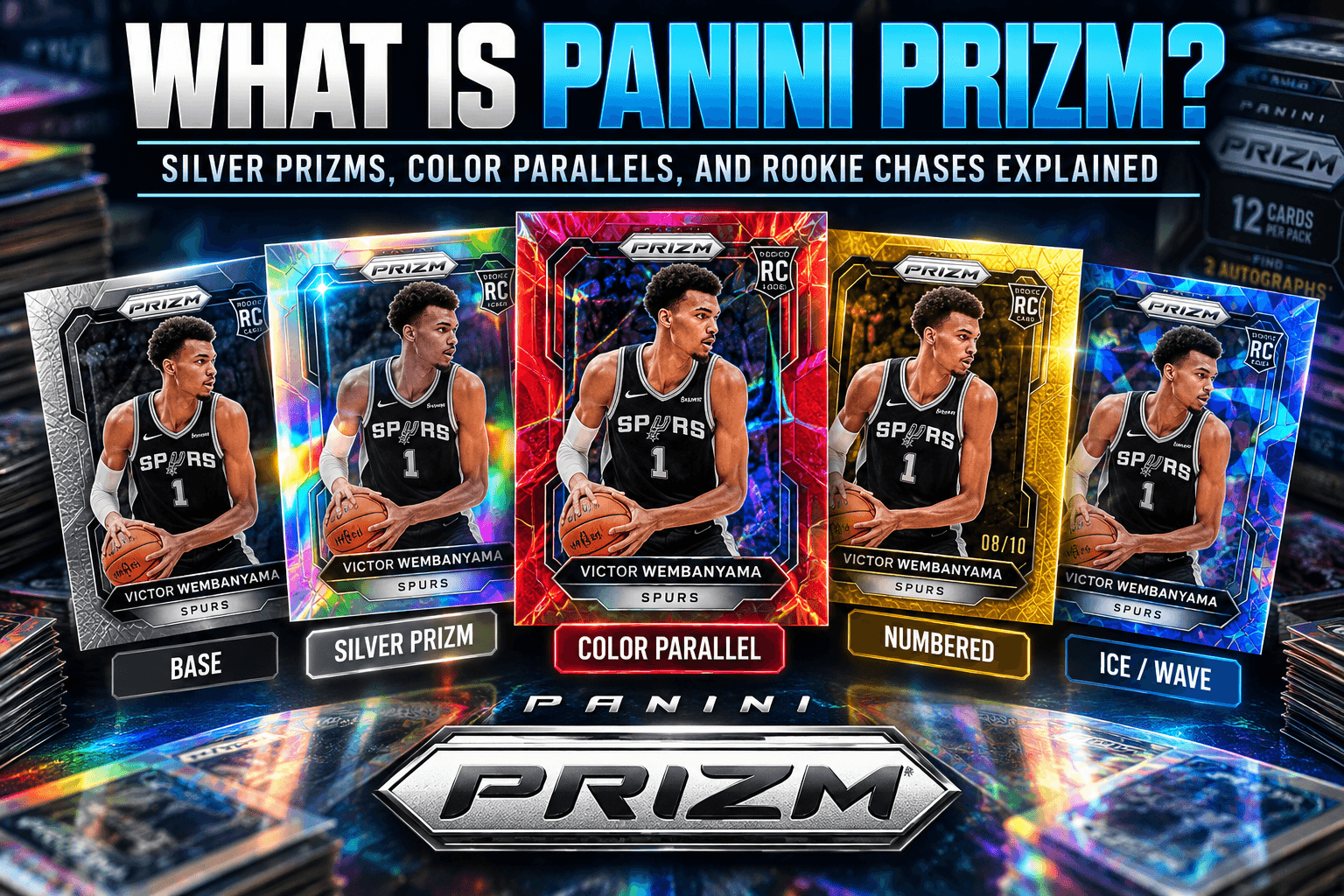
Panini Prizm is one of the most recognizable names in modern sports card collecting. Known for its reflective card surfaces, extensive parallel lineups, and popular rookie cards, Prizm has become a major part of the basketball, football, and broader sports card hobby.
But understanding Prizm isn't always as straightforward as opening a pack and finding a shiny card.
A collector might encounter a standard Prizm base card, a Silver Prizm, a Green Prizm, a numbered Gold Prizm, or a patterned parallel with a completely different name. Several cards can feature the same athlete, photograph, and card number while representing different versions with different levels of scarcity.
The terminology creates another challenge. Prizm can refer to a Panini product family, a reflective parallel treatment, or part of an official parallel name.
So, what is Panini Prizm, and how can collectors tell these cards apart?
Understanding the product structure, Silver Prizms, color parallels, and rookie chases makes it easier to identify what you actually own before researching rarity or value.
What Is Panini Prizm?
Panini Prizm is a sports trading card product family produced by Panini America. It is especially recognized for its chromium-style card surfaces, distinctive designs, and extensive selection of reflective parallels.
Prizm made its debut in basketball during the 2012-13 season and became an influential product in modern collecting.
Unlike traditional paper trading cards, Prizm cards commonly feature a metallic-looking surface that reflects light. The product's appearance is one reason collectors recognize it so easily.
However, the shiny appearance of a Prizm card doesn't automatically make it a rare parallel.
A typical Prizm release may contain:
- Base cards featuring veterans, stars, legends, and rookies
- Silver Prizm parallels with a rainbow-reflective treatment
- Colored Prizm parallels with different finishes and patterns
- Serial-numbered parallels produced in stated quantities
- Inserts featuring separate designs and themes
- Autograph cards featuring player signatures
- Short-print cards and other limited chase content
The exact checklist depends on the sport, product year, release, and configuration.
Panini has also used the Prizm name across several sports and product variations, so collectors should never assume every Prizm release follows an identical structure.
CardWiki's guide to Panini sports card releases explains how Prizm fits alongside Donruss, Optic, Select, Mosaic, and other Panini product families.
What Is a Panini Prizm Base Card?
A Panini Prizm base card is the standard version of a card within a particular Prizm base checklist.
It establishes the underlying design that many parallel versions share.
For example, a rookie may appear in the main Prizm base set with a specific card number, photograph, and design.
That same underlying card could have several officially recognized parallel versions.
The base card typically provides the starting point for identifying those variations.
A base Prizm card may include:
- The athlete's name
- Team information
- Product branding
- A checklist card number
- A standard design used throughout the set
- A rookie designation when applicable
- A metallic or reflective-looking surface
The important point is that Prizm base cards can look shiny without being Silver Prizm parallels.
This is one of the most common sources of confusion for new collectors.
Someone unfamiliar with the product might see the metallic finish and assume they pulled a special version.
In reality, the regular base card is already designed to have a premium appearance.
To confirm whether a card is base or parallel, collectors should compare its finish against the standard card from the same year and checklist.
Understanding the differences between base cards and parallel trading cards helps collectors recognize which features establish a card's identity.
What Is a Silver Prizm?
A Silver Prizm is a recognized reflective parallel that appears in many Panini Prizm releases.
It typically maintains the underlying card's design, photograph, and card number while adding a distinctive rainbow-like reflective finish.
Silver Prizms are especially recognizable when collectors tilt them under a light source.
The surface can produce a stronger spectrum of reflected colors than the corresponding standard base version.
This creates a visual appearance similar to what collectors associate with refractor-style cards.
The two terms are closely related in hobby conversations, but manufacturer naming matters.
Topps commonly uses the term Refractor for certain reflective parallels, while Panini uses Prizm terminology.
CardWiki's explanation of Refractor, Prizm, Chrome, and Holo cards explores how these terms are used across different manufacturers and products.
How Can You Identify a Silver Prizm?
A Silver Prizm typically has several characteristics worth checking:
- The same underlying player and card number as the base version
- A more pronounced rainbow-reflective finish
- No dominant colored parallel treatment
- A corresponding Silver designation in the product checklist
- A finish consistent with documented examples from the same release
Some releases may also include identifying details on the back, although collectors should not assume every Silver Prizm is labeled in the same way.
A Silver Prizm is generally not serial numbered.
That doesn't mean every Silver Prizm has the same print run or rarity.
Silver Prizm availability can vary across products and years. Without a published production figure, collectors should not assign an exact print quantity.
Silver Prizm vs Base Prizm
| Feature | Base Prizm | Silver Prizm |
|---|---|---|
| Product | Panini Prizm | Panini Prizm |
| Card design | Standard base design | Usually the same underlying design |
| Surface | Metallic or reflective-looking | Stronger rainbow-reflective finish |
| Parallel status | Standard base version | Recognized parallel |
| Serial numbering | Generally unnumbered | Generally unnumbered |
| Rookie availability | When included in checklist | When offered for that rookie |
| Identification | Base checklist | Silver parallel designation |
Both can be collectible, but they should be recorded as separate versions.
Why Are Silver Prizm Rookie Cards So Popular?
Silver Prizm rookie cards have become familiar chase cards within modern sports card collecting.
A rookie card represents an athlete during an officially recognized early-career card release. When that rookie appears in a popular chromium-style product such as Prizm, collectors often pursue both the base version and its parallels.
The Silver Prizm is particularly popular because it combines a recognizable finish with the appeal of a player's rookie year.
For many collectors, Silver rookies occupy a desirable position between standard base rookie cards and scarcer numbered parallels.
Several factors contribute to their popularity.
Recognizable Rookie Design
Silver Prizms generally maintain the design collectors associate with that year's Prizm rookie checklist.
That makes them easy to recognize alongside the standard rookie card.
Reflective Visual Appeal
The rainbow finish is an important part of the Silver Prizm's identity.
Collectors often appreciate how the surface catches light without introducing a completely different dominant color.
Established Collector Interest
Silver Prizm rookie cards have developed a strong following across multiple sports.
Collectors may pursue them for player collections, graded collections, or broader rookie-card sets.
Condition and Grading Appeal
Reflective surfaces can make scratches, print lines, and other defects noticeable.
Because Silver Prizms are frequently collected in graded condition, centering, corners, edges, and surface quality can affect collector interest.
A Silver Prizm rookie of a popular player may attract substantially more attention than a regular base version.
However, Silver does not automatically mean valuable.
Player demand, condition, production volume, timing, and the specific product all affect the market.
What Are Panini Prizm Color Parallels?
Panini Prizm color parallels are alternate versions of an underlying card that use different colors, patterns, reflective treatments, or combinations of those features.
These parallels are a defining part of the Prizm collecting experience.
A collector might own a standard rookie card and then pursue multiple alternate versions of that same card.
Depending on the release, recognizable parallel families can include:
- Silver Prizms
- Red Prizms
- Blue Prizms
- Green Prizms
- Purple Prizms
- Gold Prizms
- Black Prizms
- Ice-pattern Prizms
- Wave-pattern Prizms
- Shimmer Prizms
These names are examples of treatments used in Prizm products. They are not a universal checklist for every release.
A particular year might have several variations of Blue, including a standard Blue, Blue Ice, Blue Wave, or Blue Shimmer.
Although those names share a color, they can represent completely different parallel identities.
Some may be numbered, while others may not be.
That is why identifying a Prizm parallel requires more than recognizing its color.
How Do Different Prizm Parallel Patterns Work?
Color is only one element of Prizm parallel identification.
Panini also uses patterned and textured-looking reflective treatments to create additional parallel families.
For example, an Ice-style parallel may have a repeating crystalline appearance, while a Wave parallel may feature a wave-like reflective pattern.
A Shimmer treatment can display another recognizable reflective effect.
These visual characteristics help collectors distinguish cards that otherwise appear similar.
Consider three hypothetical versions of the same rookie card:
- A standard Blue Prizm
- A Blue Ice Prizm
- A Blue Wave Prizm
All three might feature the same athlete, photograph, and checklist number.
They may also share a dominant blue color.
But their officially recognized patterns make them different versions.
One could be serial numbered, another could be distributed through a specific configuration, and another could have a different production quantity.
The exact checklist determines which characteristics apply.
A matching color does not make two parallels identical.
For collectors organizing large collections, recognizing the difference between color and pattern prevents incorrect catalog entries.
What Are Serial-Numbered Prizm Cards?
Serial-numbered Prizm cards are limited versions marked with a number indicating the individual copy and the stated edition size.
The numbering usually appears as a fraction.
For example:
- 017/199
- 043/99
- 08/25
- 03/10
- 1/1
A stamp reading 08/25 means the card is copy number eight within a stated edition of 25 copies for that particular version.
It does not mean the athlete has only 25 cards in the entire Prizm product.
The player may also have base cards, Silver Prizms, other numbered parallels, inserts, and autographs.
CardWiki's guide to serial-numbered trading cards explains how numbered cards work, what the numbers represent, and why serial numbering helps establish rarity and exact card identity.
Are Gold Prizms Always Numbered to 10?
Gold Prizms numbered to 10 are well-known chase cards in numerous Prizm releases.
However, collectors should not assume every gold-colored Prizm card follows the same numbering structure.
Different releases may include Gold, Gold Wave, Gold Shimmer, Gold Vinyl, and other officially named versions.
Those versions can have different scarcity levels.
The release checklist is the authority for identifying the version and its stated print run.
What Is a Prizm Rainbow?
A Prizm rainbow is a collector's group of different parallel versions of the same underlying card.
Collectors sometimes try to assemble as many officially recognized parallels of one player as possible.
For example, someone collecting a favorite rookie might pursue:
- Base Prizm
- Silver Prizm
- Green Prizm
- Red Prizm
- Blue Prizm
- Purple Prizm
- Gold Prizm
- Black Prizm
That example illustrates the concept, not a complete checklist for any particular year.
A modern Prizm release may contain substantially more parallel variations, including several versions of the same color.
Some may be available only in specific configurations or distribution channels.
A complete rainbow can be difficult to assemble, especially when it includes extremely limited cards.
Some collectors focus on an entire checklist rainbow, while others pursue only selected colors or numbered versions.
The collecting goal is personal.
A rainbow doesn't have to be complete to represent a meaningful collection.
Understanding card parallels and their different variations is useful for collectors who want to organize a rainbow without confusing different colors, patterns, or releases.
What Is the Difference Between Prizm Hobby and Retail Boxes?
Panini Prizm products can be distributed through several configurations, including hobby boxes and retail products.
These configurations determine how cards are packaged and what content collectors can potentially find.
They do not automatically change the identity of every card inside.
Prizm Hobby Boxes
Hobby boxes are generally marketed toward the established card-collecting market.
Depending on the release, they may offer:
- Specific autograph content
- Hobby-exclusive parallels
- Numbered chase cards
- Exclusive inserts
- Published box-level content averages
- Different pack and card counts than retail products
Hobby boxes can offer certain cards unavailable in standard retail configurations.
However, the exact contents and guarantees vary.
A hobby box does not guarantee that every collector will pull a valuable card.
Prizm Retail Boxes
Prizm retail products may include blaster boxes, mega boxes, retail packs, and other configurations.
Depending on the year, they may contain:
- Standard base cards
- Rookie cards
- Silver Prizms
- Retail-exclusive colors
- Special retail patterns
- Inserts
- Certain autograph or limited cards
Some retail configurations feature parallels unavailable in hobby boxes.
This means retail is not simply an inferior version of hobby.
The two channels may offer different collecting opportunities.
Hobby vs Retail Prizm Comparison
| Feature | Hobby | Retail |
|---|---|---|
| Intended market | Primarily hobby collectors | Broader retail market |
| Packaging | Hobby-specific boxes and packs | Blasters, megas, packs, and other formats |
| Base cards | Commonly included | Commonly included |
| Silver Prizms | May be included | May be included |
| Exclusive parallels | Often available | Often available |
| Autographs | Product-dependent advertised content | Product-dependent availability |
| Numbered cards | Release-specific | Release-specific |
| Guaranteed valuable pulls | No | No |
Before purchasing a box, collectors should review the exact product year, configuration, checklist, and advertised contents.
A Prizm blaster box and a Prizm hobby box may contain some of the same underlying cards, but not necessarily the same exclusive parallels.
What Is the Difference Between a Prizm Parallel and an Insert?
A Prizm parallel is an alternate version of another card, while an insert generally belongs to a separately designed checklist within the release.
This can be confusing because both may feature colorful or reflective surfaces.
Consider a rookie who appears in a Prizm release.
That athlete could have:
- A standard base rookie card
- A Silver parallel of the base rookie
- A numbered color parallel of the base rookie
- A separate insert card
- A parallel of that insert
- A rookie autograph from an autograph checklist
These cards are related through the athlete and product, but they do not all belong to the same underlying checklist.
An insert might use a completely different design, card number, and theme.
It can also have its own parallel structure.
For example, a Silver version of an insert should not automatically be cataloged as a Silver parallel of the player's base rookie card.
The checklist relationship determines the correct identity.
CardWiki's introduction to base cards, parallels, autographs, and memorabilia cards provides additional context on how these collectible categories differ.
Why Can Panini Prizm Terminology Be Confusing?
The word Prizm has several uses within the hobby.
It can describe the product family, a reflective finish, or a specific parallel within a checklist.
That overlapping terminology is one reason new collectors sometimes misidentify cards.
Prizm as a Product Name
Panini Prizm identifies the product family.
A standard base card from that product is still a Panini Prizm card.
It does not need to be a Silver or colored parallel.
Prizm as a Parallel Term
Panini also uses Prizm terminology within official parallel names.
Silver Prizm, Blue Prizm, and Gold Prizm are examples.
These identify versions rather than simply naming the overall product.
Prizm as a General Hobby Description
Collectors sometimes use the word Prizm casually when describing reflective cards.
That can cause confusion with other chromium-style products.
A reflective card from Donruss Optic is not automatically a Panini Prizm card.
Likewise, a Topps Chrome Refractor is not officially a Silver Prizm just because the finish looks similar.
A card's manufacturer and product name remain essential identification fields.
For a broader comparison, CardWiki's guide to Panini Prizm, Donruss Optic, Select, and Mosaic explains how the major Panini product families relate to one another.
How Can You Identify a Panini Prizm Card Correctly?
The most reliable way to identify a Prizm card is to establish its underlying card identity and then confirm its exact version.
A useful identification process follows several steps.
Step 1: Identify the Manufacturer and Product
Confirm that the card belongs to Panini Prizm rather than another Panini release.
Similar reflective finishes can appear in Optic, Select, Mosaic, and other products.
Do not identify the product from shininess alone.
Step 2: Determine the Product Year
Locate the appropriate season or product year.
A basketball card from 2023-24 belongs to a different release than a visually similar card from 2024-25.
The year is essential for matching the correct checklist.
Step 3: Locate the Card Number
Check the card's printed checklist number.
The card number helps establish which player entry or subset the card belongs to.
Remember that a card number is not the same thing as a serial number.
Step 4: Compare the Surface and Pattern
Examine the card under good lighting.
Look for:
- Standard base appearance
- Rainbow-reflective Silver treatment
- Distinctive color
- Ice, Wave, or Shimmer effects
- Other documented patterns
- Serial-number stamps
Comparing the card against confirmed examples from the same release can help narrow the possibilities.
Step 5: Verify the Official Parallel Name
Use the product checklist and manufacturer information where available.
This is especially important for parallels with similar colors or patterns.
A generic description such as "blue shiny rookie" may omit essential identity details.
Step 6: Record Any Numbering or Special Features
If the card is serial numbered, record the exact stamp.
Also identify whether the card contains an autograph, memorabilia component, or documented variation.
Step 7: Confirm the Final Card Identity
A complete record should identify the release, underlying checklist, player, card number, and specific version.
Only after those details are established should collectors begin researching comparable sales or graded population data.
Do Silver Prizms and Color Parallels Affect Card Value?
Silver Prizms and colored parallels can affect collector demand and market value.
However, no parallel name guarantees that a card will command a particular price.
Several factors influence how collectors evaluate Prizm cards.
Player demand: Popular stars and highly followed rookies may attract more attention than lesser-known players.
Rookie status: An officially recognized rookie card may have additional appeal among player collectors.
Scarcity: Limited production can create competition among collectors, especially when demand is already strong.
Parallel identity: Certain versions, including recognizable Silver or low-numbered Gold parallels, may have established collector followings.
Condition: Surface scratches, print lines, centering, corners, and edges may influence value.
Grading: A professional grading company's assessment may affect demand, but the grading result is an opinion of condition rather than a guarantee of market value.
Product reputation: Collectors may prefer certain products or releases over others.
Market activity: Recent comparable sales provide more useful pricing evidence than unsupported asking prices.
One common mistake is assuming that every numbered Prizm is worth more than every unnumbered Silver Prizm.
A low-numbered card of an unpopular player may have limited demand, while an unnumbered Silver rookie of a highly collected athlete may attract more buyers.
Rarity and demand need to be considered together.
What Are Common Mistakes New Prizm Collectors Make?
Panini Prizm's extensive parallel structure creates several identification traps.
Some of the most common include:
- Confusing Base and Silver: Assuming every shiny Prizm card is a Silver parallel
- Ignoring Patterns: Treating Blue, Blue Ice, and Blue Wave as interchangeable names
- Assuming Colors Have Fixed Numbering: Applying one year's numbering structure to another release
- Confusing Inserts With Parallels: Treating an insert as a version of the base card
- Ignoring Product Identity: Describing cards from Optic, Select, or Mosaic as regular Prizm cards
- Mixing Up Card and Serial Numbers: Mistaking a checklist number for a limited-edition stamp
- Assuming Retail Means Common: Overlooking configuration-exclusive parallels
- Misidentifying Rookie Cards: Assuming every card featuring a young player has the same rookie status
- Assuming Numbering Guarantees Value: Equating scarcity with collector demand
- Skipping Checklist Verification: Assigning parallel names based only on appearance
Most of these mistakes can be avoided by comparing the card against verified examples and documenting its exact attributes.
Why Manufacturer Naming Matters for Card Identity
Manufacturer naming is especially important with Panini Prizm because the same hobby concepts can carry different official names across companies.
Panini's Silver Prizm and Topps' Refractor may share a recognizable rainbow-reflective appearance.
However, they belong to different manufacturer naming systems.
Even within Panini's catalog, similar-looking treatments can appear under different product families.
For example:
| Card | Manufacturer | Product | Version |
|---|---|---|---|
| Prizm Base | Panini | Prizm | Base |
| Silver Prizm | Panini | Prizm | Silver |
| Optic Holo | Panini | Donruss Optic | Holo |
| Chrome Refractor | Topps | Topps Chrome | Refractor |
These are illustrative product and version categories, not four cards from a single checklist.
The purpose is to show that similar visual characteristics do not establish identical card identities.
Using the correct manufacturer designation makes collection records more reliable.
It also improves the accuracy of pricing research, checklist matching, and comparisons between graded cards.
Collectors who want to understand these manufacturer-specific naming conventions can explore CardWiki's explanation of Chrome, Refractor, Prizm, and Holo finishes.
Why This Matters to CardWiki
Panini Prizm provides a useful example of why trading card identification requires more than the player's name, product year, and card number.
Consider a hypothetical rookie card with several recognized versions.
All versions might share:
- Manufacturer: Panini
- Product family: Prizm
- Product year: Same season
- Player: Same athlete
- Card number: Same checklist number
- Photograph: Same image
- Core design: Same layout
However, individual versions could differ in several important ways.
| Identity Attribute | Base Prizm | Silver Prizm | Numbered Color Prizm |
|---|---|---|---|
| Manufacturer | Panini | Panini | Panini |
| Product | Prizm | Prizm | Prizm |
| Underlying checklist | Base | Base | Base |
| Card number | Same | Same | Same |
| Parallel | Base | Silver | Exact color/pattern name |
| Finish | Standard | Rainbow-reflective | Version-specific |
| Serial number | Usually none | Usually none | When applicable |
| Version identity | Standard card | Silver parallel | Numbered parallel |
Although the cards share important characteristics, they are separate collectible versions.
CardWiki approaches trading card identification through structured information.
For Panini Prizm, that can mean recording:
- Manufacturer
- Brand and product family
- Product year
- Release
- Checklist
- Card number
- Player
- Rookie status
- Card type
- Parallel family
- Color
- Pattern
- Finish
- Serial numbering
- Autograph or memorabilia status
- Configuration and distribution evidence when relevant
Keeping those attributes separate prevents visually similar cards from being incorrectly combined.
It also allows collectors to distinguish the actual version they own rather than relying on vague descriptions.
For example, "Panini Prizm rookie" identifies a general category.
"Panini Prizm Silver rookie" is more specific.
Adding the correct product year, athlete, card number, and checklist confirmation produces a much more reliable record.
The larger principle is simple: exact identification comes before valuation.
Frequently Asked Questions
Is Panini Prizm the Same as a Silver Prizm?
No. Panini Prizm is a trading card product family, while Silver Prizm identifies a reflective parallel within applicable releases. A base Prizm card and a Silver Prizm can share the same player and card number while representing different versions.
Are All Panini Prizm Cards Shiny?
Many Panini Prizm cards have metallic or reflective-looking surfaces, including standard base cards. A shiny appearance alone does not establish that a card is a Silver or another special parallel.
Are Silver Prizms Rare?
Silver Prizms are recognized parallels, but their scarcity varies depending on the product and year. Most standard Silver Prizms are not serial numbered, so their exact production quantities may not be publicly established.
What Is the Difference Between a Silver Prizm and a Refractor?
Silver Prizm is terminology associated with Panini products, while Refractor is commonly used for reflective parallels in Topps products. Their visual effects can be similar, but the official manufacturer and checklist names determine the correct designation.
Are Gold Prizm Cards Always Numbered?
No universal numbering rule applies to every gold-colored Prizm card across all releases. A standard Gold Prizm numbered to 10 is a familiar example, but Gold Wave, Gold Shimmer, Gold Vinyl, and other treatments may have different published quantities.
Are Prizm Rookie Cards Worth Collecting?
Many collectors pursue Prizm rookie cards because of the product's recognizable designs, Silver parallels, and extensive color variations. Their market value depends on the player, condition, parallel, scarcity, and collector demand.
Can You Pull Silver Prizms From Retail Packs?
Yes. Silver Prizms are available in various retail configurations across Prizm releases. However, availability, quantities, and any advertised averages depend on the exact product and packaging.
What Is the Best Way to Identify a Prizm Parallel?
Start with the product year, player, and card number. Compare the card's color, reflective finish, and pattern against the appropriate checklist. Check for serial numbering and configuration-specific designations before assigning the official parallel name.
Final Thoughts on Panini Prizm Collecting
Panini Prizm is more than a recognizable sports card brand. Its combination of base cards, Silver Prizms, color parallels, numbered versions, and rookie chases has helped shape modern collecting.
The challenge is understanding exactly which version of a card you own.
A base Prizm, Silver Prizm, and numbered color parallel can share the same athlete, photograph, and checklist number while representing different collectible identities.
Learning how these versions relate to one another helps collectors organize their cards accurately, research realistic market comparisons, and avoid common identification mistakes.
CardWiki's approach starts with the manufacturer, product, checklist, and exact parallel designation because accurate identification is the foundation of understanding any trading card.
Learn the product. Confirm the parallel. Identify the exact card.


