What Is A Short Print Or Super Short Print Card?
Learn the meaning of a short print card, how super short print cards work, why they matter to collectors, and how to identify them in a trading card set.
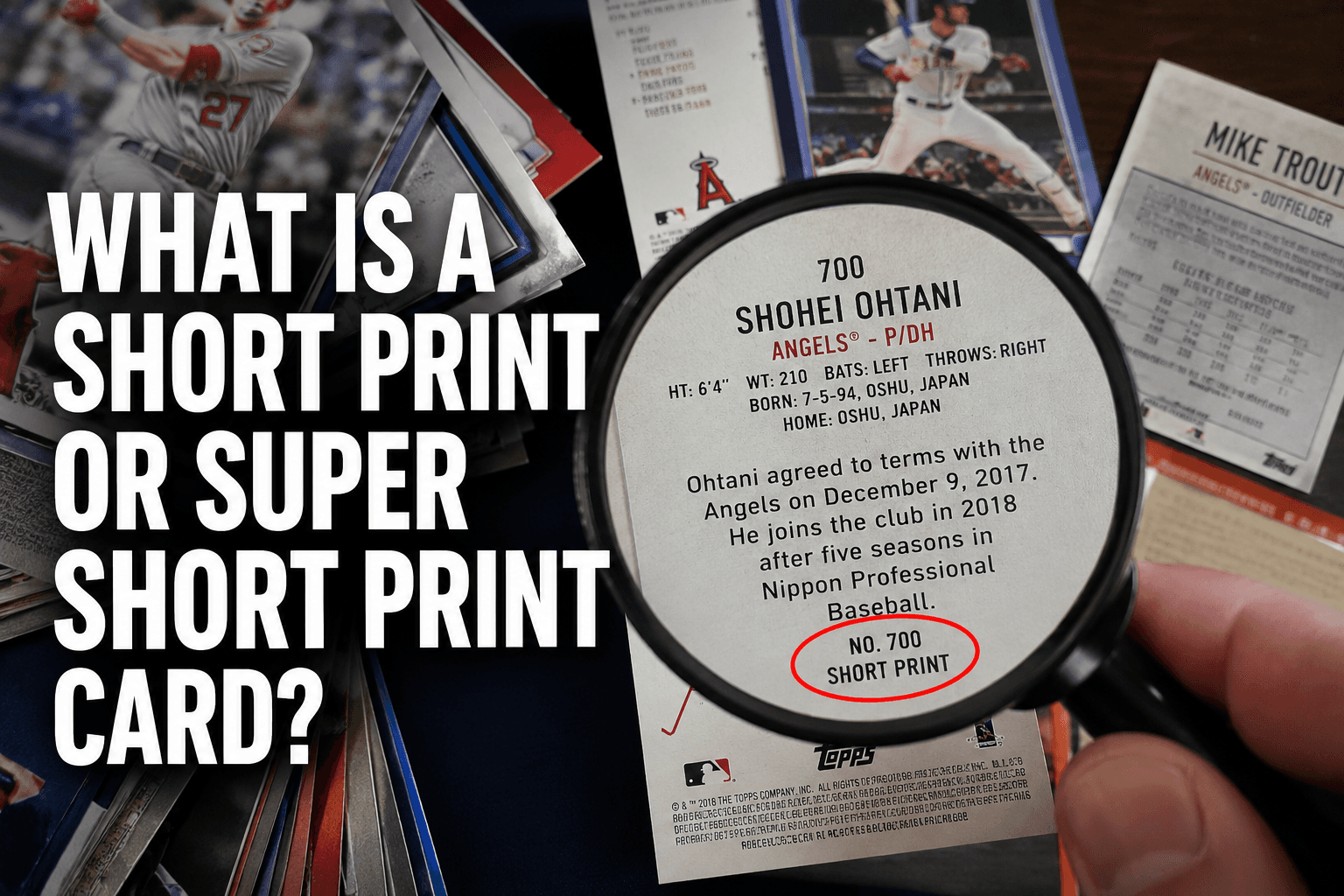
If you’ve spent any time opening packs, browsing checklists, or reading card listings online, you’ve probably seen terms like SP, SSP, short print, or super short print. These terms are everywhere in modern trading card collecting, but they can be confusing if you’re newer to the hobby.
The short print card meaning is simple at the surface: it’s a card that was made in smaller quantities than other cards in the same product or set.
But once you start looking closer, short prints can get a little more nuanced. Some are clearly labeled. Some are hidden variations. Some are obvious because of a different photo. Others are only known because collectors, checklists, or card databases have identified them over time.
That’s why understanding short prints matters. If you don’t know what you’re looking at, you might mistake a harder-to-find card for a regular base card. You might also overpay for a card that’s listed as rare but isn’t actually confirmed as a short print.
This guide explains what short print and super short print cards are, how they usually appear in trading card sets, why collectors care about them, and how structured catalog data can help you identify cards with more confidence.
What Does Short Print Card Mean?
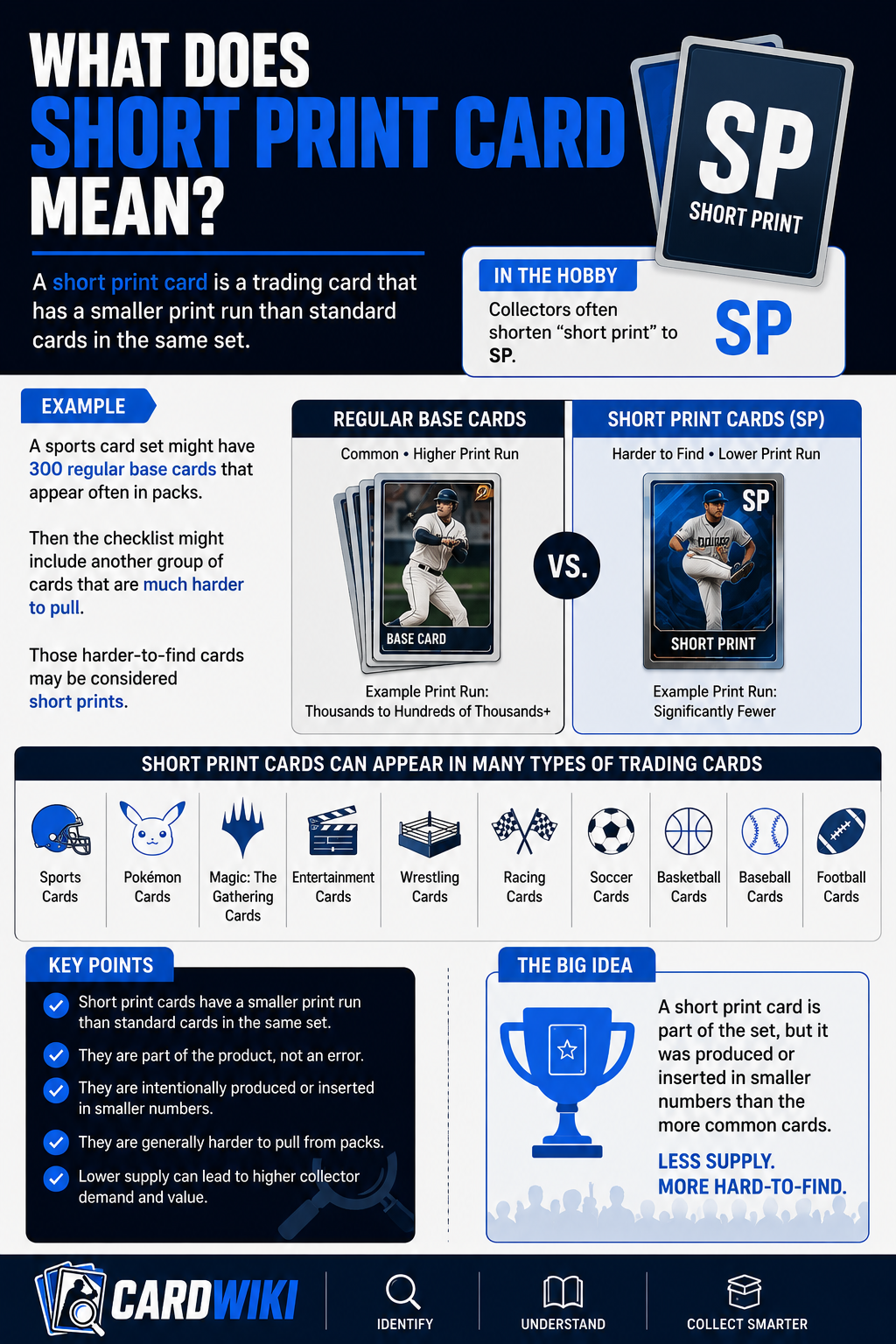
A short print card is a trading card that has a smaller print run than standard cards in the same set.
In the hobby, collectors often shorten “short print” to SP.
For example, a sports card set might have 300 regular base cards that appear often in packs. Then the checklist might include another group of cards that are much harder to pull. Those harder-to-find cards may be considered short prints.
Short prints can appear in many types of trading cards, including:
- Sports cards
- Pokémon cards
- Magic: The Gathering cards
- Entertainment cards
- Wrestling cards
- Racing cards
- Soccer cards
- Basketball cards
- Baseball cards
- Football cards
The basic idea is always the same. A short print is part of the product, but it was produced or inserted in smaller numbers than the more common cards.
What Is A Super Short Print Card?
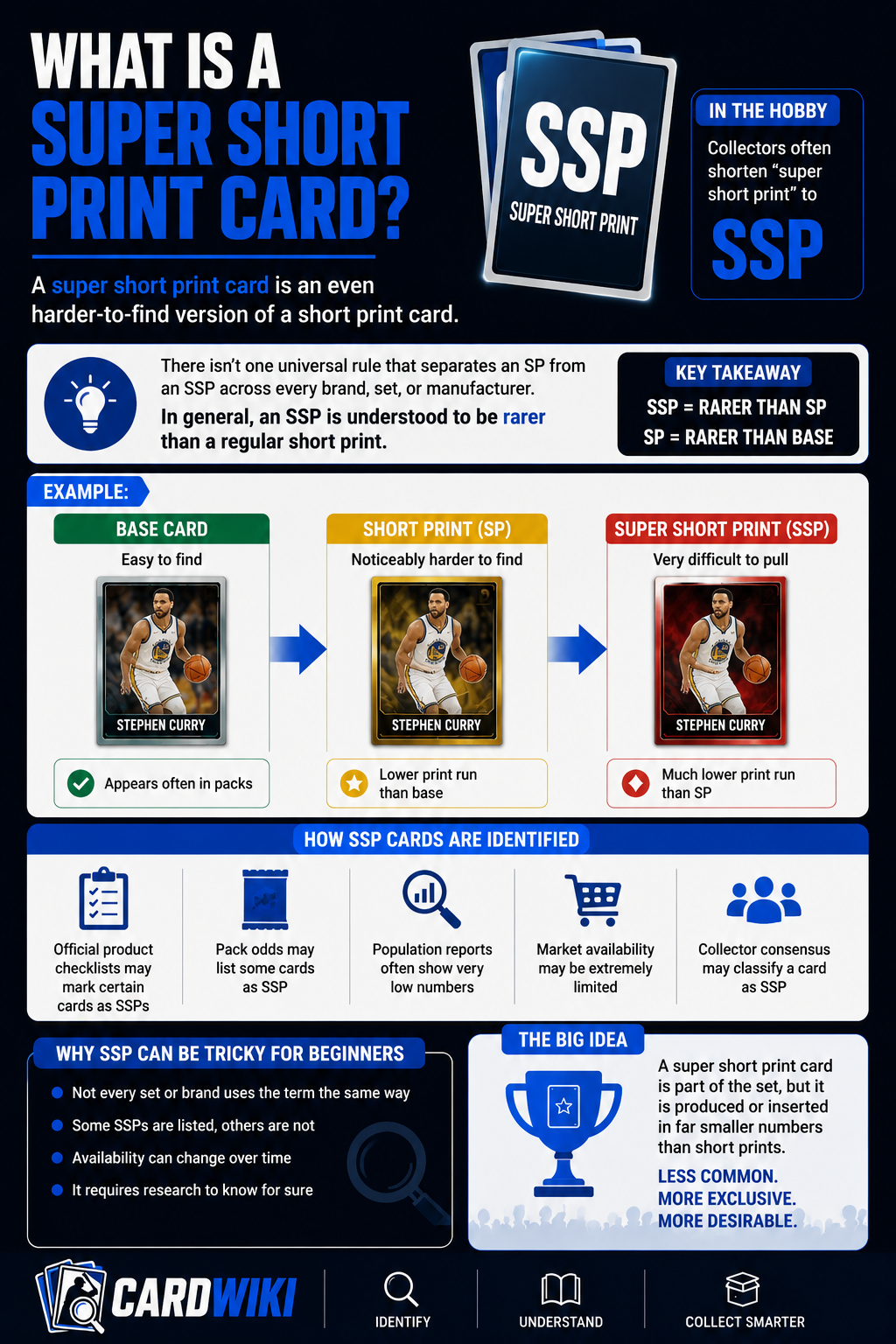
A super short print card is an even harder-to-find version of a short print card.
Collectors often shorten “super short print” to SSP.
There isn’t one universal rule that separates an SP from an SSP across every brand, set, or manufacturer. In general, an SSP is understood to be rarer than a regular short print.
For example:
- A base card might be easy to find
- A short print version might be noticeably harder to find
- A super short print version might be very difficult to pull
Some products officially identify certain cards as SSPs. In other cases, collectors use the term based on pack odds, checklist notes, market availability, or population data.
That’s one reason SSP cards can be tricky for beginners. The term is useful, but it’s not always applied consistently across the hobby.
Short Print Vs Super Short Print: What’s The Difference?
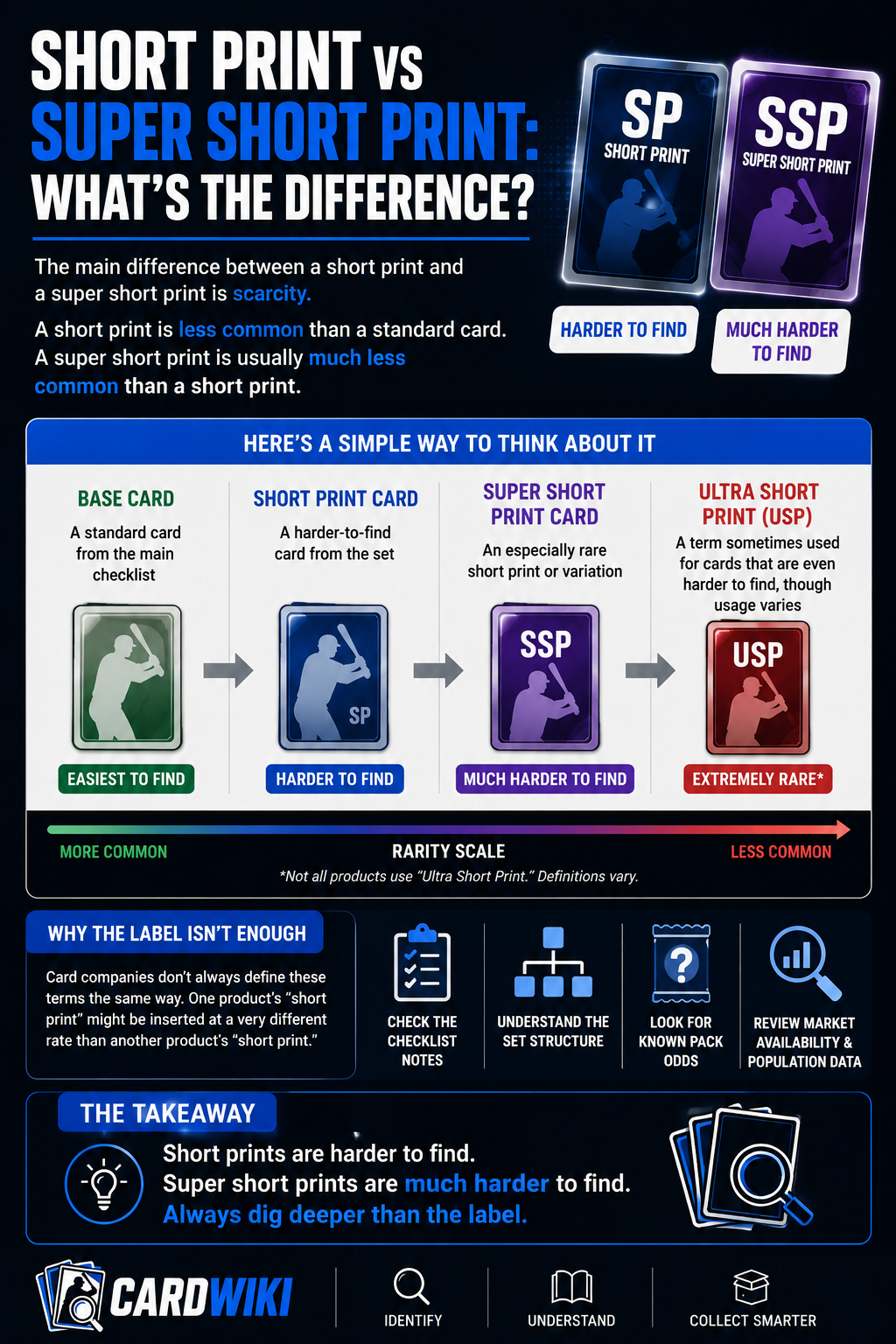
The main difference between a short print and a super short print is scarcity.
A short print is less common than a standard card. A super short print is usually much less common than a short print.
Here’s a simple way to think about it:
- Base Card: A standard card from the main checklist
- Short Print Card: A harder-to-find card from the set
- Super Short Print Card: An especially rare short print or variation
- Ultra Short Print: A term sometimes used for cards that are even harder to find, though usage varies
The challenge is that card companies don’t always define these terms the same way. One product’s “short print” might be inserted at a very different rate than another product’s “short print.”
That’s why collectors should look beyond the label and check the actual card details, checklist notes, set structure, and known pack odds when available.
Why Do Card Companies Make Short Prints?
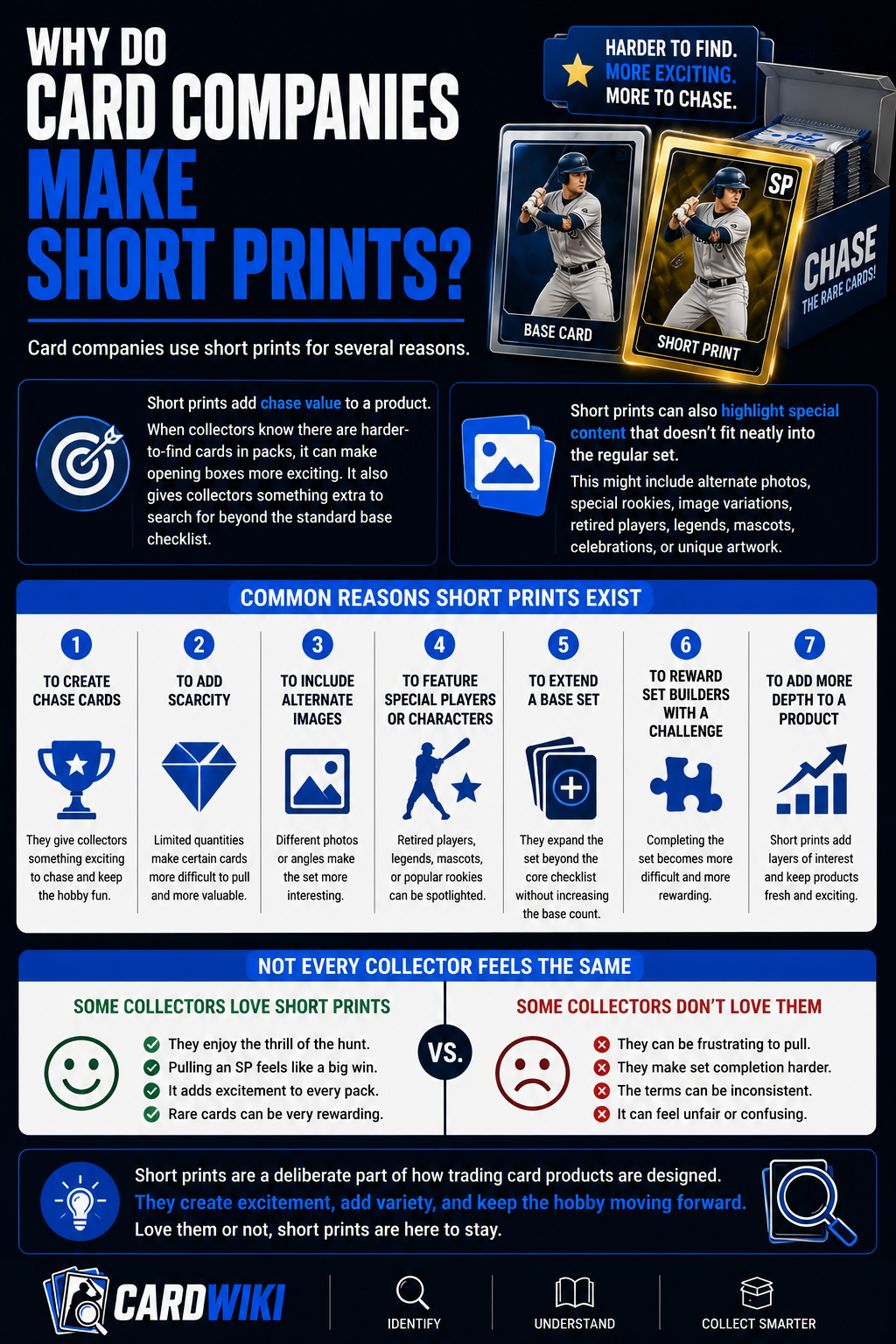
Card companies use short prints for several reasons.
Short prints add chase value to a product. When collectors know there are harder-to-find cards in packs, it can make opening boxes more exciting. It also gives collectors something extra to search for beyond the standard base checklist.
Short prints can also highlight special content that doesn’t fit neatly into the regular set. This might include alternate photos, special rookies, image variations, retired players, legends, mascots, celebrations, or unique artwork.
Common reasons short prints exist include:
- To create chase cards
- To add scarcity
- To include alternate images
- To feature special players or characters
- To extend a base set
- To reward set builders with a challenge
- To add more depth to a product
Not every collector loves short prints. Some enjoy the hunt. Others find them frustrating, especially when trying to complete a full set. Both views are understandable.
Common Types Of Short Print Cards
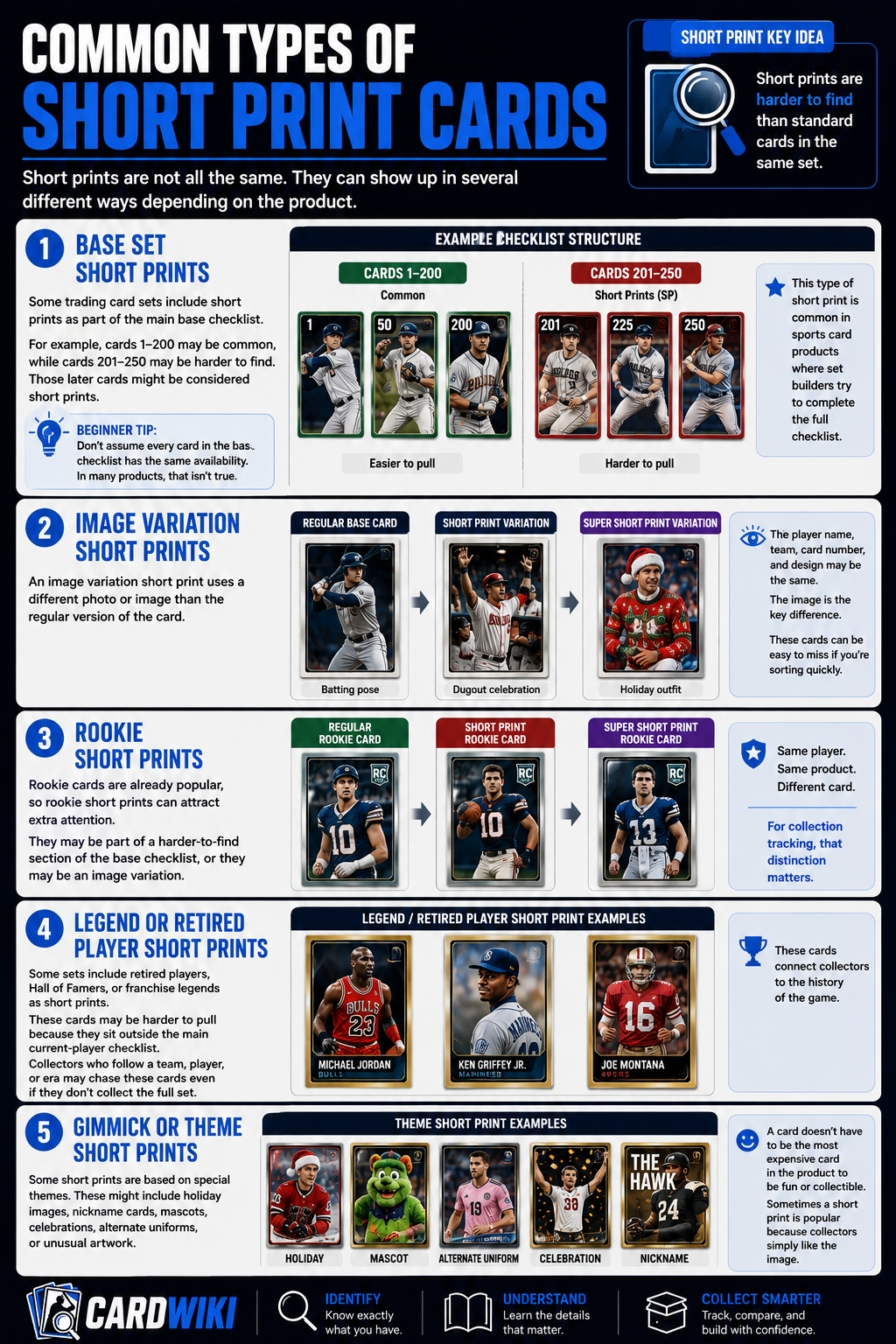
Short prints are not all the same. They can show up in several different ways depending on the product.
Base Set Short Prints
Some trading card sets include short prints as part of the main base checklist.
For example, cards 1 through 200 may be common, while cards 201 through 250 may be harder to find. Those later cards might be considered short prints.
This type of short print is especially common in sports card products where set builders try to complete the full checklist.
A beginner mistake is assuming every card in the base checklist has the same availability. In many products, that isn’t true.
Image Variation Short Prints
An image variation short print uses a different photo or image than the regular version of the card.
For example, a baseball player might have:
- A regular base card showing a batting pose
- A short print variation showing a dugout celebration
- A super short print variation showing a holiday outfit or special moment
The card may look very similar at first glance. The player name, team, card number, and design may all be the same. The image is the key difference.
These cards can be easy to miss if you’re sorting quickly.
Rookie Short Prints
Rookie cards are already popular with collectors, so rookie short prints can attract extra attention.
A rookie short print might be part of a harder-to-find section of the base checklist, or it might be an image variation of a regular rookie card.
This is where card identity matters. A regular rookie card, a short print rookie, and a super short print rookie may all feature the same player from the same product, but they are not the same card.
For collection tracking, that distinction matters.
Legend Or Retired Player Short Prints
Some sets include retired players, Hall of Famers, or franchise legends as short prints.
These cards may be harder to pull because they sit outside the main current-player checklist. Collectors who follow a team, player, or era may chase these cards even if they don’t collect the full set.
Gimmick Or Theme Short Prints
Some short prints are based on special themes. These might include holiday images, nickname cards, mascot appearances, celebration photos, alternate uniforms, or unusual artwork.
These cards often become memorable because they feel different from the standard checklist.
A card doesn’t have to be the most expensive card in the product to be fun or collectible. Sometimes a short print is popular because collectors simply like the image.
How To Identify A Short Print Card
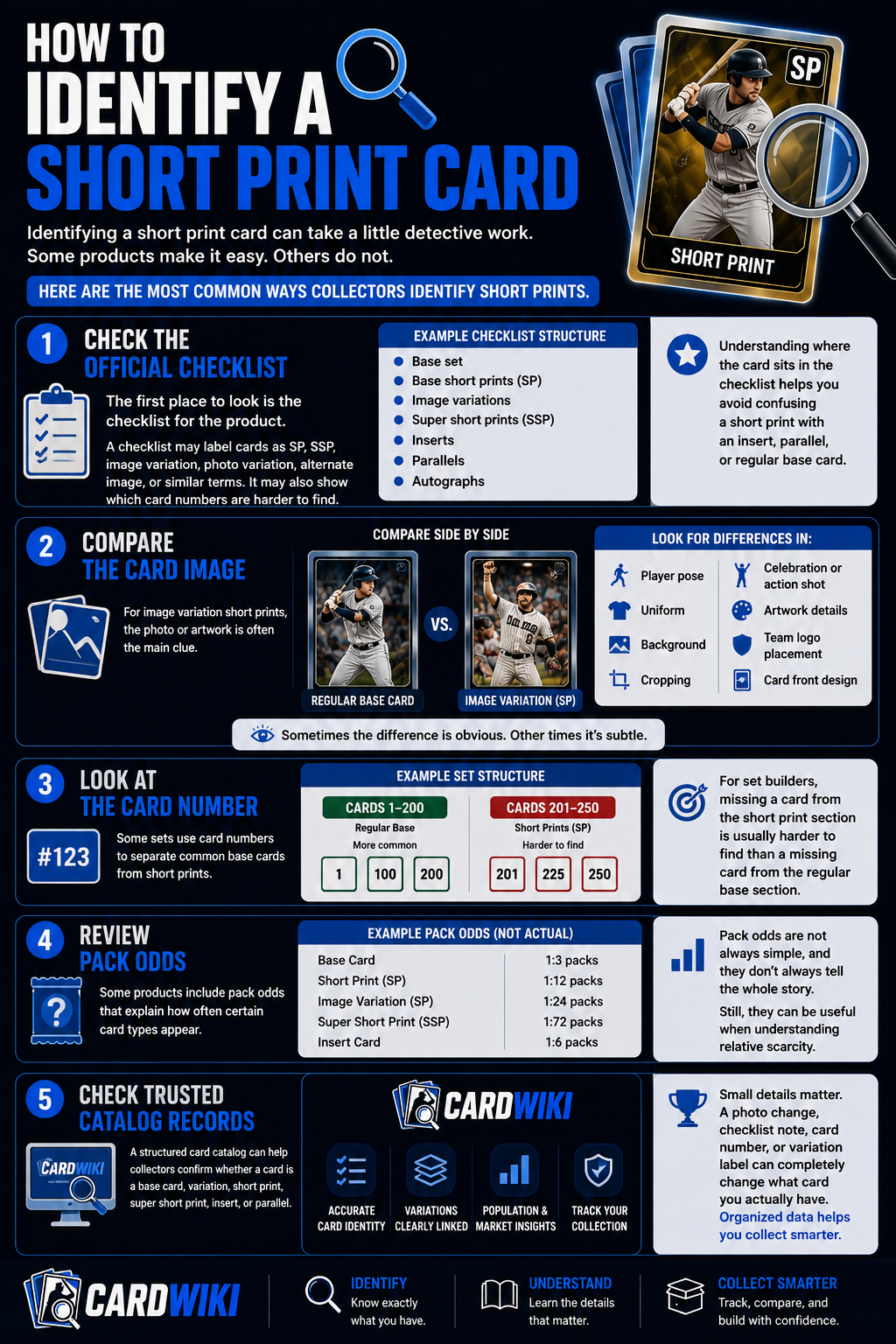
Identifying a short print card can take a little detective work. Some products make it easy. Others do not.
Here are the most common ways collectors identify short prints.
Check The Official Checklist
The first place to look is the checklist for the product.
A checklist may label cards as SP, SSP, image variation, photo variation, alternate image, or similar terms. It may also show which card numbers are harder to find.
For example, a checklist might list:
- Base set
- Base short prints
- Image variations
- Super short prints
- Inserts
- Parallels
- Autographs
Understanding where the card sits in the checklist helps you avoid confusing a short print with an insert, parallel, or regular base card.
Compare The Card Image
For image variation short prints, the photo or artwork is often the main clue.
Look at the regular version of the card and compare it with the card you have. Pay attention to:
- Player pose
- Uniform
- Background
- Cropping
- Celebration or action shot
- Artwork details
- Team logo placement
- Card front design
Sometimes the difference is obvious. Other times it’s subtle.
Look At The Card Number
Some sets use card numbers to separate common base cards from short prints.
For example, a set might have a base checklist where the final 50 cards are short printed. In that case, the card number itself can help you spot the difference.
This is especially important for set builders. A missing card from the short print section may be harder to find than a missing card from the regular base section.
Review Pack Odds
Some products include pack odds that explain how often certain card types appear.
For example, a product might state that a certain variation appears once every specific number of packs. These odds can help collectors understand relative scarcity.
Pack odds are not always simple, and they don’t always tell the whole story. Still, they can be useful when trying to understand whether a card is common, uncommon, rare, or extremely rare.
Check Trusted Catalog Records
A structured card catalog can help collectors confirm whether a card is a base card, variation, short print, super short print, insert, or parallel.
This is one of the reasons CardWiki is built around card identity and structured catalog data. In collecting, small details matter. A photo change, checklist note, card number, or variation label can completely change what card you actually have.
When card records are organized clearly, collectors can make better decisions and track their collections with more confidence.
Short Print Cards Vs Insert Cards
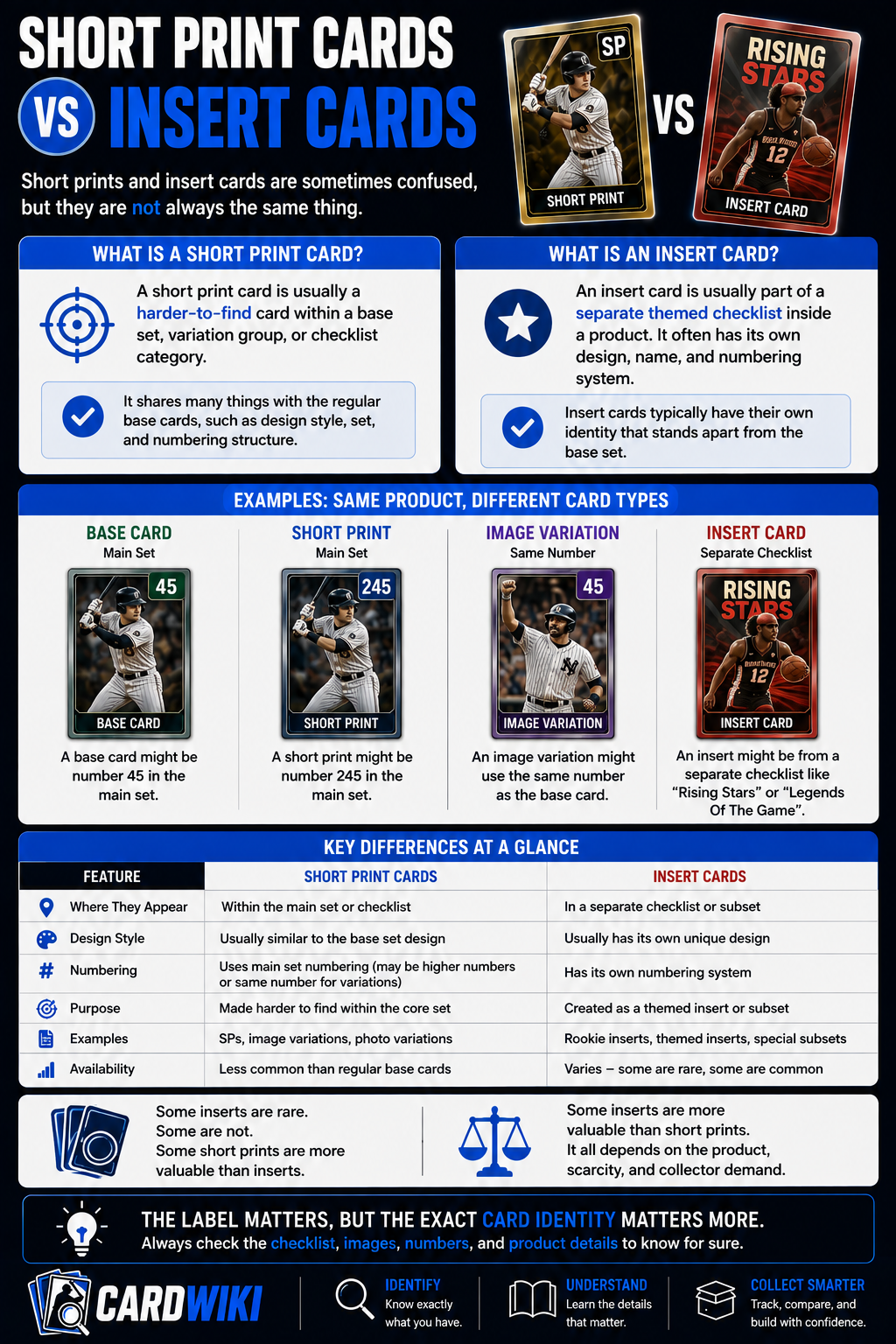
Short prints and insert cards are sometimes confused, but they are not always the same thing.
An insert card is usually part of a separate themed checklist inside a product. It often has its own design, name, and numbering system.
A short print card is usually a harder-to-find card within a base set, variation group, or checklist category.
For example:
- A base card might be number 45 in the main set
- A short print might be number 245 in the main set
- An image variation might use the same number as the base card
- An insert might be from a separate checklist like “Rising Stars” or “Legends Of The Game”
Some inserts are rare. Some are not. Some short prints are more valuable than inserts. Some inserts are more valuable than short prints.
The label matters, but the exact card identity matters more.
Short Print Cards Vs Parallel Cards
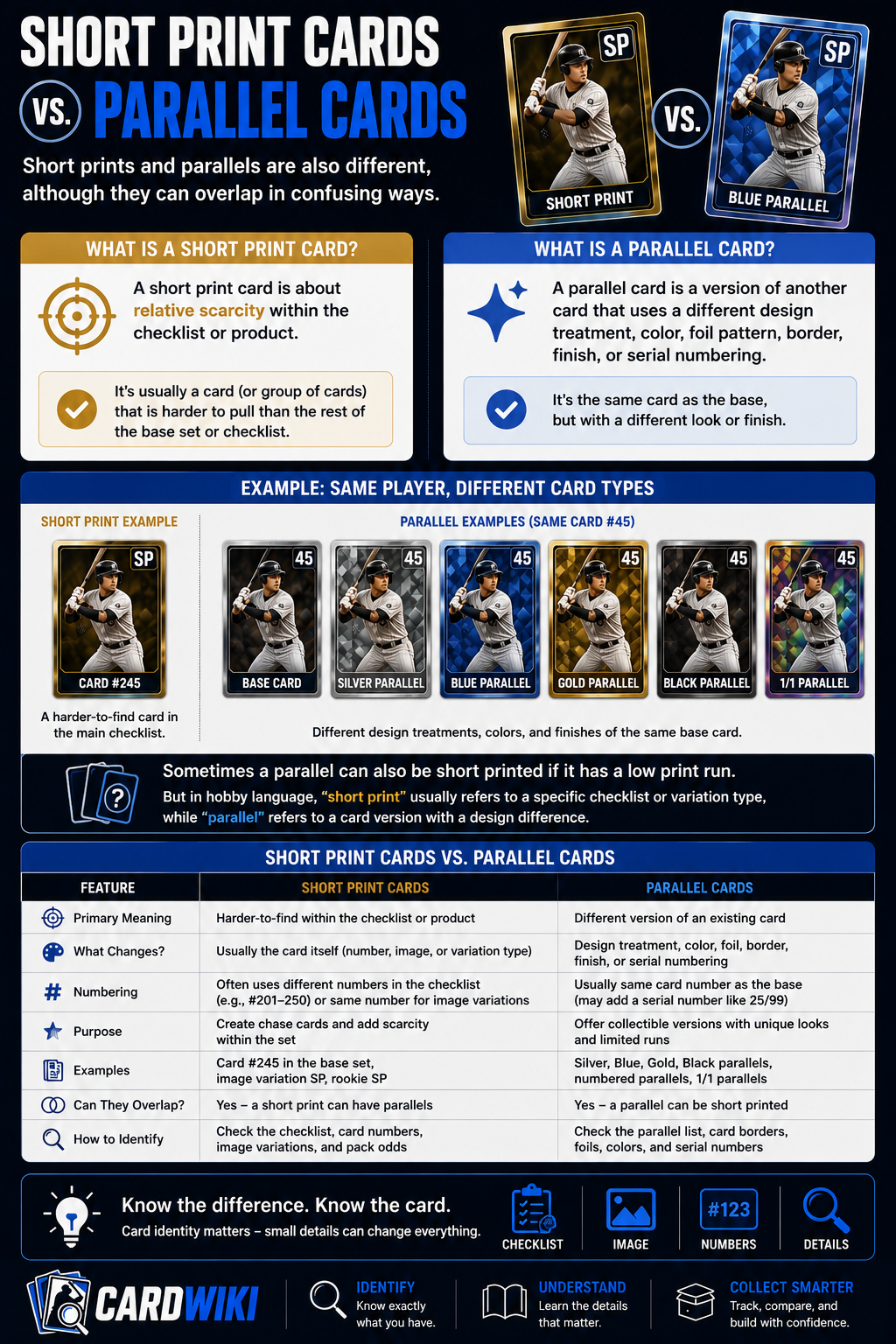
Short prints and parallels are also different, although they can overlap in confusing ways.
A parallel card is a version of another card that uses a different design treatment, color, foil pattern, border, finish, or serial numbering.
For example, a card might have:
- Base version
- Silver parallel
- Blue parallel
- Gold parallel
- Black parallel
- One-of-one parallel
A short print is about relative scarcity within the checklist or product. A parallel is about a different version of an existing card.
Sometimes a parallel can also be short printed if it has a low print run. But in hobby language, “short print” usually refers to a specific checklist or variation type, while “parallel” refers to a card version with a design difference.
Are Short Print Cards Valuable?
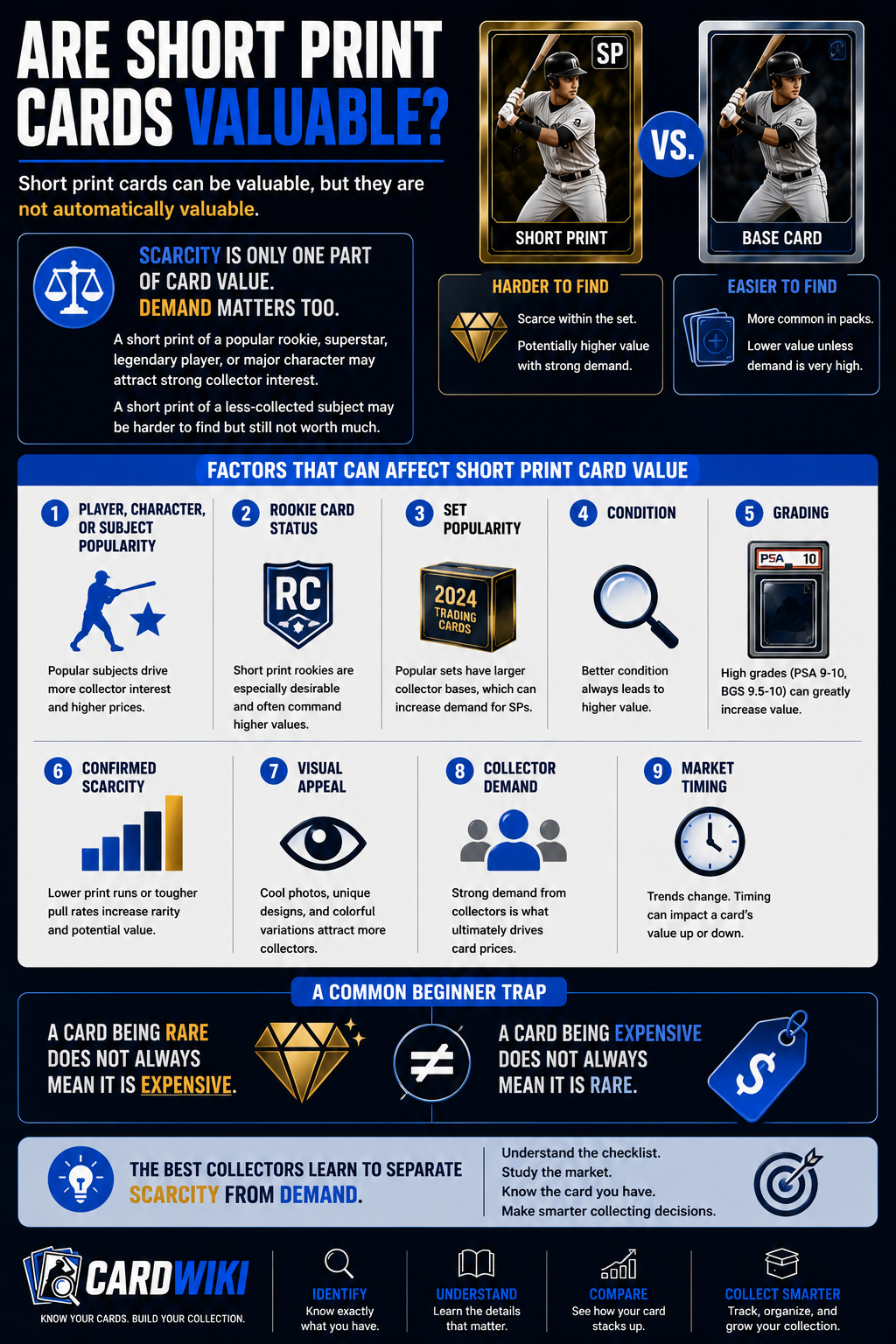
Short print cards can be valuable, but they are not automatically valuable.
Scarcity is only one part of card value. Demand matters too.
A short print of a popular rookie, superstar, legendary player, or major character may attract strong collector interest. A short print of a less-collected subject may be harder to find but still not worth much.
Factors that can affect short print card value include:
- Player, character, or subject popularity
- Rookie card status
- Set popularity
- Condition
- Grading
- Confirmed scarcity
- Visual appeal
- Collector demand
- Market timing
This is a common beginner trap. A card being rare does not always mean it is expensive. A card being expensive does not always mean it is rare.
The best collectors learn to separate scarcity from demand.
Are Super Short Print Cards Always Worth More?
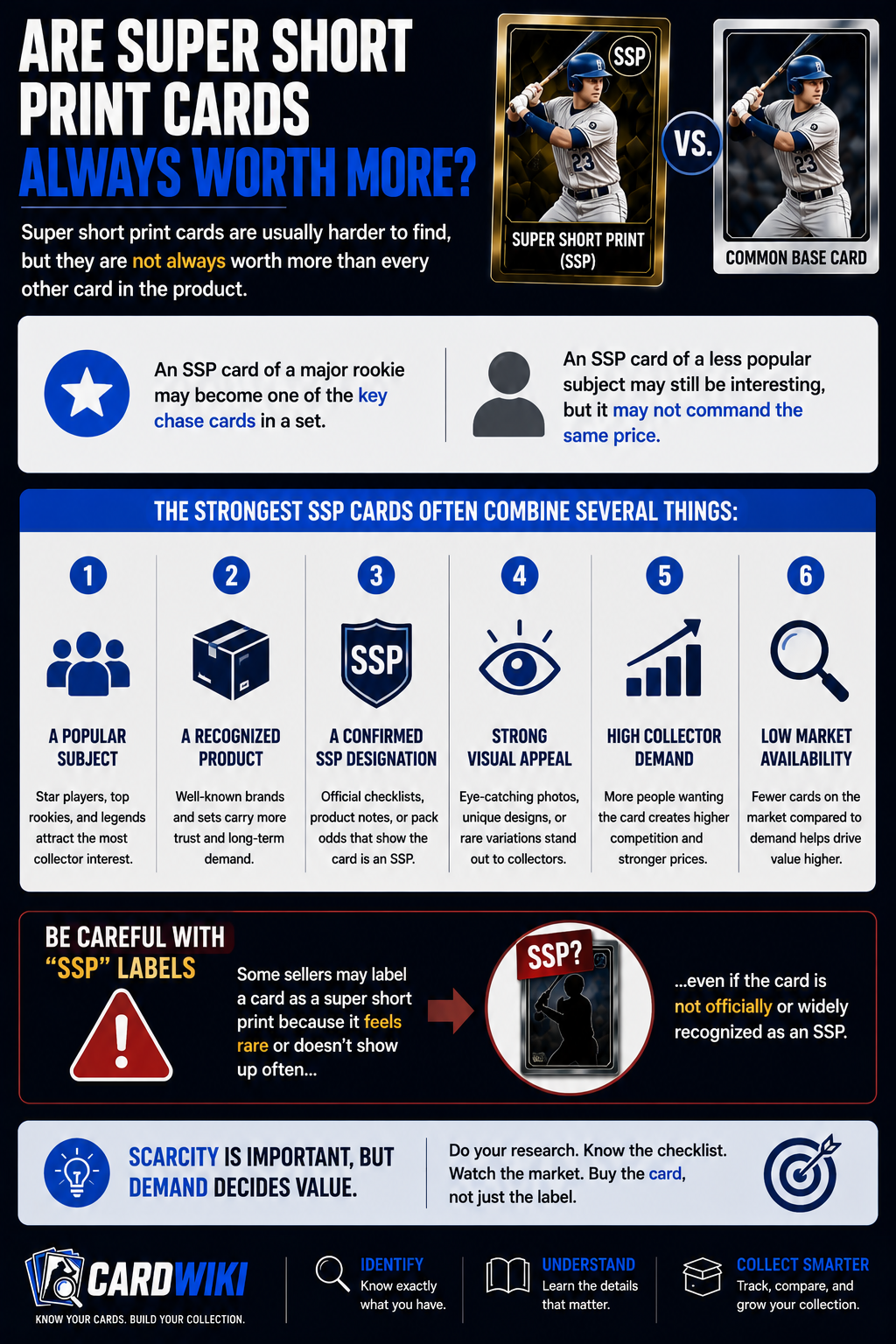
Super short print cards are usually harder to find, but they are not always worth more than every other card in the product.
An SSP card of a major rookie may become one of the key chase cards in a set. An SSP card of a less popular subject may still be interesting, but it may not command the same price.
The strongest SSP cards often combine several things:
- A popular subject
- A recognized product
- A confirmed SSP designation
- Strong visual appeal
- High collector demand
- Low market availability
Collectors should be careful with listings that use “SSP” too casually. Some sellers may label a card as a super short print because it feels rare or doesn’t show up often, even if the card is not officially or widely recognized as an SSP.
Common Beginner Mistakes With Short Prints
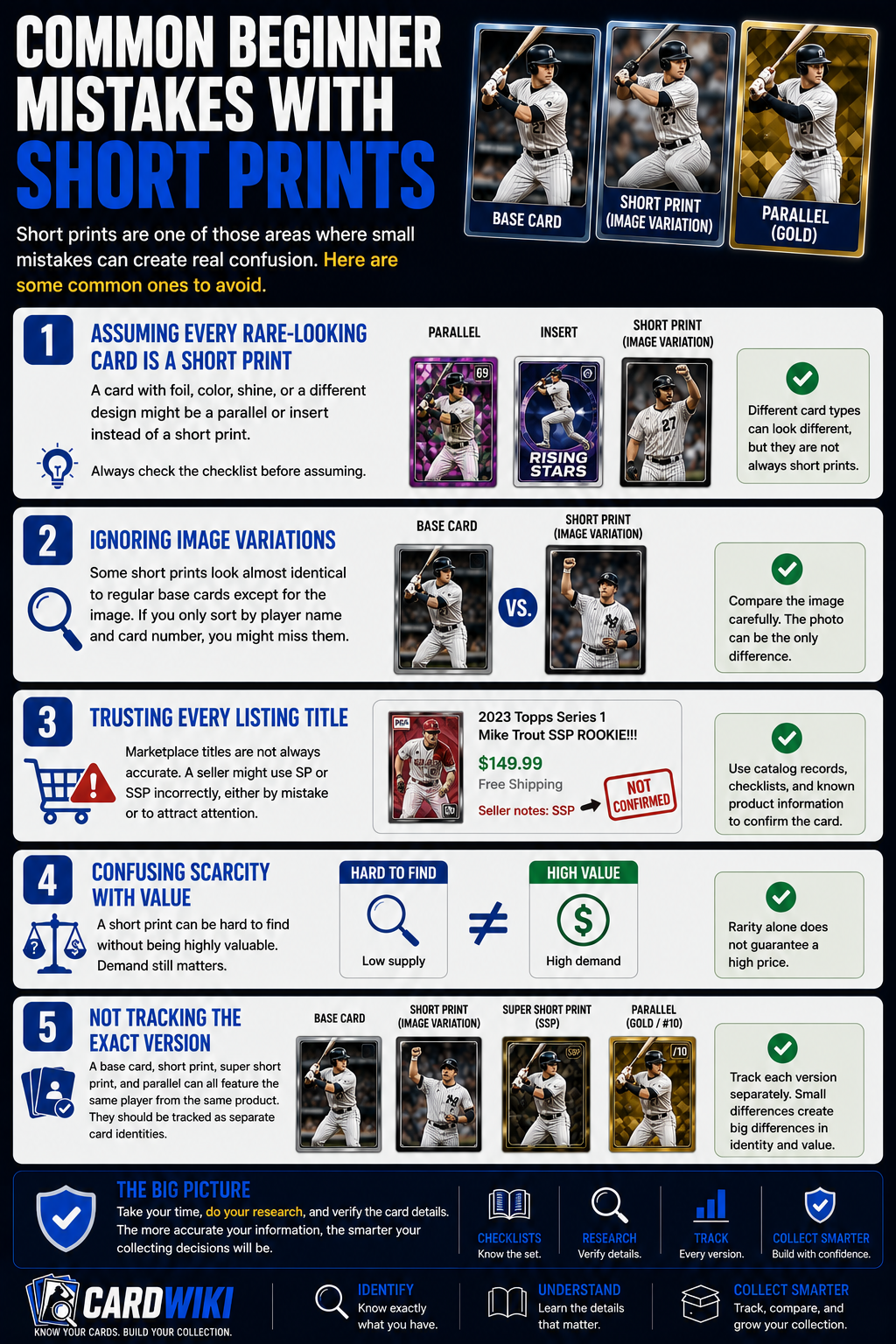
Short prints are one of those areas where small mistakes can create real confusion. Here are some common ones to avoid.
Assuming Every Rare-Looking Card Is A Short Print
A card with foil, color, shine, or a different design might be a parallel or insert instead of a short print.
Always check the checklist before assuming.
Ignoring Image Variations
Some short prints look almost identical to regular base cards except for the image. If you only sort by player name and card number, you might miss them.
Trusting Every Listing Title
Marketplace titles are not always accurate. A seller might use SP or SSP incorrectly, either by mistake or to attract attention.
Use catalog records, checklists, and known product information to confirm the card.
Confusing Scarcity With Value
A short print can be hard to find without being highly valuable. Demand still matters.
Not Tracking The Exact Version
A base card, short print, super short print, and parallel can all feature the same player from the same product. They should be tracked as separate card identities.
This is especially important if you collect rookies, team sets, master sets, or graded cards.
Why Short Prints Matter For Set Builders
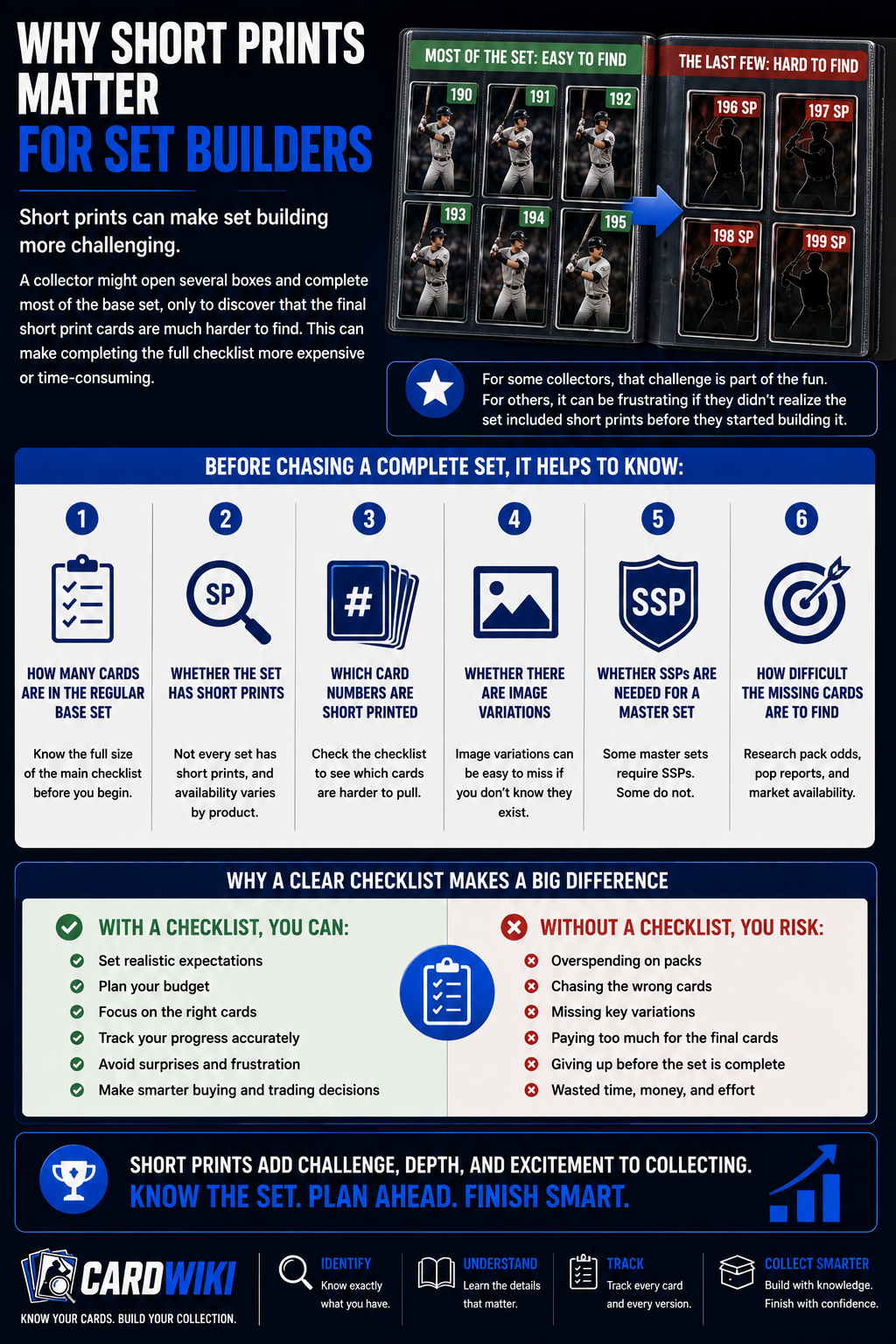
Short prints can make set building more challenging.
A collector might open several boxes and complete most of the base set, only to discover that the final short print cards are much harder to find. This can make completing the full checklist more expensive or time-consuming.
For some collectors, that challenge is part of the fun. For others, it can be frustrating if they didn’t realize the set included short prints before they started building it.
Before chasing a complete set, it helps to know:
- How many cards are in the regular base set
- Whether the set has short prints
- Which card numbers are short printed
- Whether there are image variations
- Whether SSPs are needed for a master set
- How difficult the missing cards are to find
A clear checklist can save collectors time, money, and confusion.
How CardWiki Helps With Short Print Card Identity
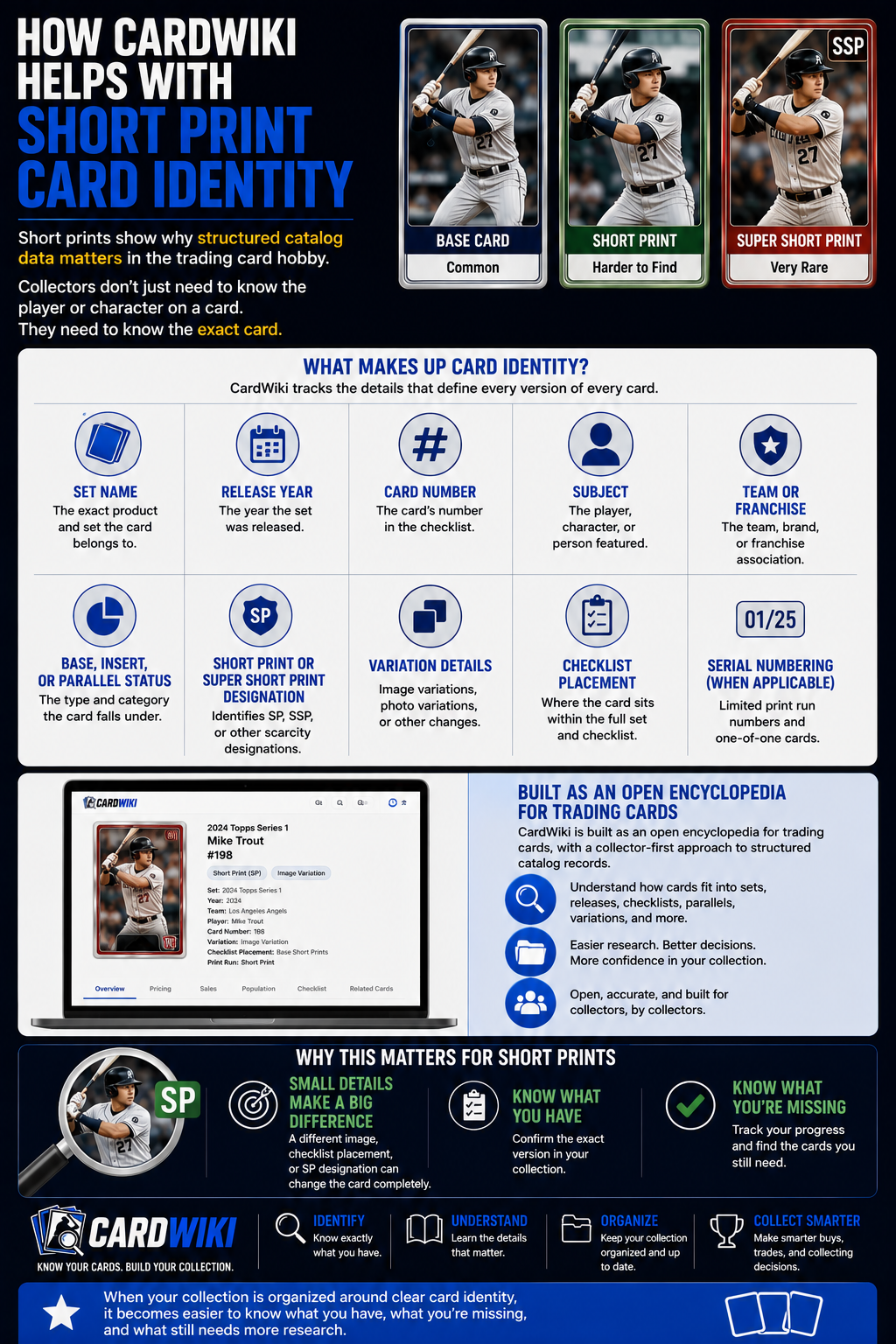
Short prints show why structured catalog data matters in the trading card hobby.
Collectors don’t just need to know the player or character on a card. They need to know the exact card.
That can include:
- Set name
- Release year
- Card number
- Subject
- Team or franchise
- Base, insert, or parallel status
- Short print or super short print designation
- Variation details
- Checklist placement
- Serial numbering when applicable
CardWiki is built as an open encyclopedia for trading cards, with a collector-first approach to structured catalog records. That structure helps collectors understand how cards fit into sets, releases, checklists, parallels, variations, and personal holdings.
For short prints, this is especially useful because the difference between a regular card and a harder-to-find version may come down to one small detail.
When your collection is organized around clear card identity, it becomes easier to know what you have, what you’re missing, and what still needs more research.
A Simple Example Of A Short Print
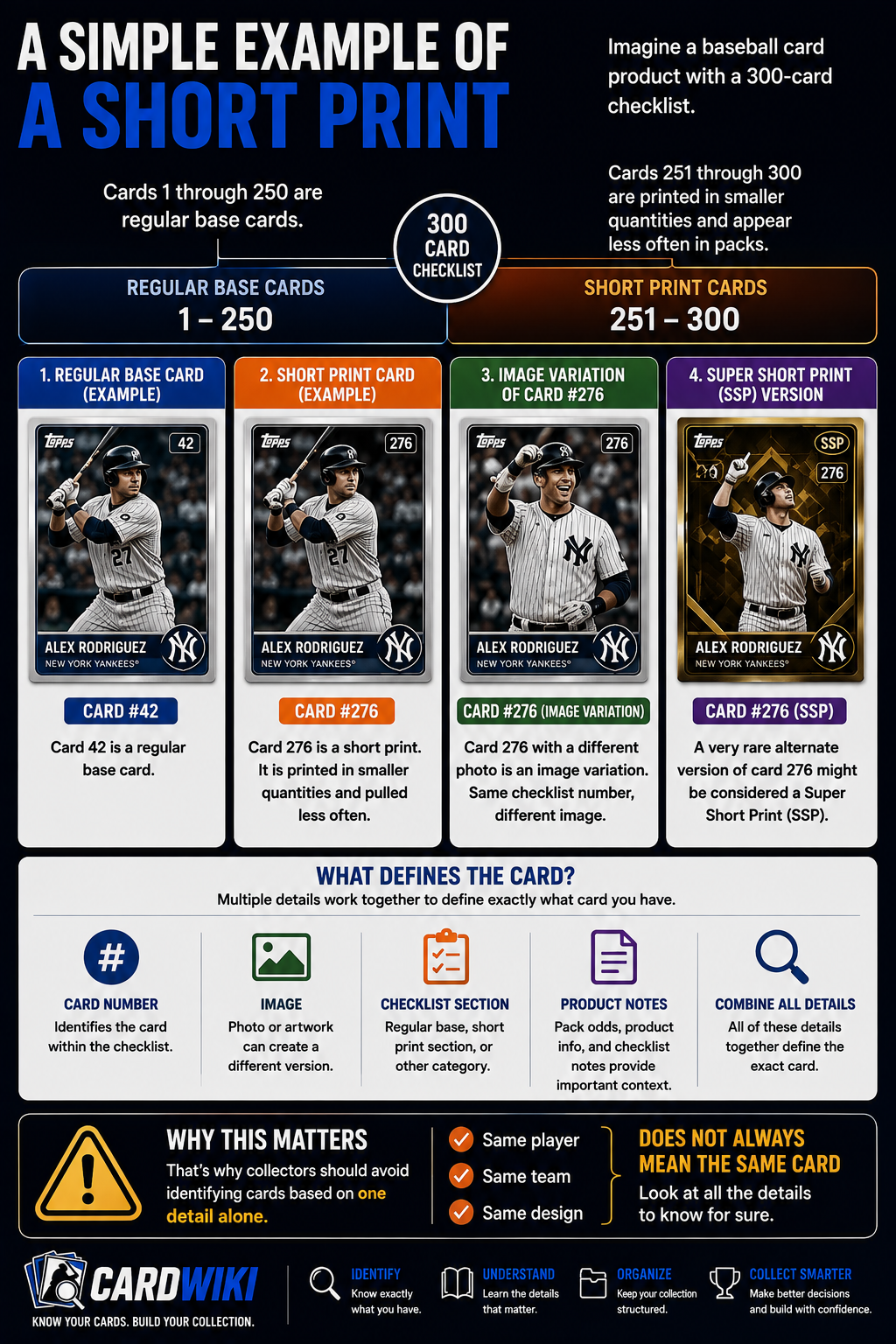
Imagine a baseball card product with a 300-card checklist.
Cards 1 through 250 are regular base cards. Cards 251 through 300 are printed in smaller quantities and appear less often in packs.
In that case:
- Card 42 is a regular base card
- Card 276 is a short print
- Card 276 with a different photo might be an image variation
- A very rare alternate version of card 276 might be considered an SSP
The card number, image, checklist section, and product notes all help define what the card actually is.
That’s why collectors should avoid identifying cards based on one detail alone.
Final Thoughts On Short Print And Super Short Print Cards
A short print card is a trading card made or inserted in smaller quantities than standard cards in the same product. A super short print card is usually an even rarer version, often harder to pull and more difficult to find.
Short prints matter because they affect collecting, set building, card identification, and sometimes value. But they can also be misunderstood. Not every rare-looking card is a short print. Not every short print is valuable. Not every seller uses SP or SSP correctly.
The best approach is to identify the exact card, compare it against the checklist, understand where it fits in the set, and track it clearly.
For collectors, that structure makes the hobby easier to enjoy.
If you are trying to understand your cards more clearly, CardWiki can help you explore structured catalog records, identify short prints and variations, and track your collection with more confidence.
FAQs
What Does SP Mean On A Trading Card?
SP means short print. It usually refers to a card that was made or inserted in smaller quantities than standard cards in the same set.
What Does SSP Mean On A Trading Card?
SSP means super short print. It usually describes a card that is even harder to find than a regular short print.
Are Short Print Cards Rare?
Short print cards are usually rarer than regular base cards, but rarity depends on the specific product, checklist, and print run.
Are Short Print Cards Worth More?
Sometimes. A short print card may be worth more if collectors want it, especially if it features a popular rookie, star, legend, or character. Scarcity alone does not guarantee high value.
How Can I Tell If My Card Is A Short Print?
Check the product checklist, compare the card image, look at the card number, review pack odds when available, and use trusted catalog records to confirm the exact version.
Is A Short Print The Same As A Parallel?
No. A parallel is usually a different version of a card with a design change, color, foil, or numbering. A short print is about lower availability within a product or checklist.
Is A Short Print The Same As An Insert?
No. An insert is usually part of a separate themed checklist. A short print is usually a harder-to-find card within a base set, variation group, or checklist section.
Do All Card Sets Have Short Prints?
No. Some sets have short prints, some do not, and some include them without making them obvious at first glance.
Should I Track Short Prints Separately In My Collection?
Yes. A short print, super short print, base card, variation, and parallel should be tracked as separate card identities because they are different versions of a card.