
Bowman Baseball Explained: 1st Bowman, Chrome, Draft, and Autos
Learn what 1st Bowman means, how Bowman Draft and Chrome differ, and why prospect cards, Refractors, and autographs matter to baseball trading card collectors.
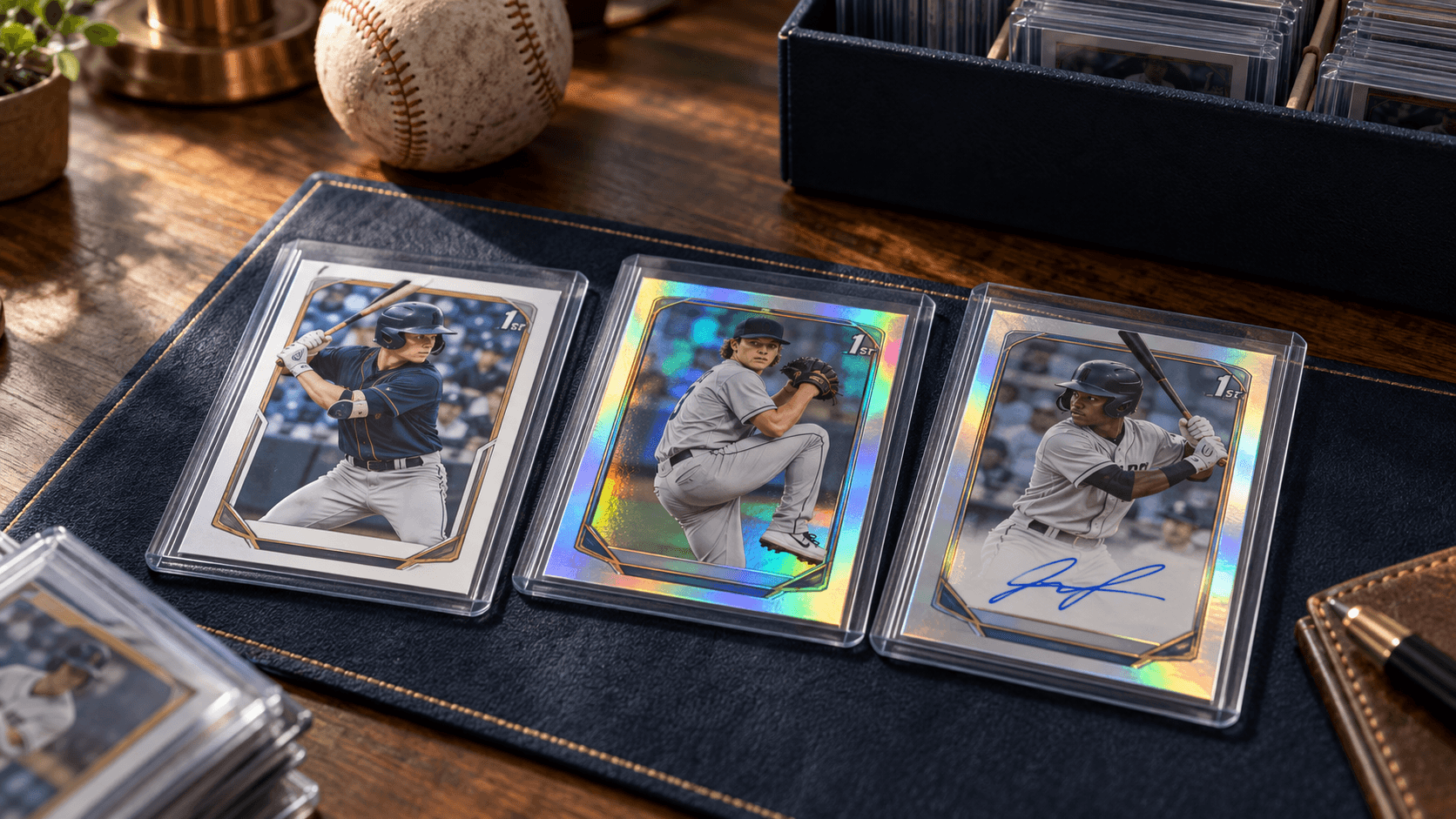
Bowman baseball is built around collecting players before they become established Major League stars. A 1st Bowman identifies a player's designated first Bowman prospect issue, while an official rookie card carries a separate MLB rookie designation. Bowman Baseball, Bowman Chrome, and Bowman Draft give collectors different ways to follow that journey through prospect cards, Chrome versions, parallels, and autographs.
For newcomers to sports card collecting, Bowman can feel like a hobby inside the hobby. One player might have a paper prospect card, a Chrome prospect card, several colored parallels, an autograph, and a later rookie card. Understanding what each represents makes the entire lineup easier to understand.
What Is Bowman Baseball?
Bowman is a Topps brand closely associated with prospect collecting. Its appeal comes from introducing collectors to emerging players who may still be years away from an MLB debut.
However, Bowman does not consist entirely of prospects. Bowman Baseball can include MLB veterans and rookies alongside separate prospect checklists. Topps' official Bowman Baseball page explains that its 2026 release has a 100-card base set of MLB stars and rookies plus a 150-card Bowman Prospect set.
That structure explains why two cards from the same product can represent very different career stages. One might show an established big leaguer, while another introduces a recently signed prospect.
What Is 1st Bowman?
The 1st Bowman logo identifies a player's designated first Bowman prospect issue. Collectors use it to recognize an early milestone in that player's card history.
The designation is printed on the card. It is not something a seller can establish simply by calling a listing a first card.
A player's 1st Bowman offerings may include paper, Chrome, and autograph versions. These are separate cards, even when they feature the same player and similar photography.
Also, the logo should not be treated as proof that no earlier card of the player exists anywhere. Earlier amateur, promotional, or other issues may require separate research. For Bowman collecting, focus on the printed designation and the exact release.
Not every Bowman prospect card is a 1st Bowman. Players can appear again in later prospect sets without receiving another first designation.
Why Is 1st Bowman Different From an Official Rookie Card?
A 1st Bowman prospect card and an official MLB rookie card mark different events.
A 1st Bowman generally appears while the player is still a prospect. An official rookie card belongs to the player's MLB rookie-card releases and typically carries the RC logo. Topps defines rookie cards as following an MLB debut, with releases in the debut year or the following year.
Imagine a player whose 1st Bowman appears in 2024, followed by an MLB debut and RC-logo cards in 2027. The 2024 card remains a prospect card. Reaching the majors does not retroactively turn it into an official RC.
Bowman products can also contain actual rookie cards. The brand name alone does not determine the card's category. Inspect the individual card, its logo, and its checklist section.
Why Prospecting Is Central to Bowman
Prospecting means collecting players before their Major League careers are established. Topps connects the practice closely with Bowman Draft and Bowman Chrome, including draft picks and international signees.
For a team collector, that might mean following a newly drafted shortstop from his first professional season. For another collector, it might mean building a collection around an international signing long before casual fans recognize the name.
The attraction is participating in a player's story early. The uncertainty is that the story is still unfolding.
Player development, injuries, roster opportunities, and changing expectations can all alter how collectors view a prospect. A high draft position or exciting scouting report does not promise a successful MLB career.
An early card can be meaningful without becoming expensive. Treat the player connection and the exact card identity as separate questions from any expectations about future prices.
Bowman Baseball vs. Bowman Chrome vs. Bowman Draft
Understanding how trading card releases work helps you separate a product name from a checklist, finish, or box configuration. Bowman has connected releases, but each must be identified individually.
Bowman Baseball combines MLB veterans, rookies, and prospects, with paper cards and Chrome prospect content. It introduces another group of emerging players while giving collectors a broader baseball checklist.
Bowman Chrome is a standalone Chrome release with MLB stars, rookies, and prospects. Topps describes the 2026 product as introducing collectors to the international talent pipeline.
Bowman Draft centers on the MLB Draft class and other prospects. It includes paper and Chrome cards, early autographs, and numerous 1st Bowman subjects.
| Release | Main collecting focus | Typical card formats |
|---|---|---|
| Bowman Baseball | MLB veterans, rookies, and prospects | Paper cards with Chrome prospect content |
| Bowman Chrome | Prospects, including international talent, plus MLB players | Chrome cards |
| Bowman Draft | MLB draft picks and other prospects | Paper and Chrome cards |
Think of these products as different entry points into prospect collecting. Draft directs attention toward recently drafted players. Chrome places particular emphasis on international emerging talent. Bowman Baseball offers a broader blend.
The broader trading card set structure follows the same principle: related products can have separate base, prospect, insert, and autograph checklists.
Those are general product identities, not guarantees that every player appears in every release. Check the specific year's checklist before looking for a particular player or autograph.
Why Bowman Draft Focuses on Draft Picks
The MLB Draft brings new players into professional organizations, giving Bowman Draft a natural starting point for another class of prospects.
Collectors can connect a player's draft story with an early card: the team that selected him, his college or high school background, and the expectations surrounding his professional career.
Bowman Draft does not mean every card is a 1st Bowman, and a checklist should not be assumed to include every draft pick. Topps' 2025 Bowman Draft guide describes a set featuring both draft picks and other top prospects.
Also, the product year and calendar release year can differ. Topps lists 2025 Bowman Draft's hobby release in January 2026. Use the product's stated year when identifying the card.
What Does Chrome Mean in Bowman?
Chrome describes a card's chromium-style construction and reflective finish. However, Bowman Chrome is also the name of a standalone product.
Collectors familiar with Topps Chrome and its related editions will recognize the need to record the exact release. Understanding how Topps baseball releases work also helps prevent Bowman Chrome and Topps Chrome from being mixed together. They belong to different brands within the Topps portfolio.
Consequently, a Chrome prospect card can come from Bowman Baseball or Bowman Draft without coming from the standalone Bowman Chrome release.
When identifying a card, record both its product and its card type. "Bowman Chrome prospect" alone may leave out the information needed to locate the right checklist.
A base Chrome card is also different from a Refractor parallel. Our guide to Refractor, Prizm, Chrome, and Holo terminology explains the broader finish vocabulary.
Refractors add a distinct reflective treatment, and releases may offer different colors or patterns. Some parallel cards are serial numbered, but do not assume every Refractor has a printed number.
Understanding serial-numbered cards helps you read that information correctly. For example, 17/50 identifies an individual copy within a 50-copy numbered parallel. It does not mean that only 50 total cards of that player exist across the release.
For a broader comparison of colors, patterns, and finishes, our Topps parallels guide explains why a color word alone is never a complete card identity.
Why Chrome Autographs Matter to Prospect Collectors
A 1st Bowman Chrome autograph combines an early prospect designation, a Chrome card, and the player's signature. That combination helps explain why collectors pay close attention to these cards.
Topps' 2026 Bowman collector guide highlights Chrome Prospect Autographs as major chase cards, including signed 1st Bowman offerings and Refractor parallels.
Our guide to base, parallel, autograph, and memorabilia card types explains how a signature adds another attribute to a card.
Still, an autograph alone does not make a card a 1st Bowman. Identify the printed logo and the autograph checklist category. A later prospect autograph, a rookie autograph, and a signed 1st Bowman represent different cards.
Also distinguish an on-card signature from a sticker autograph. With an on-card autograph, the player signs the card directly. With a sticker autograph, the signed label is applied to the card. Verify the exact issue rather than assuming all Bowman signatures use one method.
Are Bowman Inserts, Variations, and Short Prints the Same Thing?
They describe different parts of a release.
A prospect base card belongs to a prospect checklist. A parallel changes a recognized version attribute. An insert card usually belongs to a separate themed checklist. Our comparison of base cards, inserts, and parallels explains those relationships in more detail.
An insert featuring a prospect isn't automatically that player's 1st Bowman. A familiar photograph or an early product year is not enough to establish the designation.
Likewise, photo and image variations can change the image or another recognized detail without being simple color parallels. Short prints and super short prints concern limited availability, but should not automatically be equated with serial-numbered cards.
Verify how the manufacturer identifies the exact card. Don't infer an undocumented print run from a listing that says "rare."
Do Hobby Boxes and Mega Boxes Change the Card?
A box configuration explains how cards are packaged and distributed. It does not automatically create a new identity for every card inside.
The same standard card can appear in more than one configuration. An exclusive parallel, however, may have its own finish or pattern and a separate checklist identity.
Our guide to hobby boxes, retail boxes, blasters, and mega boxes explains why collectors should record configuration separately from the card's version. Check the specific product's contents and odds before assuming a box includes certain autographs or parallels.
How to Identify a Bowman Card Correctly
The basic process follows our guide to identifying a trading card. If the release is unclear, start with determining what set the card belongs to.
Use this practical checklist when reviewing a card or listing:
- Confirm the player and product year
- Identify the release: Bowman Baseball, Bowman Chrome, or Bowman Draft
- Check whether the card is paper or Chrome
- Look for the printed 1st Bowman or RC logo
- Match the card number to the official trading card checklist section
- Identify the exact parallel and any serial numbering
- Confirm whether it is a manufacturer-issued autograph and which autograph category it belongs to
Request clear front and back images if any detail is missing. An incomplete listing title


