What Are Pack Odds? How to Read Odds, Ratios, Box Averages, and “On Average” Language
Meta Description:** Learn how trading card pack odds work, what 1:10 means, how box averages differ from guarantees, and why every pack remains a game of probability.
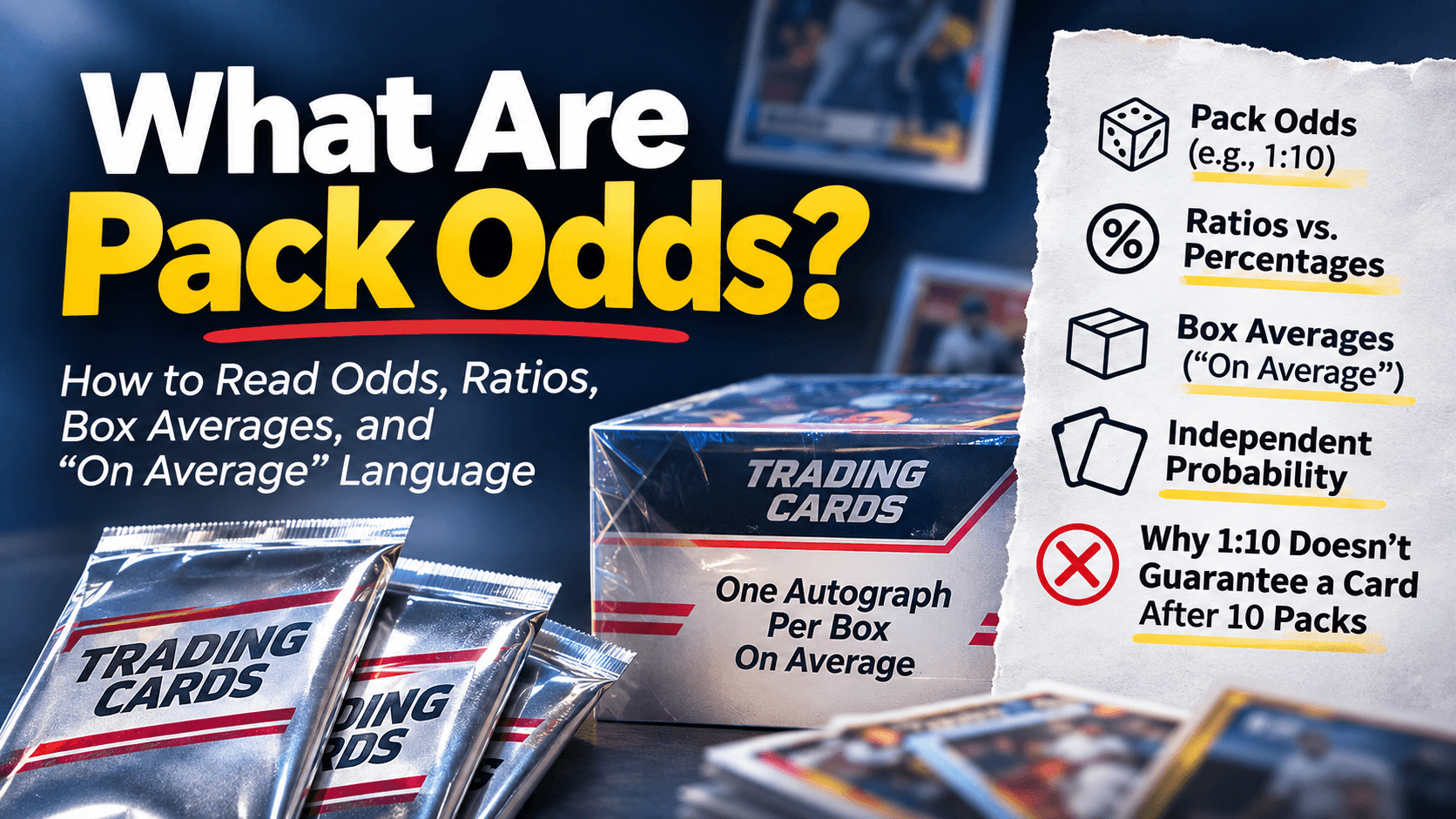
Open a box of trading cards and you'll encounter phrases such as 1:10 packs, 1:100 packs, one autograph per box on average, or approximately two numbered cards per box.
Those statements sound simple, but they're easy to misunderstand.
If the odds are 1:10, does buying 10 packs guarantee the card?
No.
If a box says one autograph per box on average, must every box contain an autograph?
Not necessarily.
Pack odds describe probability or expected distribution. They do not always describe a guaranteed sequence of cards.
Understanding the difference helps collectors interpret product information correctly, compare different trading card configurations, and set realistic expectations before opening packs.
It also prevents one of the most common mistakes in the hobby: treating an average like a promise.
What Are Pack Odds?
Pack odds describe the probability of pulling a particular card, insert, parallel, autograph, memorabilia card, or other type of card from a pack.
If you're still learning how those categories differ, CardWiki's guide to base cards, parallels, autographs, and patch cards explains the basic structure.
Pack odds are commonly written as a ratio.
Examples include:
- 1:2 packs
- 1:10 packs
- 1:24 packs
- 1:100 packs
- 1:1,000 packs
A ratio such as 1:10 means the stated card or card type is expected to appear at a rate equivalent to approximately one occurrence for every 10 packs across the relevant distribution.
It does not mean every group of exactly 10 packs contains one.
That difference between probability and guarantee is the foundation for understanding trading card odds.
What Does 1:10 Mean in Trading Cards?
If a card has odds of 1:10 packs, the simple interpretation is:
Each applicable pack has approximately a 1 in 10 chance of producing that result.
A 1 in 10 probability is equivalent to:
10%
The math is:
1 ÷ 10 = 0.10
0.10 × 100 = 10%
Other common odds work the same way.
Pack Odds Ratio to Percentage Chart
| Pack Odds | Probability Per Pack |
|---|---|
| 1:2 | 50% |
| 1:4 | 25% |
| 1:5 | 20% |
| 1:10 | 10% |
| 1:20 | 5% |
| 1:25 | 4% |
| 1:50 | 2% |
| 1:100 | 1% |
| 1:200 | 0.5% |
| 1:500 | 0.2% |
| 1:1,000 | 0.1% |
The larger the second number becomes, the lower the probability of pulling that card from a single applicable pack.
Ratio vs Percentage: What's the Difference?
Ratios and percentages can describe the same probability in different forms.
Consider:
1:10
This means one chance out of ten.
As a percentage:
10%
Consider:
1:25
The conversion is:
1 ÷ 25 = 0.04
That equals:
4%
Neither format changes the underlying probability.
Collectors may find ratios easier when reading pack odds because manufacturers commonly present odds as something like 1:8, 1:72, or 1:450.
Percentages can sometimes make those numbers easier to understand.
For example:
1:200 may feel abstract.
Expressed as a percentage, it becomes:
0.5% per pack
That makes the pull probability easier to visualize.
Why Doesn't 1:10 Guarantee a Card in 10 Packs?
This is the most important concept in the entire discussion.
A 1:10 probability does not mean the packs operate like numbered slots where exactly one of every 10 must contain the card.
Each pack represents another chance.
Imagine flipping a coin.
The probability of heads is 50%.
If you flip the coin twice, you're not guaranteed to get exactly one head and one tail.
You could get:
- Heads, heads
- Heads, tails
- Tails, heads
- Tails, tails
Trading card pack odds work on the same basic probability principle.
If a card has a 10% chance per pack, opening one pack and missing does not make the next pack an automatic hit.
A collector could open 10 packs and pull none.
Another collector could pull two.
Another could hit one in the first pack.
The odds describe the probability attached to each applicable pack rather than a countdown toward a guaranteed hit.
Are Pack Odds Independent?
When odds are described as independent per pack, the result of one pack does not change the stated probability of the next pack.
Suppose a particular insert card has odds of:
1:10 packs
You open pack one and miss.
Pack two does not suddenly become 1:9.
You open nine packs and miss all nine.
Pack ten does not suddenly become guaranteed.
The stated per-pack probability remains approximately 10%.
This can feel counterintuitive because people naturally expect results to "even out" quickly.
Probability doesn't work that way over short runs.
Averages become more meaningful across large numbers of packs, boxes, cases, or an entire production run.
What Is the Probability of Getting at Least One Hit in Multiple Packs?
This is where pack odds become more interesting.
Suppose each pack has a 10% probability of containing a certain card.
That means each pack also has a:
90% probability of not containing it
If you open 10 packs, the chance of missing all 10 is:
0.9¹⁰
That works out to roughly:
34.9%
The probability of getting at least one is approximately:
65.1%
So even with odds of 1:10, there's still roughly a one-in-three mathematical chance of opening 10 independent packs and missing completely.
1:10 Odds: Chance of Pulling at Least One Hit
| Packs Opened | Chance of At Least One Hit |
|---|---|
| 1 | 10.0% |
| 5 | 41.0% |
| 10 | 65.1% |
| 20 | 87.8% |
| 30 | 95.8% |
| 50 | 99.5% |
This chart shows why 1:10 should never be interpreted as guaranteed within 10 packs.
The probability rises as more packs are opened, but it does not become a guarantee merely because the number of packs matches the denominator in the stated odds.
What Does “One Per Box on Average” Mean?
Another common phrase is:
One autograph per box on average
The important words are:
on average
This usually describes expected distribution across a larger quantity of boxes rather than a promise about every individual box.
Imagine 100 boxes distributed with 100 total autographs.
That could theoretically produce:
- Some boxes with no autograph
- Many boxes with one autograph
- Some boxes with two autographs
The overall result could still average one autograph per box.
This is different from explicit guarantee language such as:
One autograph guaranteed per box
Collectors should read the exact product wording carefully.
Terms such as:
- Average
- Approximately
- Look for
- Odds
- Expected
- Guaranteed
do not necessarily mean the same thing.
Average vs Guarantee
This distinction deserves special attention.
“One Per Box on Average”
This describes an average distribution rate.
It doesn't necessarily promise that every individual box contains one.
“One Guaranteed Per Box”
This is much stronger language.
A guarantee indicates the manufacturer is representing the stated item as a defined part of that configuration.
Collectors should still check the official product information for the specific release because wording and policies can differ.
“Look for Autographs”
This isn't necessarily a guarantee or even a specific stated average.
It may simply indicate that autographs are available within the product.
“Autographs Fall 1:24 Packs”
This expresses pack odds.
If the box contains 24 packs, a collector might expect roughly one autograph per box across a large enough sample.
That still isn't automatically the same thing as a guaranteed autograph in every box.
What Are Box Averages?
Box averages convert broader product distribution into an expected result per box.
Suppose a configuration contains:
20 packs per box
An insert has odds of:
1:5 packs
The expected average would be:
20 ÷ 5 = 4
So collectors might expect approximately:
Four of those inserts per box on average
Individual boxes may differ.
One box could contain three.
Another might contain five.
Another might contain four.
The average becomes increasingly useful as the sample size grows.
This is why collectors should avoid drawing broad conclusions from a single box opening.
Why Configuration Matters When Reading Odds
Odds need context.
A hobby pack and a retail pack aren't automatically interchangeable.
Different product configurations may have different:
- Pack counts
- Cards per pack
- Exclusive parallels
- Inserts
- Autographs
- Memorabilia cards
- Pull odds
- Distribution rules
CardWiki's guide to hobby boxes, retail boxes, blasters, and mega boxes explains why configuration should be treated as its own product attribute.
A card's identity and the packaging it came from are related, but they aren't the same thing.
For example, two cards might share:
- Player
- Year
- Product
- Checklist
- Card number
But one could be a hobby-exclusive parallel card while another is a retail-exclusive version.
The configuration helps explain how the card entered the market.
The parallel, finish, color, serial numbering, and other characteristics explain what the card actually is.
Can Hobby and Retail Packs Have Different Odds?
Yes.
Collectors should never assume that odds shown for one configuration automatically apply to another.
The same release may be sold through:
- Hobby boxes
- Jumbo boxes
- Retail boxes
- Blaster boxes
- Mega boxes
- Hanger packs
- Value packs
- Online-exclusive configurations
Different configurations may contain different content or distribution patterns.
This connects closely with how trading card releases work.
The release tells you which product you're dealing with.
The configuration tells you how that product was packaged and distributed.
Do Pack Odds Tell You How Many Copies Exist?
Not necessarily.
Pack odds and print runs are related concepts, but they're not interchangeable.
Suppose a card has odds of:
1:500 packs
That tells you something about how difficult the card is to pull from the applicable product.
It does not automatically tell you how many copies were produced.
To determine a print run from pack odds, you would need additional information such as:
- Total packs produced
- Which configurations contain the card
- Distribution across those configurations
- Whether odds differ between formats
- Whether every copy entered normal pack distribution
Without enough production information, pack odds alone cannot establish an exact print run.
This is very different from a serial numbered card, where numbering such as 17/99 directly identifies a defined numbered production quantity for that version.
Does 1:100 Mean the Card Is Rare?
It means the card is relatively difficult to pull from the product under those stated odds.
Whether collectors should describe it as "rare" requires more context.
Pull difficulty can be influenced by:
- Total product production
- Number of configurations
- Checklist size
- Number of cards sharing the same odds category
- Distribution
- Serial numbering
- Short-print status
A card can be difficult to pull without being serial numbered.
A serial numbered card can also have published pack odds.
A photo variation or short-print variation may also be difficult to pull without carrying a printed serial number.
Those pieces of information describe different aspects of scarcity.
Does Harder-to-Pull Mean More Valuable?
No.
A difficult pull isn't automatically valuable.
Value can depend on:
- Player demand
- Rookie status
- Character or subject demand
- Product popularity
- Parallel reputation
- Condition
- Grade
- Autograph status
- Memorabilia
- Serial numbering
- Historical importance
- Collector demand
- Market activity
CardWiki's guide to why some trading cards are valuable explains why rarity needs demand before it becomes meaningful in the market.
A card with extremely difficult odds may receive little market attention if collectors don't strongly want the card.
A much easier pull featuring a highly desirable rookie, superstar, character, or iconic design can potentially attract greater demand.
Scarcity matters most when demand exists.
Why Large Sample Sizes Matter
Probability becomes easier to observe across large sample sizes.
Suppose the published odds are:
1:10 packs
Open 10 packs and you might pull:
- Zero
- One
- Two
- Three
Open tens of thousands of properly sampled packs and the observed rate would generally be expected to move closer to the stated probability, assuming the published odds accurately describe that population.
This is why a single box break doesn't prove that published odds are wrong.
It's also why an unusually strong box doesn't prove every box is loaded.
Short-term results can swing dramatically around a long-term average.
Common Beginner Mistakes With Pack Odds
Collectors frequently misunderstand odds in predictable ways.
Treating 1:10 as a Guarantee
Opening 10 packs doesn't guarantee one hit.
The ratio describes probability, not a countdown.
Assuming Misses Improve the Next Pack
If the probability is independent, missing repeatedly doesn't make the next pack "due."
Treating “On Average” as Guaranteed
An average describes distribution across multiple units.
It may not describe every individual box.
Ignoring Configuration
Hobby, retail, blaster, mega, and other configurations may have different odds or available cards.
Confusing Odds With Print Run
1:500 odds do not automatically mean only 500 copies exist.
Assuming Harder Pulls Must Be More Valuable
Scarcity alone does not determine market value.
Comparing Odds From Different Products Directly
A 1:100 card in one release isn't automatically as scarce as a 1:100 card in another release because total production may differ dramatically.
Ignoring the Checklist
A trading card checklist can help confirm whether the odds apply to a base card, insert, parallel family, variation, autograph set, or another specific part of the product.
How Should Collectors Read an Odds Sheet?
Start by identifying the exact product.
Look for:
- Manufacturer
- Brand
- Product year
- Release
- Configuration
- Pack type
- Insert or parallel name
- Stated odds
Then determine what the ratio actually refers to.
For example:
Gold Parallel: 1:75 packs
Questions to ask include:
- Does this apply to hobby packs?
- Retail packs?
- Both?
- Is this for one specific Gold card?
- The entire Gold parallel set?
- Are different configurations listed separately?
- Is the card serial numbered?
- Is there an official checklist?
Context matters.
An odds number without the correct release and configuration can be misleading.
This is especially important with reflective products where Refractor, Prizm, Chrome, and Holo terminology can describe different product or parallel relationships depending on the manufacturer and release.
Why Pack Odds Matter to Card Identification
Odds don't usually define the identity of a card by themselves.
They provide supporting evidence.
Suppose you're comparing two cards that look nearly identical.
They may share:
- Player
- Photograph
- Year
- Product
- Card number
- General design
But differ in:
- Parallel
- Color
- Finish
- Pattern
- Serial number
- Configuration availability
- Distribution odds
Knowing that a particular parallel appeared only in a specific configuration or carried specific odds can help support identification.
Pack odds are especially useful when combined with an official trading card checklist, product information, serial numbering, and visual evidence.
Why This Matters to CardWiki
CardWiki treats product information as structured data because trading cards can't always be identified accurately from the player name and card number alone.
Pack odds add another useful layer of evidence.
A structured record might distinguish:
- Manufacturer
- Brand
- Product family
- Product year
- Release
- Set
- Checklist
- Card number
- Player
- Insert
- Parallel
- Color
- Finish
- Serial number
- Configuration
- Distribution channel
- Pack odds
- Evidence
This separation matters because probability doesn't define the card in the same way that a parallel name, checklist placement, or serial number does.
Instead, odds can help explain where the card appeared and how difficult it was to pull.
Keeping those concepts separate prevents information about packaging, rarity, and card identity from being incorrectly merged.
Exact identification comes first.
Frequently Asked Questions
What Are Pack Odds in Trading Cards?
Pack odds describe how frequently a card, insert, parallel, autograph, memorabilia card, or other card type is expected to appear in applicable packs.
They are often shown as ratios such as 1:10 or 1:100.
What Does 1:10 Mean on Trading Card Packs?
A 1:10 ratio means the stated card or card type has approximately a one-in-ten probability per applicable pack.
That is equivalent to a 10% chance per pack.
If the Odds Are 1:10, Am I Guaranteed One After 10 Packs?
No.
A 1:10 ratio does not create a guarantee after 10 packs.
With independent pack odds, each pack remains another probability event.
What Does One Hit Per Box on Average Mean?
It means the product is expected to distribute roughly one hit per box across a larger sample of boxes.
An individual box may contain more or fewer unless the manufacturer explicitly guarantees a specific number.
Is “On Average” the Same as Guaranteed?
No.
“On average” describes expected distribution across many boxes or packs.
“Guaranteed” indicates a much stronger product promise about what should be included in that configuration.
Are Pack Odds the Same as Print Run?
No.
Pack odds describe how frequently a card is expected to appear in packs.
Print run describes how many copies of that card or version were produced.
You usually need additional production information to calculate print run from pack odds.
Can Hobby and Retail Packs Have Different Odds?
Yes.
Different configurations can have different parallels, inserts, autograph availability, and pull rates.
Always make sure you're reading the odds for the exact hobby, retail, blaster, mega, jumbo, or other configuration you're opening.
What Does 1:100 Mean in Trading Cards?
A 1:100 ratio means the stated result has approximately a 1% probability per applicable pack.
It does not mean every 100-pack group will contain exactly one.
Can You Open More Packs Than the Odds Suggest and Still Miss?
Yes.
Even if the odds are 1:10, a collector can open more than 10 packs without hitting the card.
Probability does not guarantee a hit after a specific number of attempts.
Does Missing Several Packs Make the Next Pack More Likely to Hit?
Not if the stated odds are independent.
If each pack has a 10% chance, the next applicable pack still has approximately a 10% chance even after several misses.
Does a Harder Pull Rate Mean a Card Is More Valuable?
Not automatically.
Value can depend on player demand, rookie status, scarcity, condition, grade, autograph status, serial numbering, product popularity, collector interest, and other factors.
How Can I Tell Whether Pack Odds Apply to My Box?
Check the exact product year, release, configuration, pack type, checklist, and official odds information.
Hobby and retail formats may not share the same odds.
Can Pack Odds Help Identify a Card?
Yes, but usually as supporting evidence rather than the primary identity field.
Pack odds can help confirm that a certain parallel, insert, or variation appeared in a particular configuration or release.
Final Takeaway
Pack odds are best understood as probability, not promises.
A ratio such as 1:10 describes the chance associated with an applicable pack. It does not mean the tenth pack must contain the card.
Similarly, phrases such as "one per box on average" describe expected distribution rather than automatically guaranteeing identical contents in every box.
Once collectors separate ratios, percentages, averages, guarantees, configuration, checklist structure, and print run, product odds become much easier to interpret.
And when odds are used alongside checklists, card attributes, serial numbering, parallels, and configuration information, they become another useful piece of evidence for understanding exactly what a trading card is.