Subset vs Insert vs Parallel vs Variation vs Short Print
Learn the differences between trading card subsets, inserts, parallels, variations, SPs, and SSPs with examples from major trading card brands.
Secondary Keywords: trading card subset meaning, insert card vs parallel, SSP card meaning, SP trading cards, sports card variations, short print vs super short print, trading card identification, trading card checklists
How to Tell the Difference Between a Subset, Insert, Parallel, Variation, and Short Print
Two trading cards can feature the same player, come from the same product, and even share a card number while representing completely different versions.
One might be a standard base card. Another could be a parallel with a different finish. A third might feature an alternate photograph, while a fourth belongs to a separate insert checklist.
Collectors also encounter terms like subset, short print (SP), and super short print (SSP). These descriptions sometimes overlap, making identification more complicated than simply checking the player's name on the front.
Understanding subset vs insert vs parallel and variation vs short print is one of the most useful skills a collector can develop.
These distinctions matter when organizing collections, researching checklists, comparing sales, and determining exactly which card is being bought or sold.
The key is understanding that these terms don't all describe the same thing.
Some explain where a card belongs within a product. Others describe its relationship to another card, its appearance, or how frequently it was distributed.
CardWiki's guide to the different types of trading cards provides a useful introduction to base cards, parallels, autographs, and memorabilia cards.
Now let's examine the categories collectors most frequently confuse.
What Is the Difference Between a Subset, Insert, Parallel, Variation, and Short Print?
The simplest way to understand these categories is to identify what each term actually describes.
| Card Type | What It Means | Main Identifying Feature |
|---|---|---|
| Subset | A defined group within a larger checklist, commonly the base set | Shared theme, numbering range, or checklist designation |
| Insert | A separate card series distributed within a product | Distinct checklist, design, or insert name |
| Parallel | An alternate version of an existing card | Different color, pattern, finish, or treatment |
| Variation | An alternate version distinguished by a designated change | Changed photograph, image detail, text, or another recognized feature |
| Short Print (SP) | A card or version produced or distributed less frequently | Lower availability than an appropriate reference card |
| Super Short Print (SSP) | A particularly scarce card or version | Designated rarity or exceptionally limited distribution |
An important distinction is that these categories aren't always mutually exclusive.
A card can be an insert and have multiple parallels.
A base-set subset can contain short-printed cards.
An image variation can also be classified as an SSP.
For example, a rare photograph variation of a Topps baseball card may be both a variation and a short print. The variation describes what makes the card different, while the short-print designation describes its relative scarcity.
That's why collectors need to examine more than one attribute when identifying a card.
What Is a Subset in Trading Cards?
A subset is a group of cards organized around a particular theme, category, or numbering range within a larger set.
In the traditional hobby definition, subsets are part of the main base checklist rather than independent insert sets.
Common subset themes include:
- Rookie players
- All-Star selections
- League leaders
- Team checklists
- Award winners
- Season highlights
- Special player accomplishments
For example, a baseball product might contain a 300-card base checklist, with cards 251 through 275 dedicated to season highlights.
Those 25 cards could form a subset while still being part of the complete 300-card base set.
They don't automatically become inserts simply because they have a different design or theme.
Upper Deck Young Guns as a Subset Example
One of the most recognizable examples comes from Upper Deck hockey.
Young Guns cards are traditionally part of Upper Deck's flagship base-set structure, with designated rookie cards occupying specific portions of the checklist.
In many Series One releases, collectors identify Young Guns rookies within the base checklist rather than treating them as a completely separate insert series.
Young Guns cards are also commonly short printed relative to regular base cards.
This demonstrates an important distinction:
Young Guns describes a base-set rookie subset, while short print describes the relative availability of those cards.
Upper Deck also produces Young Guns parallels, creating additional versions of individual cards.
A standard Young Guns rookie and an Outburst parallel may share the same player and underlying checklist position while representing separate collectible versions.
The specific checklist structure and parallel offerings should always be verified for the release being examined.
For a more detailed breakdown, CardWiki explains Upper Deck Young Guns rookie cards, Canvas inserts, and parallels.
Are All Rookie Cards Part of Subsets?
No.
Some manufacturers organize rookie cards into a designated section of their base checklist.
Other products mix rookies and veterans together or place rookie content in separate insert and autograph sets.
A rookie designation alone doesn't establish that a card belongs to a subset.
The checklist determines its actual placement.
What Is an Insert Card?
An insert is a card belonging to a separate series or checklist within a trading card product.
Insert cards frequently feature distinctive designs, special themes, or premium materials.
Instead of being part of the regular base checklist, they generally have their own identity within the release.
Common characteristics include:
- Separate insert names
- Distinct card numbering or prefixes
- Designs different from the base cards
- Special themes or artwork
- Separate stated pack odds
- Their own parallel families
Some inserts are common, while others are exceptionally difficult to pull.
Being an insert doesn't automatically make a card rare.
Examples From Panini and Fleer/SkyBox
Panini products offer useful examples of the difference between base cards and inserts.
A Panini Prizm basketball product may include regular base cards alongside insert sets such as Fireworks, Fearless, or other themes, depending on the year.
Those insert cards belong to different checklists from the standard Prizm base set.
They may also have Silver or other Prizm parallels.
That means a Silver Prizm version of a Fireworks insert remains an insert. Its Silver finish describes the parallel version of that insert.
CardWiki's explanation of Panini Prizm base cards, Silver Prizms, color parallels, and rookie cards provides additional examples of how these relationships work.
Fleer and SkyBox also helped establish the popularity of visually distinctive inserts, particularly during the 1990s.
Products such as Metal Universe featured themed insert series including Planet Metal and other designs that were separate from the regular base checklist.
Some insert series also offered their own parallel versions, further expanding the number of collectible identities within a product.
Collectors interested in these older releases can explore CardWiki's guide to Fleer, Fleer Ultra, SkyBox, and Metal Universe trading cards.
How Can You Recognize an Insert?
Start with the card's design and numbering.
If the card uses a completely different template from the base set, examine its back for an insert name or identifying prefix.
Then compare it against the product checklist.
A different design is a helpful clue, but it isn't definitive proof. Some base subsets have distinctive designs too.
The checklist is the deciding evidence.
What Is a Parallel Trading Card?
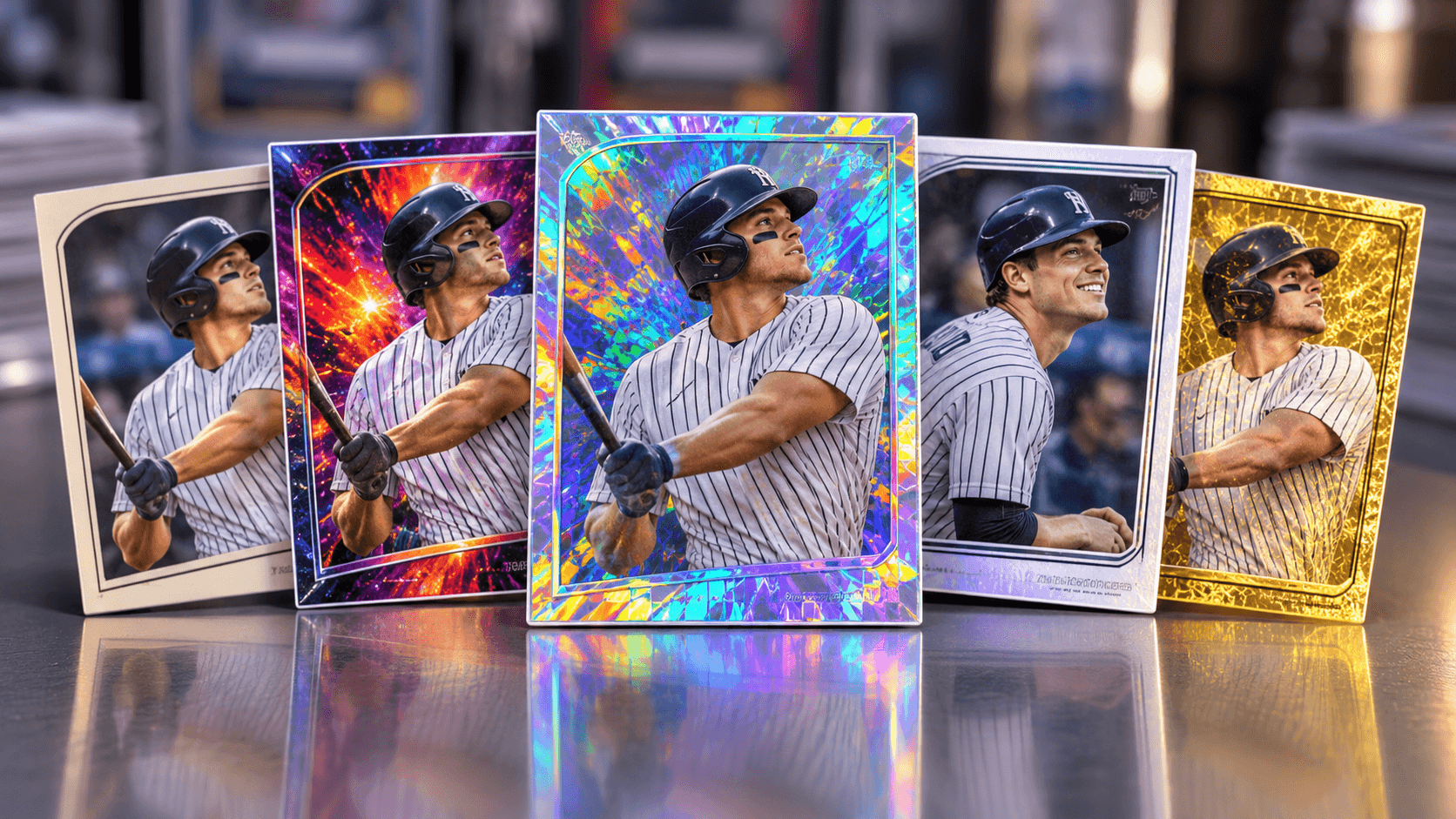
A parallel is an alternate version of an existing card that changes an identifiable attribute while preserving its relationship to the original card.
This might involve a different color, surface treatment, pattern, or serial-numbered edition.
A parallel often shares the same:
- Player or subject
- Photograph or underlying artwork
- Product and release
- Checklist position
- Card number
- Core design
What changes is the specific version.
For example, a manufacturer might create a standard base card along with Blue, Green, Gold, and other alternate versions.
These become different parallels of the same underlying card.
Topps Chrome and Bowman Chrome Refractors
Topps Chrome and Bowman Chrome provide familiar examples.
A standard Chrome card may have a reflective finish because of the card's underlying material.
A Refractor is a recognized alternate finish within eligible Chrome checklists.
Some releases also include colored or patterned Refractors.
A Gold Refractor and a Blue Refractor aren't interchangeable descriptions, even if both feature the same player.
Collectors need to distinguish their exact parallel names, colors, finishes, and serial numbering.
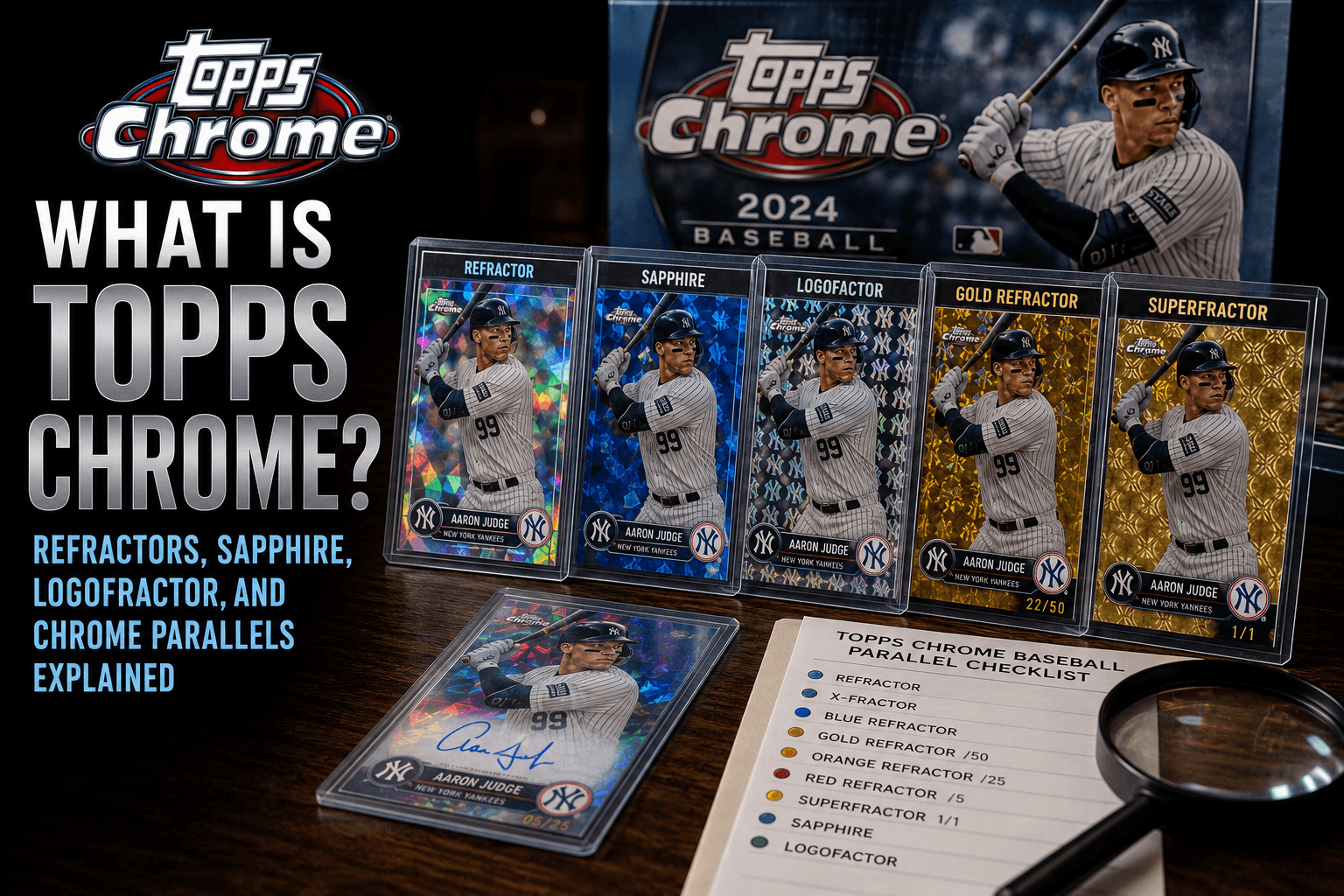
CardWiki explains these relationships in its guide to Topps Chrome, Refractors, Sapphire, Logofractor, and Chrome parallels.
Bowman products may also have separate prospect, rookie, autograph, and insert checklists, each with its own parallel structure.
For example, Bowman Chrome Prospect Autographs can have Refractor and colored Refractor versions, with the exact selection varying by year and release.
Collectors should also understand the differences between Bowman Baseball, Bowman Chrome, and Bowman Draft.
A Chrome prospect card from Bowman Baseball shouldn't automatically be treated as the same card from a standalone Bowman Chrome release.
Panini Prizm Silver vs Base
Panini Prizm provides another useful example.
A standard Prizm card and its Silver Prizm parallel may share the same player, photograph, design, and card number.
The distinguishing characteristic is the Silver Prizm treatment.
The standard Prizm base card may already appear shiny, so collectors shouldn't assume every reflective card is a Silver.
The specific finish must match the documented parallel.
Silver Prizms are often unnumbered, which also demonstrates that a parallel doesn't need a stamped serial number to be a parallel.
Can Insert Cards Have Parallels?
Absolutely.
An insert series may include a standard version and additional colored, numbered, or patterned versions.
In that situation, collectors should identify both the insert and the parallel.
Calling a card simply a "Gold Parallel" may leave out the most important part of its identity.
The correct description might be a Gold version of a particular named insert.
What Is a Trading Card Variation?
A variation is an alternate version of a card distinguished by a specific change recognized within the product.
Unlike many standard color parallels, variations often involve a change to the card's underlying image or content.
Common examples include:
- Alternate player photographs
- Different poses
- Changed uniforms or image details
- Alternate text or captions
- Special nicknames
- Different artwork
- Manufacturer-designated image versions
The most familiar modern example is the image variation.
Topps Heritage Image Variations
Topps Heritage baseball products frequently provide examples of officially designated variations.
Depending on the release, variations may feature alternate images, nicknames, changed design details, or other intentional differences.
Some differences are obvious.
Others require comparing the card against a checklist or inspecting small details.
Collectors need the exact release information rather than relying on a generic "variation" label.
CardWiki explains how to identify photo variations, image variations, and hidden card differences.
Variation vs Parallel: What's the Difference?
The distinction is generally based on the type of change.
A parallel usually modifies the visual treatment of an existing card, such as its color, finish, or pattern.
A variation changes another designated feature of the card, often the photograph or content.
Consider these two situations.
Example A:
A player appears in the same photograph on two cards. One has a standard finish, while the other has a Blue Refractor finish.
That's a typical parallel relationship.
Example B:
A player appears in one photograph on the regular card and a different photograph on another manufacturer-designated version.
That's a typical image variation relationship.
However, manufacturer terminology can overlap. Some products name specific variations as parallels or offer parallels of variation checklists.
When the distinction isn't obvious, use the official checklist designation.
What Is a Short Print Card?
A short print, commonly abbreviated SP, is a card or version that was produced or distributed in lower quantities than a relevant comparison group.
Short prints may appear within base sets, subsets, insert series, or variation programs.
This is where collectors often get confused.
Short print describes scarcity or relative availability, not necessarily a separate card type.
A short-printed card doesn't need a unique photograph.
It doesn't need a different color.
It doesn't even need a printed serial number.
Traditional Base-Set Short Prints
Historically, some manufacturers produced particular base cards in smaller quantities than other cards in the same release.
Collectors might encounter a base set where certain high-numbered cards were more difficult to find.
Those cards could still be part of the regular base checklist.
The distinction was their relative availability.
Modern Short Prints
Modern products may use SP designations for different kinds of limited cards.
Examples can include:
- Short-printed base checklist sections
- Limited image variations
- Special rookie cards
- Scarcer insert versions
- High-numbered base cards
Topps Heritage has used high-numbered short-print sections, while Upper Deck hockey has long featured relatively scarce rookie cards within its flagship checklist structure.
These examples show that a card can be a base-set card and still be short printed.
Understanding how trading card releases work across Series 1, Series 2, Update, Chrome, Draft, and Extended sets can also help collectors understand why availability changes across product releases.
What Does SSP Mean in Trading Cards?
SSP stands for super short print.
The term generally identifies a card or version that is substantially more difficult to obtain than a standard card and often scarcer than a product's regular SP cards.
Collectors may encounter SSP labels on alternate images, specialty inserts, and limited versions.
However, there is no single universal print-run threshold that defines an SSP across every manufacturer.
A card doesn't automatically become an SSP because only 100 copies exist.
Likewise, not every SSP has an officially disclosed production quantity.
Manufacturers may distinguish SP and SSP versions through their product checklists, published odds, or designated classifications.
For collectors, the safest approach is to identify the card's officially documented status.
Does SSP Mean the Card Is Serial Numbered?
No.
Serial numbering and short-print designation describe different things.
A card stamped 14/50 has a visible serial number indicating its place within an edition numbered to 50.
An unnumbered SSP may be extremely scarce without stating its total production quantity.
Pack odds and serial numbers also aren't the same as verified total print runs.
A stated pull rate can help estimate relative difficulty, but it doesn't necessarily establish how many copies exist.
For a deeper explanation, CardWiki's guide to serial-numbered trading cards and numbered parallels shows how numbered editions differ from unnumbered rare cards.
How Do Different Trading Card Brands Use These Categories?
The fundamental ideas apply across the hobby, but terminology and checklist structures vary between manufacturers.
Understanding those differences makes card identification much easier.
| Brand | Useful Example | What Collectors Should Understand |
|---|---|---|
| Topps | Heritage image variations and high-number SPs | Variation identifies the alternate version; SP describes relative scarcity |
| Bowman | Chrome Prospect Autographs and Refractor parallels | Checklist identity and parallel identity must be recorded separately |
| Upper Deck | Young Guns rookie cards | A base-set subset may be short printed and have parallels |
| Panini | Prizm Silver and named insert sets | A Silver parallel is different from a separate insert checklist |
| Fleer/SkyBox | Metal Universe inserts and Precious Metal Gems | The parallel relationship depends on the particular checklist |
| Leaf | Metal Draft autograph parallels | Multiple finishes and numbering levels can exist within an autograph checklist |
Fleer/SkyBox: Precious Metal Gems vs Inserts
Precious Metal Gems, frequently called PMGs, are especially useful for understanding the difference between an insert and a parallel.
In classic Fleer/SkyBox Metal Universe releases, PMGs are closely associated with parallel versions of underlying cards.
Meanwhile, themed card series such as Planet Metal are inserts.
Collectors shouldn't assume every unusual metallic card from Metal Universe is a PMG.
They also shouldn't assume all PMGs across different years or products share identical numbering structures.
The precise release and checklist determine the correct classification.
In some Metal Universe products, separate insert sets also have Precious Metal Gems parallels.
Leaf: Autographs and Parallel Families
Leaf products demonstrate another important point.
A signed card isn't automatically an insert simply because it contains an autograph.
In some autograph-focused products, signed cards form the primary checklist or a defined autograph set.
Different color and finish treatments can represent parallels of those autograph cards.
Leaf Metal Draft checklists, for example, have included multiple Prismatic parallel treatments.
The exact color, pattern, and serial-numbering structure must be checked against the specific release because parallel print runs can vary between subjects and products.
How Can You Identify an Unknown Trading Card?
The most reliable identification method is to start with the product and checklist before making assumptions about rarity or value.
A collector can use the following process to work through an unfamiliar card.
Step 1: Identify the Manufacturer, Year, and Product
Start with the information printed on the card.
Look for the manufacturer, copyright information, product branding, and other release identifiers.
A Topps Chrome card shouldn't automatically be treated as the same release as a Topps Chrome Sapphire card.
Related product families may include separate releases with different checklists and parallels.
Step 2: Find the Card Number
Check the back of the card for its number.
The numbering format may offer useful clues.
A standard numerical card number might indicate a base-checklist position.
A prefix could suggest a particular insert, autograph, or other checklist.
However, card-number formats aren't universally standardized.
Verify the actual checklist.
Step 3: Determine Whether the Card Is Base, Subset, or Insert
Locate the card in the product's checklist.
If it belongs to the primary base checklist, determine whether it sits within a defined subset.
If it belongs to a separately named checklist, it may be an insert or another distinct set type.
Don't use visual design alone to make that determination.
Step 4: Check for a Parallel
Compare the card to the documented standard version.
Look for:
- Different border colors
- Special foil treatments
- Refractor patterns
- Unusual textures or surface effects
- Serial-numbered stamps
- Manufacturer-designated parallel names
Remember that two cards with similar colors may belong to different parallel families.
Step 5: Look for Variations
Compare the card's photograph and other design details against documented examples.
Look closely at the image, uniform, background, printed text, and other features.
A different photograph may indicate an intentional image variation, but not every photograph difference is necessarily an officially recognized variation.
Step 6: Confirm SP or SSP Status
Review the checklist, official product information, and published odds where available.
Avoid assigning an SP or SSP designation simply because a card is difficult to find online.
Low marketplace availability doesn't establish an official short-print classification.
Step 7: Record the Complete Identity
Once the card is identified, record the relevant details together.
That creates a much more useful description than player, year, and card number alone.
Why Can One Trading Card Fit Multiple Categories?
The most important concept in this entire discussion is that these terms describe different dimensions of card identity.
Consider a hypothetical hockey card with the following characteristics:
- It belongs to a rookie subset
- It is short printed compared with regular base cards
- It has an alternate photograph designated as a variation
- That variation also has a Gold parallel
- The Gold version is serial numbered
That single card could legitimately require multiple classifications to describe it correctly.
It wouldn't be enough to call it a "Gold rookie card."
Its complete identity would depend on its checklist position, variation designation, parallel family, and numbering.
This is also why collectors must distinguish configuration from card identity.
A hobby box, blaster box, mega box, or online-exclusive configuration describes how cards are packaged and distributed.
Those configurations may contain exclusive versions, but the packaging format itself doesn't automatically define the card's parallel or variation.
Two cards pulled from different configurations may be identical, or they may represent different documented versions.
CardWiki's guide to trading card releases helps explain why product structure, distribution, and card identity should be recorded separately.
The evidence determines which is true.
Does a Parallel, Insert, Variation, or SSP Have More Value?
There's no universal ranking that makes one category more valuable than another.
An SSP may be harder to obtain than a common parallel, but scarcity alone doesn't determine market value.
A popular insert featuring a highly collected player could attract more demand than a much rarer variation of a less popular subject.
Collectors should consider several factors together:
- Player or subject popularity
- Rookie status
- Actual scarcity
- Product and set reputation
- Insert or parallel popularity
- Autograph or memorabilia features
- Card condition
- Professional grading results
- Recent comparable sales
- Overall collector demand
A rare card with limited demand may sell for less than a more common card with strong collector interest.
Likewise, two cards that appear nearly identical can have dramatically different market activity if one is a documented premium parallel and the other is a standard base version.
Professional grading introduces another layer of information.
A grading label may identify the card's set, player, number, variation, parallel, and condition grade. Collectors can learn more from CardWiki's explanation of how to read PSA, BGS, and SGC graded card labels.
The correct sequence is to identify the exact card first, then research comparable sales for that specific version.
What Are the Most Common Identification Mistakes?
Collectors can avoid many problems simply by recognizing how easily the hobby's categories overlap.
Mistake 1: Calling Every Shiny Card a Parallel
Reflective stock may be standard for a particular product. A special finish must be documented as a distinct parallel before assigning that classification.
Mistake 2: Treating Every Subset as an Insert
A themed group within the base checklist isn't automatically a separate insert set.
Mistake 3: Assuming Every Variation Is an SSP
Some variations are scarce, but variation status and SSP status aren't interchangeable.
Mistake 4: Assuming All Inserts Are Rare
Insert sets vary widely in their availability. Some appear frequently, while others are extremely limited.
Mistake 5: Ignoring the Complete Card Number
A card-number prefix can identify an entirely different checklist from a similarly numbered base card.
Mistake 6: Treating All Gold Parallels as Identical
A Gold Refractor, Gold Wave, Gold Shimmer, and another Gold-themed treatment may represent completely different versions.
Mistake 7: Assuming Serial Numbering Automatically Means SSP
A serial-numbered parallel isn't necessarily classified as an SSP by the manufacturer.
Mistake 8: Comparing Cards Based Only on the Player
Two cards featuring the same athlete can belong to different releases, inserts, parallels, or variation programs.
Why Does This Matter to CardWiki?
CardWiki's approach to trading card identification is built around a simple principle:
Exact identification comes before valuation.
Traditional descriptions sometimes reduce a trading card to its player, year, and card number.
Those details are useful, but they may not be sufficient to distinguish every version produced.
A more complete card identity can include:
| Identity Field | Example of What It Records |
|---|---|
| Manufacturer | Topps, Upper Deck, Panini, Leaf |
| Product and Release | Specific product name and release year |
| Set and Checklist | Base set, insert checklist, or autograph checklist |
| Card Number | Exact printed identifier |
| Player or Subject | Person featured on the card |
| Subset | Defined group within the checklist |
| Parallel Family | Refractor, Prizm, PMG, or another documented family |
| Color and Finish | Silver, Gold, patterned, foil, or other treatment |
| Variation | Alternate image or other designated change |
| Scarcity Classification | SP, SSP, or another supported designation |
| Serial Number | Printed edition number, if present |
| Evidence | Checklist, product information, or physical card details |
The purpose isn't to make card descriptions unnecessarily complicated.
It's to keep genuinely different cards from being merged into the same identity.
For example, two collectors might each own a Bowman Chrome prospect autograph featuring the same player.
One card could be a standard autograph, while the other is a colored Refractor with a specific serial number.
Those cards may share many identifying fields, but their parallel and numbering attributes distinguish them.
The same principle applies when comparing a standard Topps Heritage card against an image variation or a regular Upper Deck Young Guns rookie against one of its parallels.
Structured identification helps collectors organize collections accurately, recognize missing versions, and research appropriate market comparisons.
It also makes card databases more useful for identifying cards that look similar but aren't the same.
Frequently Asked Questions
Is a Subset the Same as an Insert?
No. A subset is traditionally a themed group within the main base checklist, while an insert generally belongs to a separate checklist. Some hobby databases use these terms differently, so the official product structure should take priority.
Can an Insert Card Also Be a Parallel?
Yes. An insert set may have multiple parallel versions. A Silver or Gold version of a particular insert remains part of that insert checklist while also having a distinct parallel identity.
What Is the Difference Between a Variation and a Short Print?
A variation describes an alternate version of a card, frequently involving a different image or other designated change. A short print describes relative scarcity. An image variation can also be short printed, but the two terms don't mean the same thing.
What Does SSP Mean on a Trading Card?
SSP means super short print. It generally identifies a particularly scarce card or version. There is no universal production threshold that applies to every manufacturer, and an SSP may not have a printed serial number.
Are Upper Deck Young Guns Cards Inserts or Subsets?
Standard Young Guns rookie cards in Upper Deck flagship hockey are generally part of the base checklist and commonly treated as a rookie subset. Some are short printed relative to regular base cards. Other Young Guns-branded cards, such as specific Canvas versions, belong to separate insert checklists.
Is a Refractor a Parallel or an Insert?
A Refractor is generally a parallel treatment within applicable Topps Chrome or Bowman Chrome checklists. Refractor parallels can exist for base cards, autographs, and certain inserts. The underlying checklist determines whether the card is also an insert.
Does a Serial-Numbered Card Automatically Count as a Short Print?
No. Serial numbering identifies a numbered edition or version. SP and SSP are separate classifications involving relative scarcity or specific product designations. A card can be serial numbered without being officially labeled an SP or SSP.
How Can I Tell Whether My Card Is a Rare Variation?
Start with the exact product checklist. Compare the card's photograph, design details, text, and numbering against documented versions. Check official variation designations and odds where available. Don't rely solely on the seller's description or the card's appearance.
Final Thoughts: Learn the Structure Before Judging the Card
Subsets, inserts, parallels, variations, and short prints aren't simply five different names for rare trading cards.
They describe different aspects of how cards are organized, designed, produced, and distributed.
A subset explains where a card belongs within a larger checklist. An insert identifies a separate card series. A parallel describes an alternate treatment. A variation identifies a designated change, and SP or SSP describes relative scarcity.
Once collectors understand those relationships, identifying cards becomes much more straightforward.
Whether you're sorting vintage Fleer and SkyBox cards, comparing Topps Chrome Refractors, researching Bowman prospects, or identifying Upper Deck Young Guns, the same principle applies.
Learn the structure. Identify the exact version. Then evaluate the card.