
Limited Releases, Online Exclusives, Sapphire, First Edition, e-Pack, and Other Special Drops Explained
Learn how limited trading card releases, Topps Sapphire, First Edition cards, online exclusives, and Upper Deck e-Pack differ and what collectors should check.
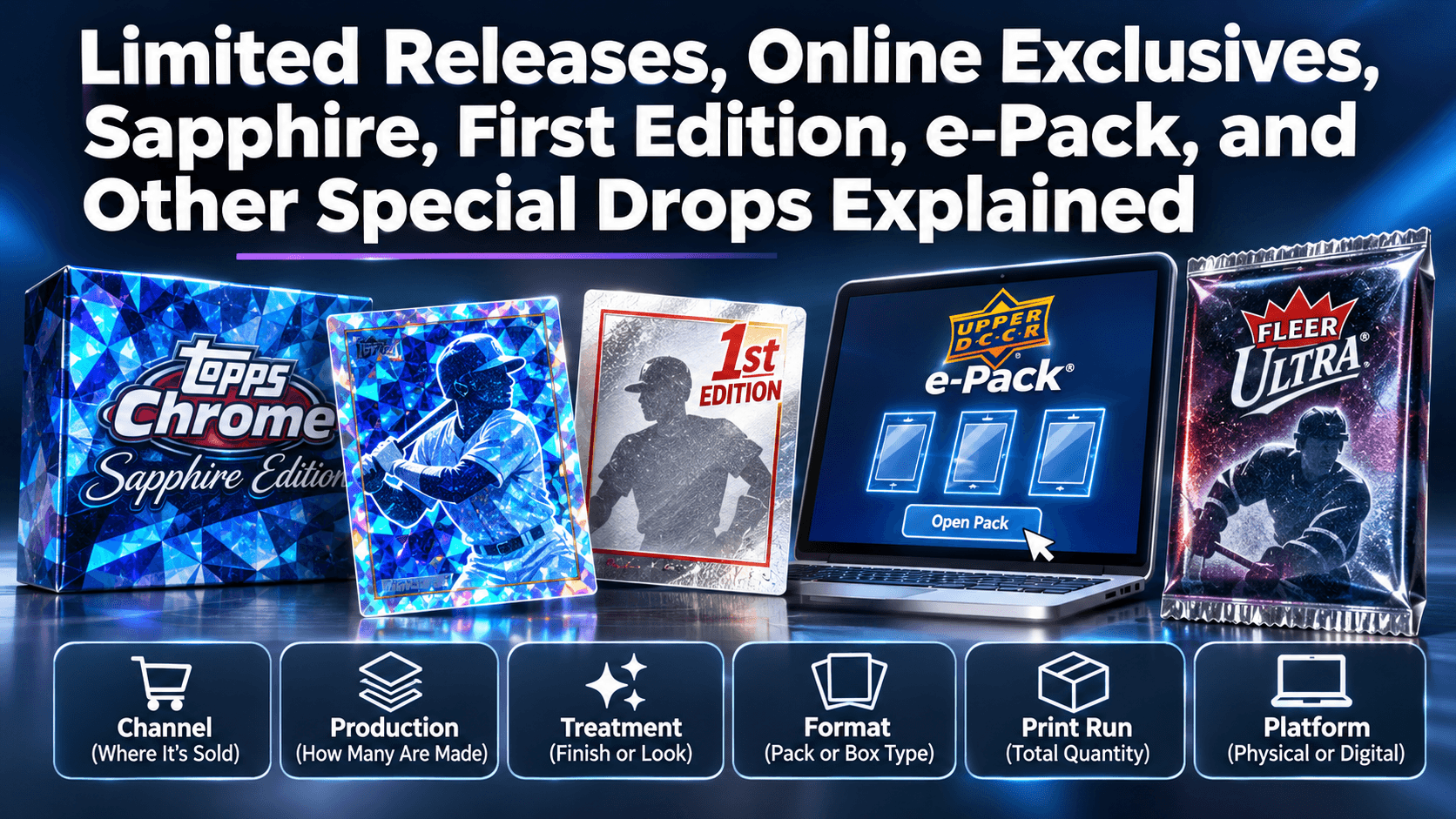
Not every trading card product follows the traditional path from manufacturer to hobby shop or retail store.
Some products launch exclusively through manufacturer websites. Others feature special finishes, early-edition markings, limited production windows, or digital pack-opening platforms. Collectors regularly encounter names like Topps Sapphire, First Edition, Upper Deck e-Pack, and online-exclusive releases, but these terms don't all describe the same thing.
Limited trading card releases are products or cards with some form of restricted production, availability, distribution, or special-edition identity. That restriction might involve where a product is sold, how many copies are produced, when it becomes available, or what makes its cards different from a standard release.
Understanding these differences helps collectors identify cards accurately, interpret product descriptions, and avoid confusing distribution methods with actual card rarity.
A card from an online-exclusive product isn't automatically serial numbered. A First Edition card isn't necessarily the first card ever produced of a particular player. And a pack opened digitally through Upper Deck e-Pack doesn't necessarily contain only digital collectibles.
Each term describes a different part of the collecting experience.
What Are Limited Trading Card Releases?
A limited trading card release is a product, edition, or group of cards distinguished by restrictions or special characteristics that separate it from a broader product offering.
The word limited can describe several different things.
- Distribution channel: A product sold through a particular website, retailer, event, or platform
- Production quantity: A release manufactured in a restricted number of boxes, packs, or cards
- Availability window: A product offered for a specific period
- Special treatment: Cards featuring a distinct finish, pattern, foil technology, or other recognizable design element
- Edition: A separately identified version of a product, such as First Edition
- Platform: A product distributed through a digital service rather than conventional sealed packs
- Configuration: A particular box or pack format with different contents or exclusives
These categories can overlap.
For example, a special edition might have its own card treatment, a restricted sales channel, and a smaller production run than the standard product.
However, those characteristics should be identified separately.
Limited availability, limited production, and limited card numbering are not interchangeable concepts.
A manufacturer might describe a release as limited without publishing an exact production total. Likewise, a product can be difficult to purchase initially without every card inside being especially scarce.
For collectors, the important question isn't simply whether something is limited. It's what makes that particular release different.
Understanding how trading card releases work helps explain why manufacturers create separate editions, extensions, and special product offerings within larger product families.
What Makes an Online-Exclusive Trading Card Product Different?
An online-exclusive trading card product is distributed through a designated online sales channel rather than following the usual combination of hobby-shop and retail distribution.
Manufacturers may offer these products through their own websites, specialized launch platforms, or other authorized online storefronts.
Online exclusivity primarily describes how the product reaches collectors.
It doesn't necessarily describe the identity, rarity, or physical characteristics of every card inside.
An online-exclusive product might feature:
- A checklist shared with another release
- A separate checklist created for the exclusive product
- Exclusive parallels or inserts
- A special card finish or treatment
- A different box configuration
- A restricted purchasing window
- Purchase limits or a special allocation system
Some online exclusives represent entirely separate product editions. Others are special configurations that distribute cards from an existing product.
That difference is important.
Imagine a standard product and an online-exclusive box that both contain the same base cards. If the only difference is the packaging and where the boxes were sold, those base cards don't necessarily become separate card identities.
However, if the online edition features different card treatments, edition markings, or an independently documented checklist, those differences may identify distinct cards.
The product information and official checklist should determine how the cards are classified.
This is similar to the relationship between hobby boxes, retail boxes, blasters, and mega boxes. Different configurations can offer different content without automatically changing the identity of every card inside.
What Is Topps Sapphire?
Topps Sapphire is a premium trading card edition associated with the Topps Chrome product family, known for its distinctive crystalline-style finish.
Instead of treating Sapphire simply as another colored parallel of a standard Chrome card, collectors should recognize that Sapphire Edition can represent its own separately released product.
Topps has produced Sapphire editions across different sports and product families.
For example, the official Topps Chrome Update Sapphire Edition product page describes an online-first offering with a distinct Sapphire treatment.
The cards may retain familiar photographs, player names, card numbers, or design elements from the associated Chrome release.
But the Sapphire version has a different product identity and recognizable surface treatment.
Topps Chrome vs. Topps Chrome Sapphire
Consider two cards featuring the same player.
They may share:
- Manufacturer
- Product year
- Player
- Photograph
- Card number
- General design
But they can differ in:
- Release or edition
- Card finish
- Surface pattern
- Checklist
- Available parallels
- Distribution details
- Production characteristics
A collector shouldn't automatically merge them into one card record just because the player, image, and number match.
The Sapphire card may be a base card within the Sapphire release, even though it is different from the standard Chrome base card.
Likewise, a numbered Gold Sapphire parallel belongs within the Sapphire edition's own parallel structure.
This shows why the relationship between product edition and parallel is so important.
Sapphire identifies the broader release or treatment family. A particular color or numbered version may identify an additional parallel within that release.
Collectors researching the reflective appearance of these cards can also review Refractor, Prizm, Chrome, and Holo card differences to understand how finishes and card types are identified.
Exact names and classifications should always follow the relevant product checklist.
What Does First Edition Mean on a Trading Card?
First Edition generally identifies a specially designated edition of a trading card product, often released ahead of or separately from a standard edition.
In modern products, the meaning depends on the manufacturer and specific release.
Topps, for example, has offered 1st Edition products featuring distinctive branding and, depending on the release, exclusive cards or variations.
A First Edition card might feature:
- A printed First Edition logo or stamp
- A separate product designation
- Exclusive parallels
- Special variations
- A different release schedule
- A distinct checklist or documented edition structure
Not every trading card product has a First Edition version.
The presence of a First Edition designation also doesn't mean that every card in the product is individually numbered.
First Edition vs. First-Year Cards
These terms are easy to confuse.
A First Edition card identifies a particular product edition.
A first-year card generally refers to a card associated with an early year of a player's professional career or participation in a particular product line.
A rookie card is another separate identification concept.
A card can be a First Edition card without being a rookie card. It can also be a rookie card without belonging to a First Edition release.
Collectors should avoid interpreting First Edition as proof that a card was the first trading card ever manufactured featuring that player.
Instead, look for the official edition designation and supporting checklist information.
How Does Upper Deck e-Pack Work?
Upper Deck e-Pack is a digital pack-opening and collecting platform that allows collectors to purchase, open, manage, and trade eligible trading card products online.
Although the pack-opening experience takes place digitally, the contents can involve both digital-only items and cards with physical counterparts.
This creates an important difference between digital distribution and digital-only card ownership.
On e-Pack, collectors may encounter:
- Digital representations of cards in their online collections
- Cards eligible for physical transfer or shipment
- Digital-only base cards or other items
- Platform-specific achievements
- Combining or redemption features, where supported
- Trading and collection-management features
The exact options depend on the product and card type.
Collectors shouldn't assume that every card displayed in an e-Pack account can be shipped as an individual physical card.
Similarly, they shouldn't assume that opening a pack online means no physical cards are involved.
Upper Deck identifies cards with physical counterparts through its platform features, helping collectors distinguish transferable cards from digital-only items.
Before purchasing packs, collectors should review the specific product's rules and available card-transfer options.
What Is Fleer Ultra e-Pack?
Fleer Ultra provides a useful example of a traditional trading card brand distributed through a digital pack-opening platform.
Upper Deck has offered Fleer Ultra Hockey products through e-Pack, combining digital base-card collecting with eligible physical parallels, inserts, and other collectible cards.
For example, 2022-23 NHL Fleer Ultra Hockey was offered as an e-Pack-exclusive release featuring a digital base set and multiple collectible parallel and insert families.
This illustrates how an established card brand can be distributed differently without abandoning the familiar structure of trading card collecting.
Fleer Ultra still has recognizable card-collecting concepts:
- Base sets
- Rookies
- Inserts
- Parallels
- Autographs
- Serial-numbered cards
- Product checklists
What changes is the distribution and collection experience.
The platform provides an online method for opening packs and managing eligible cards.
However, e-Pack is not itself a card parallel, finish, or grading designation.
A Fleer Ultra card obtained through e-Pack should be identified according to its actual product, checklist, card type, and other relevant attributes.
Its platform origin may be useful supporting information, but the platform alone doesn't describe every characteristic of the card.
Collectors interested in the history and identity of the brand can read Fleer, Fleer Ultra, SkyBox, and Metal Universe Cards Explained.
Are Limited Print Run Cards the Same as Serial-Numbered Cards?
No. Limited print run cards and serial-numbered cards are related concepts, but they are not identical.
A limited print run refers to the quantity of cards produced.
Serial numbering refers to an individual card carrying a printed number identifying its position within a specified numbered edition.
For example, a card marked 17/50 indicates that it belongs to a version numbered to 50 copies.
However, a manufacturer may produce a limited number of cards without printing individual serial numbers on them.
Consider three different situations:
| Card Description | What Collectors Actually Know |
|---|---|
| Limited Edition | The product or card is described as restricted, but the exact quantity may be unknown |
| Print Run of 500 | The manufacturer identifies a production total of 500 copies |
| Serial Numbered /50 | The card belongs to a numbered version with a stated edition size of 50 |
These distinctions matter when comparing scarcity.
A card doesn't become serial numbered simply because its product was produced in limited quantities.
Likewise, a numbered parallel doesn't automatically reveal the total production of the entire product.
A product containing several numbered parallel families may also contain a much larger quantity of unnumbered base cards.
Collectors should distinguish the production quantity of an individual card version from the production quantity of the complete release.
For a closer explanation of stamped numbering, edition sizes, and 1/1 cards, see what serial numbered means in trading cards.
What Are Other Types of Special Trading Card Drops?
Not all special releases use names like Sapphire or First Edition.
Manufacturers use different release strategies across sports, entertainment, and collectible card categories.
Some common examples include the following.
Print-on-Demand Releases
Print-on-demand programs produce cards in response to orders placed during a defined sales period.
Depending on the program, the final production quantity may be determined by how many copies collectors purchase.
For these products, the availability window and the final print run are separate pieces of information.
A short ordering period doesn't automatically prove a small final print run.
Event-Exclusive Cards
Some cards are distributed through conventions, promotional events, tournaments, or other designated locations.
Their exclusivity may come from where or how they were distributed.
An event-exclusive card could have a unique design or stamp, but that isn't guaranteed.
Collectors need to determine whether the event provided a separate card version or simply served as a special distribution channel.
Retailer-Exclusive Cards
Certain retailers may receive exclusive parallels, inserts, or configurations.
For example, a retailer-exclusive box might contain the same core base set as another configuration while offering additional exclusive card versions.
The retailer name identifies the distribution relationship, but the card's actual parallel or insert designation identifies which version it is.
Online-Only Special Editions
Some manufacturers release distinct editions through online platforms.
These editions may include special finishes, altered checklists, exclusive inserts, or packaging differences.
The word exclusive should be interpreted alongside the actual product description.
It might describe the entire release, a specific configuration, or only selected cards inside.
How Do Release, Edition, Parallel, and Configuration Differ?
These terms describe different layers of trading card identity.
| Term | What It Describes |
|---|---|
| Release | The specific product offering or release within a product family |
| Edition | A designated version of a product, such as Sapphire or First Edition |
| Parallel | An alternate recognized version of a card |
| Insert | A card belonging to a separately defined subset or theme |
| Configuration | How packs and cards are packaged or distributed |
| Distribution Channel | Where or through what platform the product reaches collectors |
| Print Run | The number of copies produced |
| Serial Number | The individual numbering printed on a card within a numbered edition |
A card can have several of these attributes at once.
For example, a card might belong to a Sapphire Edition release, be a Gold parallel, carry a printed serial number, and have originated from an online-purchased hobby box.
Those attributes aren't competing descriptions.
They explain different parts of the card's identity and distribution history.
This also prevents a common classification problem: treating every variation in where a card was purchased as a different card.
The box configuration may be relevant to collecting history or distribution. It doesn't necessarily create a new card identity.
In contrast, an officially designated parallel with a different finish or printed numbering is a recognizable card version.
For more detail about these categories, CardWiki's guide to base cards, parallels, autographs, and patch cards explains the differences between major card types.
How Can Collectors Identify an Online Exclusive or Special Edition Card?
Special releases sometimes look similar to standard products, especially when manufacturers reuse familiar designs or photographs.
Accurate identification requires more than recognizing the player.
Start with the physical card and work outward to the product documentation.
- Identify the manufacturer and product family: Determine whether the card belongs to Topps Chrome, Fleer Ultra, or another recognizable product
- Confirm the product year and release: Similar-looking cards can come from different years or separate editions within the same product family
- Check the card number and player: Use both to locate the card on an official checklist
- Examine the finish and markings: Look for Sapphire-style patterns, First Edition stamps, distinctive foil treatments, or other release-specific features
- Identify the parallel or insert: Determine whether the card is a base card, numbered parallel, image variation, autograph, or another recognized type
- Check serial numbering: Record any printed numbering exactly as it appears
- Verify the official checklist: Compare the card against the manufacturer documentation for the particular release
- Record distribution information when relevant: Note whether the product was online-exclusive, event-distributed, or offered through e-Pack
Packaging and original purchase records can help, particularly when two cards look nearly identical.
However, packaging should support the identification rather than replace examination of the card itself.
For e-Pack products, confirm whether the specific item is digital-only, physically transferable, or eligible for another platform feature.
Collectors should also check for subtle differences in player photographs, backgrounds, and markings. CardWiki's guide to photo variations, image variations, and hidden card differences explains how similar-looking cards can be identified using checklist and physical evidence.
Do Limited Trading Card Releases Have More Value?
Limited releases can attract collector interest, but limited availability alone doesn't establish a card's market value.
A product may have restricted distribution without developing strong collector demand.
Likewise, an unnumbered card from a popular standard release might attract more interest than a numbered card from a less desirable product.
Several factors can influence value:
- Player popularity and collector demand
- Rookie status
- Actual scarcity
- Serial numbering
- Product reputation
- Parallel or edition popularity
- Autographs and memorabilia
- Card condition
- Professional grading
- Historical importance
- Market activity and available comparable sales
Collectors should also avoid assuming that a special release is automatically scarcer than every standard product.
A manufacturer may disclose the production quantity of a particular numbered parallel while keeping overall product production figures private.
Without reliable production information, claims about total scarcity can be difficult to verify.
Rare does not automatically mean valuable. Scarcity becomes more meaningful when collector demand exists.
Before comparing prices, identify the exact card version.
A standard Chrome base card, a Sapphire base card, and a numbered Sapphire parallel may feature the same player and similar imagery while representing different collectibles.
Sales data should be matched to the correct version whenever possible.
Common Beginner Mistakes With Limited Trading Card Releases
Special editions introduce additional terminology, which can make identification confusing.
The most common mistakes involve treating different concepts as interchangeable.
- Assuming online exclusive means serial numbered: A product can be sold online exclusively while containing unnumbered base cards
- Treating Sapphire as an ordinary color parallel: Sapphire Edition can be its own release with a distinct base set and parallel structure
- Assuming First Edition means rookie card: First Edition identifies a product edition, not a player's rookie status
- Believing every e-Pack card is physically shippable: Some e-Pack items are digital-only, while others have eligible physical counterparts
- Confusing limited availability with a verified print run: A short sales window or sold-out product doesn't reveal the exact number produced
- Assuming exclusive packaging means an exclusive card: Some special configurations distribute otherwise identical cards
- Comparing prices across different editions: Cards with similar images or card numbers may belong to different releases and have different market histories
- Ignoring official product documentation: Checklists and manufacturer information often resolve confusion that photographs alone cannot
These errors are understandable because manufacturers use exclusivity in several different ways.
The solution is to identify which product characteristics are actually different.
Why This Matters to CardWiki
CardWiki's approach to trading card identification emphasizes structured information rather than relying on player, year, and card number alone.
Special releases show why that additional structure is necessary.
Imagine three cards featuring the same player and photograph.
The first is a standard Topps Chrome base card.
The second is a Topps Chrome Sapphire Edition base card.
The third is a numbered Sapphire parallel.
A simple database might mistakenly treat all three as the same card if it only compares the player, year, and card number.
A more complete identification system separates the attributes that define each version.
A CardWiki record may need to account for:
- Manufacturer
- Brand and product family
- Product year
- Release and edition
- Checklist
- Card number
- Player
- Base, insert, or parallel designation
- Color, pattern, finish, and treatment
- Serial number
- Print run, when documented
- Configuration or distribution channel
- Digital or physical status, when relevant
- Supporting identification evidence
Not every card requires every field.
The goal is to record the information necessary to distinguish one collectible from another without adding unsupported classifications.
For an e-Pack release, platform information may explain how the card was obtained or managed.
For Sapphire, the release and finish help separate it from standard Chrome.
For First Edition, the official edition marking provides another identifying attribute.
This structured approach makes it easier to compare the correct versions, organize collections, and research cards accurately.
Collectors can explore how these records are organized through the CardWiki public trading card catalog.
Exact identification comes before valuation.
Frequently Asked Questions
Are Online-Exclusive Trading Cards Always Rare?
No. Online exclusivity describes a distribution method. Although some online-exclusive releases have limited production, the sales channel alone doesn't establish how many cards were made.
Check manufacturer disclosures, serial numbering, and product-specific details before making scarcity claims.
Is Topps Sapphire the Same as Topps Chrome?
No. Sapphire is related to the Topps Chrome product family, but Sapphire Edition can be a separately released product with its own treatment and checklist.
Similar player photographs and card numbers don't automatically make the cards identical.
Are First Edition Cards Always Worth More?
No. First Edition status may influence collector interest, but value depends on demand, player popularity, scarcity, condition, and other factors.
A First Edition designation doesn't guarantee a price premium.
Are Upper Deck e-Pack Cards Real Physical Cards?
Some e-Pack items have physical counterparts that collectors can transfer or request for shipment.
Others exist only as digital items on the platform.
The specific card and product rules determine what is available.
Is Fleer Ultra e-Pack Different From Regular Fleer Ultra?
The answer depends on the release being compared.
Fleer Ultra is a trading card brand, while e-Pack is a distribution and collecting platform.
Certain Fleer Ultra releases have been distributed exclusively through e-Pack, with product-specific rules governing digital cards and physical counterparts.
Does a Sold-Out Trading Card Product Have a Limited Print Run?
Not necessarily in a documented numerical sense.
Sold out means the available inventory has been purchased or is no longer offered through that sales channel.
It doesn't reveal the total number of cards or boxes manufactured.
Can a Limited Release Contain Common Base Cards?
Yes. A limited or exclusive product may contain unnumbered base cards alongside scarcer inserts and parallels.
The product's overall availability and the rarity of an individual card version should be considered separately.
How Can I Tell Whether My Card Is an Exclusive Edition or a Parallel?
Start with the official checklist and product description.
An edition may represent a separately released product, while a parallel is a recognized alternate version within a card or set structure.
Compare markings, finishes, card numbers, and the manufacturer's terminology.
Final Thoughts: Understand What Makes the Release Different
Limited trading card releases aren't all defined by the same kind of exclusivity.
Some products are restricted by distribution channel. Others feature distinctive card treatments, special edition markings, controlled production quantities, or digital pack-opening platforms.
Topps Sapphire shows how a recognizable finish can become part of a separate product identity. First Edition highlights an edition designation. Upper Deck e-Pack demonstrates how digital distribution can coexist with physical card collecting.
Understanding these categories helps collectors research products, distinguish similar cards, and interpret scarcity claims with greater accuracy.
The most useful question isn't simply whether a card is limited.
It's what makes that specific card different, and how can that difference be verified?
That is the foundation of accurate trading card identification and the structured collecting knowledge CardWiki is designed to support.


